“And the Lord spake unto Moses, saying, Speak unto the children of Israel, that they bring Me an offering: . . . and let them make Me a sanctuary: THAT I MAY DWELL AMONG THEM.”Ex. 25: 1, 2, 8.
A individual who will devote the time necessary for a careful study of the book of Hebrews, must perceive clearly that the great apostle to the Gentiles lays particular stress upon the subject of the sanctuary which is in heaven, and, for a way of final escape from richly merited punishment, from the consequences of multiplied transgression, points the weary, sin-sick soul to a High Priest “who is set on the right hand of the throne of the Majesty in the heavens; a Minister of the sanctuary, and of the true tabernacle, which the Lord pitched, and not man;” One able to save even “unto the uttermost.” That High Priest is Christ—the same who was with the Father “in the beginning,” who accompanied the hosts of Israel in their march thru the wilderness (1 Cor. 10: 1-4), who was born in a manger on the eventful night when the shepherds watched the flocks and heard the music of the angelic company; who grew to manhood; who walked with the children of men; who healed the sick and afflicted, cleansed the leper, stilled the tempest-tossed Galilee and the still greater tempest that raged in human hearts, taught the world its greatest principles of righteousness and government; who gave up His life upon the tree, that sinners might be eternally redeemed; who triumphantly arose from the grave and ascended to heaven to become “the Mediator of the new covenant”—such an one the apostle Paul declares to be the great High Priest for fallen humanity!
The Sanctuary and the Gospel.
To rightly understand the Gospel—“the power of God unto salvation”—it is necessary to rightly understand the teachings of the Bible concerning the sanctuary. For the two—the institution of the sanctuary and the working-force of the Gospel—are inseparably connected by the very nature of the circumstance that their work is identical.
The Gospel, in fact, gave birth to the sanctuary, and it, in turn, is a part of the Gospel; a piece of literal machinery, if you choose so to call it, with which the working-force of the power of God secures for the individual the “remission of sins.”
Peter writes that it is the “divine power” that has given to us “all things that pertain unto life and godliness;” and we are commended to the love and keeping of “Him that is able to do exceeding abundantly above all that we ask or think, according to the power that worketh in us.” Eph. 3: 20.
The sanctuary, we shall find, is a veritable power-house of that Gospel which is said to be “the power of God.”
The Two Sanctuaries.
There are two distinct sanctuaries brought to view in the Scriptures; the one of which—and its work—can only be clearly understood in the light of the other; the office and glory of the greater interpreted by a correct knowledge of the lesser.
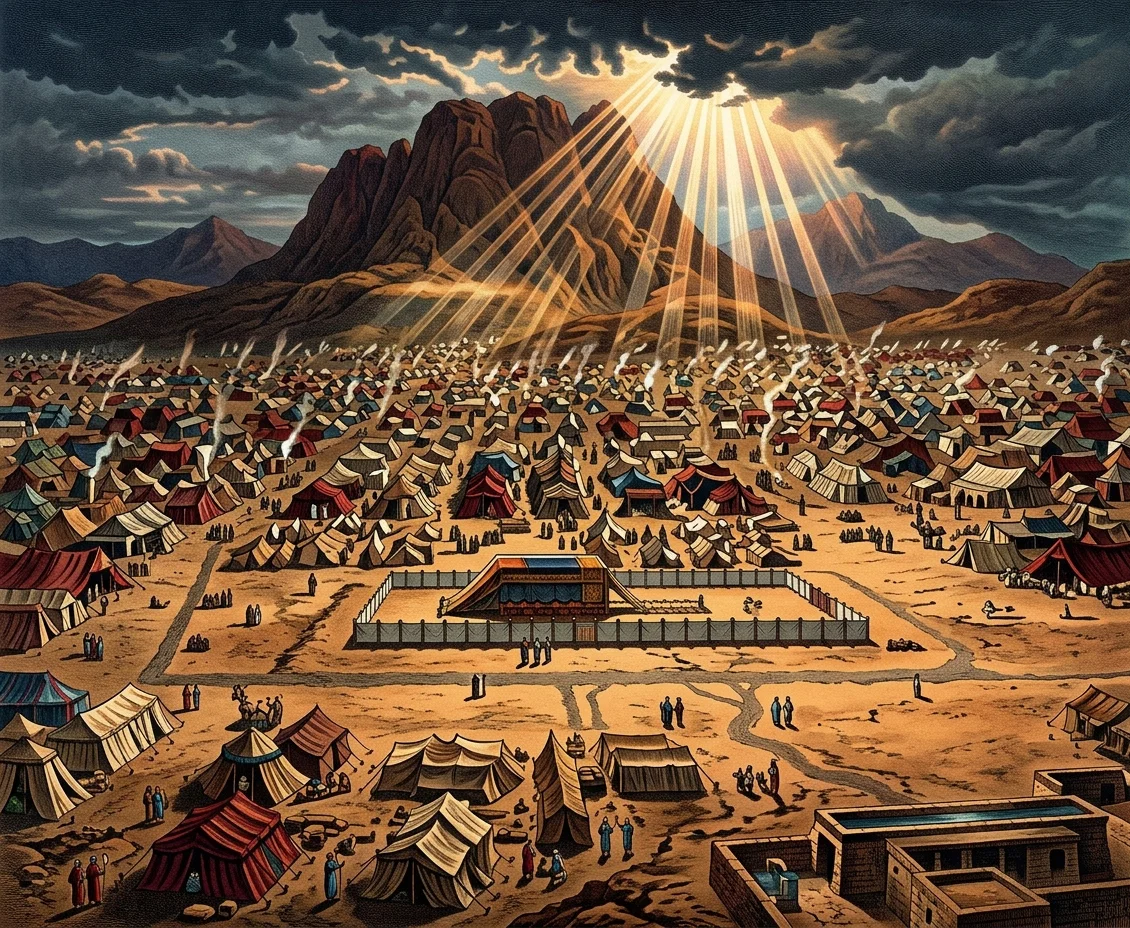
The New Testament describes a worldly sanctuary and even specifies the articles of furniture that it contained. Heb. 9: 1-5. Some fifteen hundred years before the Lord had successfully brought the multitudes of His people out from under the rule of Pharaoh and his cruel taskmasters, across the Red Sea, and into the mountain fastnesses of the wilderness, and in the devouring fires on the glowing height of Mount Sinai commanded His servant Moses: “And let them make Me a sanctuary; that I may dwell among them.” Forthwith the sanctuary was constructed. In the heart of the wilderness and far from the hateful presence of their enemies, the people of God wrought and fashioned a place, “a dwelling-place,” that their Divine Deliverer might ever be with them. Its dimensions, material, furnishings, and all were exactly according to the explicit directions that had been given to Moses in the mount. Exodus 25 to 31. The temple of God was with men. It is interesting to note what occurred when the faithful leader of the hosts of Israel had hung the last curtain upon the court gate of the movable dwelling-place of his God:
“Then a cloud covered the tent of the congregation, and the glory of the Lord filled the tabernacle. And Moses was not able to enter into the tent of the congregation, because the cloud abode thereon, and the glory of the Lord filled the tabernacle.”Ex. 40: 34, 35.
A description of this tabernacle was given last week by other writers, and is found in chapters 25 to 40 of the book of Exodus.
This ancient sanctuary answered every purpose for which it was constructed. Yet it was always typical of, and foreshadowed, a better temple, a more perfect service, “the true tabernacle, which the Lord pitched, and not man.” The earthly sanctuary, and its priests served unto the shadow of “heavenly things.” Heb. 8: 5. And all the rites and ceremonies of ancient Israel were but so many object lessons, pointing to the Lamb of God that taketh away the sins of the world. The significance and efficacy of all these lay in Christ, and every one and all, like an index finger, pointed to the coming Messiah, and were typical, or indicative, of His power to forgive sin, transform the character, and deliver the people from the heavy burdens.
The worldly sanctuary was first pitched in the wilderness, and afterward succeeded by the magnificent temple of Solomon in Jerusalem, and until the time of Christ, and His sacrifice and offering—the price paid at Calvary—the true worship of God for Israel and all nations centered in “the worldly sanctuary.” But with the death of Christ the veil of the temple is rent in twain and that which had been only typical and shadowy—the earthly sanctuary—now passes away, entirely and forever.
The Heavenly Sanctuary.
We now come to a heavenly sanctuary. Christ becomes the great “High Priest” in4“a greater and more perfect tabernacle, not made with hands.” Heb. 9: 11. The earthly sanctuary, then, was a figure of “the true;” that is, of the tabernacle in heaven, for the Lord had said to Moses, “See that thou make all things according to the pattern shown thee in the mount.”
The figure serves to show us what the heavenly sanctuary and its service is like; it is a faithful expositor. Thus we read: “For Christ is not entered into the holy place made with hands, which are the figures of the true; but into heaven itself, now to appear in the presence of God for us.” And unlike the sons of Levi, He is the High Priest forever, after the order of Melchizedek. While the first tabernacle was standing, it signified “that the way into the holiest of all [Greek, “holy places,” plural] was not yet made manifest;” but when our Lord ascended on high, He entered the temple of God and became a great High Priest, “having obtained eternal redemption for us.” Heb. 9: 8-12.
John, the beloved apostle, was enabled by the Spirit of God to look into this heavenly sanctuary of the High Priest Christ, and he saw the throne, and before the throne the seven lamps were burning (Rev. 4:5); there was the Son of God, the officiating High Priest (Revelation 5); an altar of incense and a golden censer (Rev. 8:3); and the ark of God’s testament (Rev. 11:19; 15:8). All these objects must be recognized as essential furniture of the sanctuary, and thus we find an exact parallel. “And the temple of God was opened in heaven, and there was seen in His temple the ark of His testament.” Wonderful indeed! The ark—that which contained the tables of stone upon which were written the Ten Commandments—marks with certainty the second apartment of the heavenly sanctuary, as the seven lamps and golden altar of incense mark the first!
The following scriptures will make it clear that the Lord is on His throne; that His throne is in the sanctuary; that the sanctuary is in heaven; and that underneath the mercy-seat of the heavenly sanctuary there is the law of Ten Commandments.Ps. 102:19; 99:1; Jer. 17:12; Ps. 97: 2. From these, and the statement, “Righteousness and judgment are the habitation [establishment, margin] of His throne” what may we conclude? As all “the commandments” are declared by the psalmist to be “righteousness” it is only reasonable to conclude that the law of God—Ten Commandments—is the foundation of His throne! And it is equally obvious that the earthly tabernacle was the earthly throne, “a figure of the true” because—
The ark contained the law of God.
The “most holy” place was the dwelling-place of God.
The sanctuary was the central place of worship.
All this passed away at the cross—the service and its typical work—and was superceded by the heavenly!
The sanctuaries of the Bible, then, consist; first, of the typical tabernacle established with the children of Israel at the Exode from Egypt, which was the sanctuary of the first covenant; and, secondly, of the true tabernacle in heaven, of which the former was a type, or figure, which is the sanctuary of the new covenant. Heb. 9: 24.
Reader, think of a great High Priest now in the heavenly sanctuary, a faithful Advocate, pleading for you and for me! And the apostle declares that “unto them that look for Him shall He appear the second time, without sin unto salvation.” Yes, Christ is coming again! The worldly sanctuary and its service pointed forward to His first advent and the glory of the cross; the heavenly sanctuary and its service presages His second advent and the glory of the crown!He is coming with salvation for those who look for Him! Out of the sanctuary—back to earth—Jesus of Nazareth is coming again! Having “such a High Priest” “let us draw near with a true heart” and in the “full assurance of faith;” for if we are faithful and just to confess our sins, He will be faithful and just to forgive us our sins, and our iniquities will be remembered “no more.”