THE twenty-three hundred days is a prophetic period connected with the prophecy of Daniel 8. Verse 14 reads as follows: “And he said unto me, Unto two thousand and three hundred days; then shall the sanctuary be cleansed.” This is an answer to the question recorded in the previous verse, namely, “How long shall be the vision concerning the daily sacrifice, and the transgression of desolation, to give both the sanctuary and the host to be trodden under foot?” That is, How long will earthly powers oppose God’s work and worship, and oppress His people?
This prophetic period, the longest found in the Bible, reaches to the cleansing of the sanctuary, the closing service of our great High Priest in behalf of God’s people.
When Does It Begin?
To be a revelation to us, we must be able to ascertain when this period begins and ends. Let us study the context to see what instruction is given concerning it. We find it connected with symbolic prophecy. A ram, a goat, and a little horn are shown to Daniel in vision, as symbols of earthly powers. Dan. 8:1-12. The angel Gabriel, by divine command, explained to Daniel that they represented Media and Persia, Greece, and the kingdom which succeeded Greece, which all students of history know to be Rome. Verses 16-25. This explanation was clear and easily understood.
Not Understood.
Then Gabriel said: “And the vision of the evening and the morning which was told is true; wherefore shut thou up the vision; for it shall be for many days.” Verse 26. What vision was this? By comparing the marginal reading of verse 14 with this, we find that it refers to the vision of the twenty-three hundred days, or twenty-three hundred evenings and mornings, and in the American Standard Revised Version, both verses 14 and 26 have “evenings and mornings,” a Hebraism for day. See Gen. 1:5, 8. Hence, when Gabriel declares that the vision of the evenings and mornings is true, he has direct reference to the vision of the twenty-three hundred days (“evenings and mornings”) of verse 14. He had explained the symbols of the ram, the goat, and the little horn, and Daniel “fainted and was sick certain days.” The time had not yet been explained, hence Daniel said, “I was astonished at the vision, but none understood it.” Verse 27. Here he referred to the vision of the evenings and the mornings of the previous verse.
Was the Vision Explained?
Did Gabriel obey the command to make Daniel “understand the vision”? Verse 16. The chapter closes with the statement that “none understood it.” Verse 27. We can not believe that Gabriel failed to explain it. We would naturally expect to find an explanation in the next chapter. In the first nineteen verses we read of Daniel’s studying the prophecy of Jeremiah concerning the seventy years’ captivity, and his earnest prayer, with humble confession, that Jerusalem might be restored and the sanctuary service might be revived. See verses 2-5 and 16-19. God’s people were then in captivity at Babylon, Jerusalem was desolate, and the sanctuary had been destroyed. In answer to his fervent prayer, Gabriel came with words of comfort and encouragement, saying, “I am now come forth to give thee skill and understanding. At the beginning of thy supplications the commandment came forth, and I am come to show thee; for thou art greatly beloved; therefore understand the matter, and consider the vision.” Verses 22, 23.
The Time Explained.
Gabriel begins his explanation with these words: “Seventy weeks are determined upon thy people and upon thy holy city, to finish the transgression, and to make an end of sins, and to make reconciliation for iniquity, and to bring in everlasting righteousness, and to seal up the vision and prophecy, and to anoint the Most Holy.”
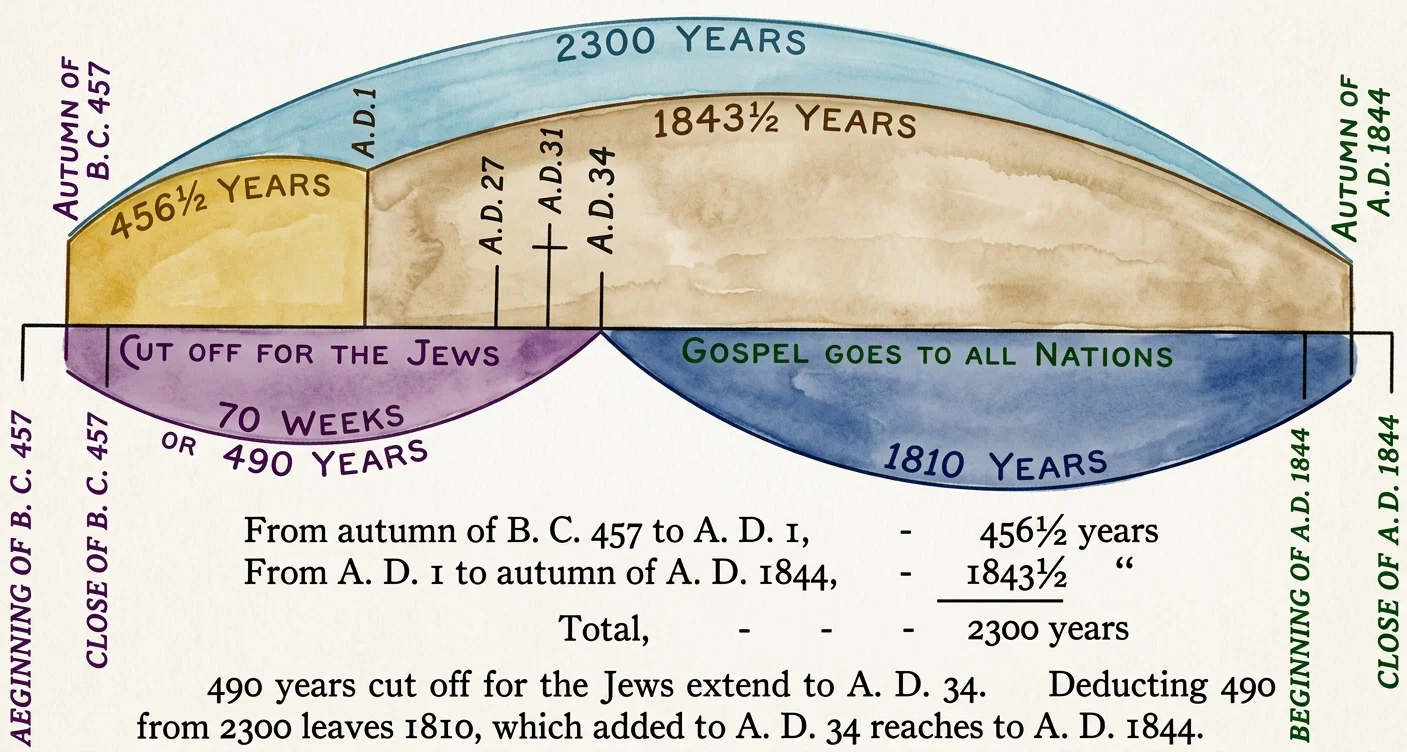
No. 4. DIAGRAM OF THE 2300 DAYS. (Symbolic Time.)
In other words, seventy weeks of the two thousand and three hundred days are appointed, or given particularly to the Jewish people and to Jerusalem, till they should fill up the cup of their iniquity, and Christ should come and make reconciliation for iniquity by His death, and bring in an example of everlasting righteousness by His spotless life. The seventy weeks would also serve as a measuring rod for the twenty-three hundred days, which would seal up, or make sure, the vision and prophecy; that is, would approve and confirm, or make sure, the correct application of the time, and would thus forbid and expose every false theory concerning it. Seal is often used in this sense. See Dan. 6:17; Matt. 27:65, 66.
The seventy weeks would also reach to the time when the Most Holy would be anointed. Before the service in the earthy sanctuary began, it was to be anointed with oil. Ex. 40:9. Jesus began His ministry in the heavenly sanctuary when He ascended. Heb. 8:1, 2. Therefore the anointing of that sanctuary preparatory to His service in it must have been just prior to that service, as in the type.
When the Days Began.
As yet we have not been informed when the seventy weeks, the first great division of the two thousand three hundred days, would begin. The next verse, however, names the event which marks its commencement. Gabriel says: “Know therefore and understand, that from the going forth of the commandment to restore and to build Jerusalem, unto the Messiah the Prince, shall be seven weeks and threescore and two weeks; the street shall be built again, and the wall, even in troublous times. And after threescore and two weeks shall Messiah be cut off, but not for Himself. . . . And He shall confirm the covenant with many for one week; and in the midst of the week He shall cause the sacrifice and the oblation to cease.” Verses 25-27.
In these verses we have several important truths revealed.
1. The commandment to restore and build Jerusalem is the event which marks the commencement of the seventy weeks and therefore of the twenty-three hundred days of which it forms a part, and is the key.
2. The seventy weeks is divided into three parts, namely: (a) Seven weeks, (b) Three score and two weeks, (c) One week. Seven weeks were allotted to the building of the city. Sixty-two weeks more would reach to Messiah the Prince. Verse 25. The last week of the seventy would be devoted to confirming the covenant. And in the midst, or middle of the week, “He shall cause the sacrifice and the oblation to cease.” This He did by His offering on Calvary, which superseded all the typical service and offerings of the Jewish dispensation.
The Date of the Commandment.
Do the Scriptures give the date of the commandment to restore and to build Jerusalem?—They surely do. If they do not, these scriptures can not be understood, and are, therefore, unprofitable. But Jesus said7of Daniel’s prophecy, “Whoso readeth let him understand.” Matt. 24:15. In Ezra 6:14 we find this statement: “And they builded and finished it, according to the commandment of the God of Israel, and according to the commandment of Cyrus, and Darius, and Artaxerxes king of Persia.” Three decrees were issued by the kings of Persia. Taken together they constituted the commandment of God to restore and to build Jerusalem. The first was issued by Cyrus in 536 B.C. Ezra 1:1-4. The second was issued by Darius in 519 B.C. Ezra 6:1-10. The third by Artaxerxes in 457 B.C. Ezra 7:6-26. The last one was fuller in its scope, and greater in its powers than the first two, and thus filled out what was lacking in the others, and made full and complete the commandment to restore and to build Jerusalem.
The seventh year of Artaxerxes, in which the last decree was issued (Ezra 7:7-13), was 457 B.C. This is one of the best established dates in ancient history, and is proved correct by the concurrent agreement of more than twenty eclipses.
Let us now use our measuring-rod, the seventy weeks, and see if the events and dates coincide. It must be remembered that the time we are studying is prophetic, or symbolic time, being used in symbolic prophecy. A day when used as a symbol represents a literal year. This is the Lord’s instruction. See Num. 14:34; Eze. 4:3-6. This is so clear and definite that Bible scholars and commentators generally accept and adopt this plan of reckoning.
The Time Is Fulfilled.
Beginning 457 B.C., the first seven weeks (49 prophetic days or 49 literal years) would reach to 408 B.C., when the street and wall were finished. This work began in the autumn of 457 B.C., doubtless about the seventh month, as they did not reach Jerusalem till the fifth month. Ezra 7:8. Sixty-two weeks (434 symbolic days, or 434 years) would extend to the autumn of 27 A.D., when Messiah the Prince was to be manifested. This occurred at that time when He was baptized, in exact fulfilment of the prophecy. See John 1:29-34; Matt. 3:13-17; Acts 10:38. “Messiah” means “the Anointed.” Jesus was anointed by the descent of the Holy Spirit upon Him at His baptism, and He went forth preaching, “The time is fulfilled.” Mark 1:9-15. What time?—Evidently the prophetic time of Daniel 9:25, that was to reach to Messiah the Prince.
During the last week the Messiah was to confirm the covenant with many for one week. This He did in person during the first half of that week till He was crucified in the spring of 31 A.D. This work was carried forward by His representatives, the apostles, during the remainder of the seventieth week, which ended in the autumn of 34 A.D. During this week the Gospel was carried especially to the Jewish people, and thousands accepted it. In the very last part of the seventieth week, Stephen was martyred, the Jewish Sanhedrin formally rejected the Gospel, and Paul, the great apostle to the Gentiles, was called. See Acts 7 and 8. From this time, A.D. 34, the believers went among the Gentiles preaching the word. See Acts 8:4, 5; 10:1-6, 44-47; 13:45, 46.
When the 2,300 Days Close.
The seventy weeks, or 490 years, ended, therefore, in the autumn of A.D. 34. How many more years remain of the 2,300? By deducting 490 from 2,300 we have 1,810. Then adding this to 34 A.D. gives 1844 A.D. the date for the end of the 2,300 days of Dan. 8:14. See diagram. How clear, plain, and harmonious all these dates are. The seventy weeks with its various divisions, and the events which mark them, is a measuring-rod that tests their accuracy, and proves that 457 B.C. is the correct date for the beginning of the 2,300 days, and proves every other date wrong.
Truly it seals, or makes sure, “the vision and prophecy” (Dan. 9:24); and we are enabled to know when the Saviour begins His closing work in the most holy place of the heavenly sanctuary. How solemn and momentous the truth that the hour of God’s “judgment is come,” and soon its decisions will be rendered. How shall we stand in the judgment? May we so seek His face and believe His word that Jesus may confess our names before His Father (Rev. 3:5), and that our sins may be blotted out. Acts 3:19, 20.