California’s Unique Position Compared with Other States
By J. O. CORLISS.
UNTIL February 14, 1912, when Arizona was proclaimed a State of the American Union, California was the only State in the Federal combination of States without a Sunday law. It can not, however, be too often repeated that notwithstanding this unmatched condition, the citizens of this great State have, as a rule, paid as much honor to the Sunday institution as any other commonwealth of the great American federation.
The reason for this is easily assigned. No civil restraint having been imposed requiring a formal observance of the common day for church attendance, each individual has been left entirely free to attend to that day’s duties as his conscience and best judgment dictated. The result has been freedom from neighborhood animosity and religious wranglings such as have attended in other parts where strict Sunday laws have regulated the religious prejudices of the people.
It is not just to affirm that the last named conditions are exceptions, confined to narrow areas and to irresponsible peoples. True, such conditions have been specially marked in rural districts of some Southern States, such as Tennessee, Maryland, and Arkansas. But the course of some religionists in highly intellectual and eminently refined Massachusetts, together with other New England States, has seemed fully as vicious as that of Maryland, or any part of the South where Sunday laws have been enforced.
Intolerant Everywhere
If the request be made for definite statements regarding the bad effect of Sunday-rest laws in the States named, the history of the last thirty years might be cited to reveal the rancor which such religio-civil statutes engender, and the power they place in the hands of narrow-minded and intolerant people, with which malignantly to pursue those who differ with them in religious opinion.
Cases in Illustration
A few cases out of the many on record must suffice to illustrate the point in hand. In 1884 two seventh-day keeping ministers organized a church of their order in Springdale, Arkansas, as the result of a series of meetings there held. Mr. Scoles, one of the ministers, donated the work of painting their newly erected house of worship, and being pressed for time, thought to paint on Sunday a small unfinished strip at the rear of the building. The job was finished in two hours, and the man returned to his home, but was early indicted for his alleged offense.
Mr. J. A. Armstrong, of the same place and communion, was summoned before the Grand Jury. Upon being asked if he knew of any violations of the Sunday law, he said “Yes.” Asked to state the guilty parties, he mentioned the Sunday railroad-trains, the hotels, drug stores, barber shops, and livery-stables. But, said the questioner, “Do you know of any Seventh-day Adventists who ever work on Sunday?” The answer was in the affirmative, with the result that he and four others, including Mr. Scoles, were indicted. Conviction followed, as it was sure to do, and these, with many more, were heavily fined, or sent to languish in the county jail.
Of course the railroads, hotels, livery-stables, and barber shops were not troubled, but the seventh-day people were penalized to the fullest extent permissible. For instance, Mr. Armstrong was fined $26.50, Mr. F. N. Elmore was fined $28.95, William L. Gentry $28.80, and so on through seventeen other cases. In one case, that of Z. Swearingen and son, one of the farm horses was taken and sold at public auction, but not bringing enough quite to pay the legal demand, father and son were remanded to prison, and charged $21.25 in addition for jail board, for which the remaining horse, harness, wagon, a cow, and calf were levied on to meet the bill. All this for having done a little quiet Sunday work, and that, too, in the face of a former exemption clause in the law for those who observed the seventh day.
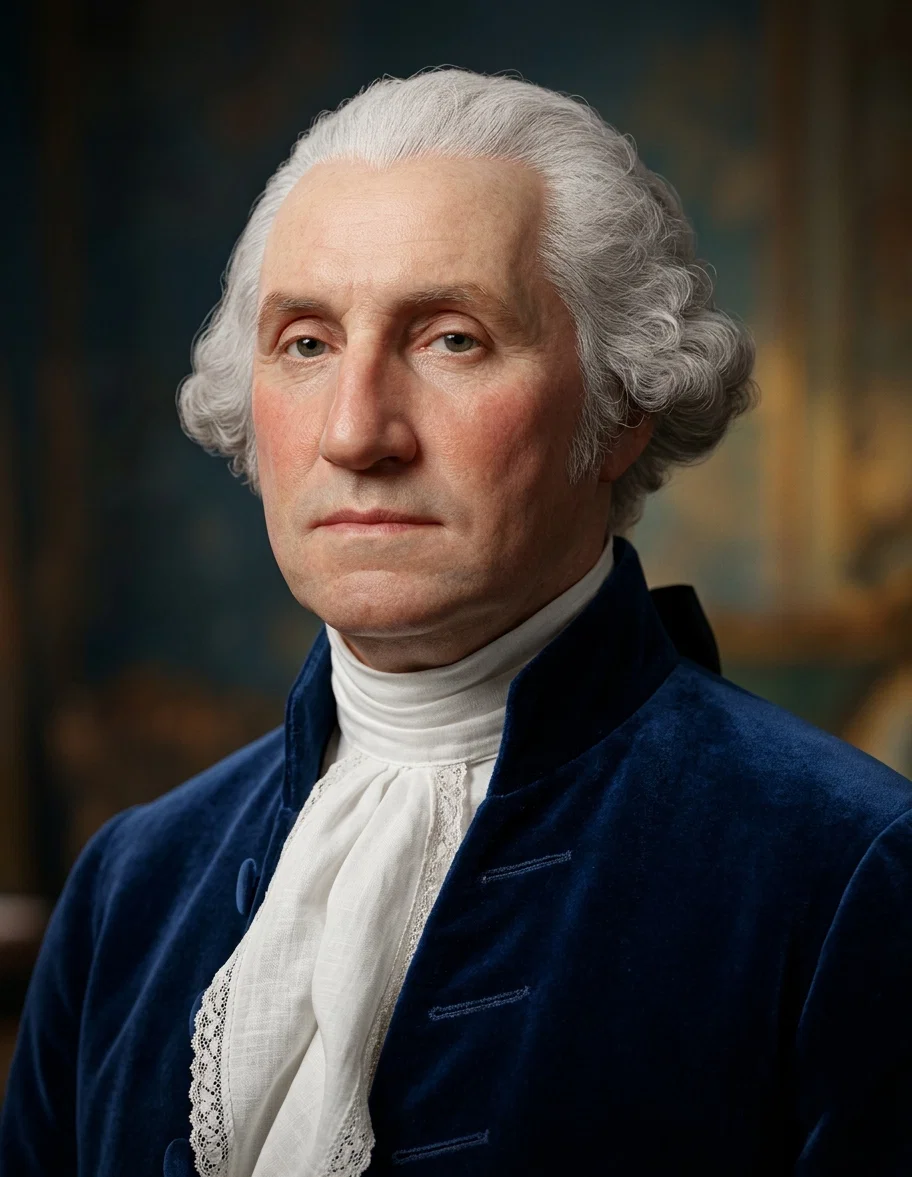
George Washington, who wrote to the Ephrata Community (seventh-day Christians) as follows: “Every man who conducts himself as a good citizen is accountable alone to God for his religious faith, and should be protected in worshiping God according to the dictates of his conscience.”
Such treatment of people because of mere prejudice, shows what a State Sunday law enables intolerant people to do in the way of persecution. Commenting on these cases, the St. Louis Globe-Democrat of November 30, 1885, said:
Of the Dark Ages
“They have been from the first apparently an industrious and God-fearing people, the chief difference between them and other Christian bodies being that they observe the seventh day as the Sabbath, according to the commandment. But it seems that sectionalism can not lay down its arms even when the sacred precincts of religion are entered. . . . It is a little singular that no one else has been troubled on account of the law, with perhaps one minor exception, while members of the above denomination are being arrested all over the State. It savors just a trifle of the religious persecution which characterized the Dark Ages.”
Ten cases of a similar nature soon followed in Tennessee, which resulted in the death of one victim, R. M. King, from undue exposure while in prison. In the case of the last named person, the case records show that the attorney-general, in prosecuting the prisoner, brought forward the assassin Guiteau as an example of villainy, and said he “took a pistol, and shot down the ruler of the nation, and they hung him; and that is what they ought to do with all these fellows” (referring to Mr. King and his fellow believers).
Continuing his foul and utterly mendacious utterances for the purpose of prejudicing the jury, the prosecuting attorney said, “Not satisfied with working on Sunday, and keeping a half dozen women, they come down here and want to save us.” This character stab, with others of like nature, seemed very amusing, it is said, to visitors in the court room, the jury, but especially to some of the leading witnesses for the prosecution, who were devout church-members.
These few cases are cited solely to show what opportunities are given to, and how such might be used by, viciously inclined persons. The same disreputable results naturally follow in the wake of all Sunday laws, but in most cases are prevented simply by mother pride, which recoils at the thought of undue neighborhood notoriety. But let such a law obtain in California, and the momentary passions of men, necessarily indifferently informed, become inflamed by fiery partisan address, and in a little time members of general society would be engaged in a mutually destructive war of religious foment.
Lessons of the Past
The certain workings of human nature over religious controversy have been well determined by past history. In Virginia Baptists were frequently arrested between the years 1768 and 1775 for advocating the tenets of their faith. In his “Life of Thomas Jefferson,” Mr. Parton refers to these, and describes the defense made by Patrick Henry in behalf of three of these unfortunate victims of religious bigotry. The crime charged against them was that of disturbing the public peace. Mr. Henry’s eloquence secured the discharge of his clients, but the historian said of that time, “It was not till the Revolutionary War absorbed all minds, that Baptists ceased to be imprisoned.”
When permitted by law to plead a disturbance of one’s peace in order to prosecute an opponent, it is a dangerous official deed to undertake. This may be the better appreciated by reviewing this comparatively recent bit of history:
In 1887 an ordinance of the city of San Francisco carried this form of prohibition: “No person shall in any place indulge in conduct having a tendency to annoy persons passing or being upon the public highway, or upon adjacent premises.”
Savors of Tyranny
The intention of this ordinance was well enough, had not some unprincipled person seen fit to take advantage of its provision. It seems that one Ferdinand Pape, for distributing circulars on the street, was arrested for “annoying” some one to whom he handed a circular. He applied to the Superior Court for a writ of habeas corpus, on the ground that the offense charged did not constitute a crime, and that the ordinance making such action as his an offense7was invalid and void, because it was unreasonable and uncertain.
In the report of the case the judge declared that the terms of the ordinance were too vague and uncertain to lay down a rule of conduct. Because of this, the ordinance was liable to be made tyrannical, simply because its enforcement depended solely upon the humor of the complaining party. “Any condition of the law,” said the judge, “which allows the test of criminality to depend on the whim or caprice of judge or juror, savors of tyranny.”
The danger must lurk in a Sunday law, if foisted on the fair State of California, because such a law would remain inoperative, as in other States, unless some creed-bound zealot should consider himself disturbed by the work done by another, and complain of the alleged offender, as one who should not be permitted at large until he submit to reform his ways.
Because They Think It Wrong
An incident of just this character came up some years ago at Lewiston, Maine, and the case was tried before Judge Walton of that city. The defendant was charged with drawing cord-wood through the streets on Sunday to the disturbance of the public peace. In his charge to the jury the judge said his impression was that the complaint could not be maintained, since the defendant had quietly and in an unobtrusive manner hauled the wood, without coming into the immediate neighborhood of a meeting. The prosecuting attorney suggested that it might have been where people were returning from church. But the judge decided that even then there could be but a bare mental operation, a matter of mind, of conscience, because they thought the act wrong, or that it did not look right to them. “For my part,” said he, “I do not see why any one driving quietly along with his load on one day of the week should cause any more disturbance than on any other day of the week. It only disturbs people merely because they think it wrong.”
This, too, is the basis of all Sunday legislation. People just think Sunday work to be wrong, and are therefore disturbed because everybody else does not believe just the same as they do in the matter. But if mental disturbance constitutes a civil offense, then the preaching and publishing of opinions diverse from those of the majority could also be made a civil offense, and thus become indictable in the courts of the State. Let California re-enact a Sunday law, and those now clamoring for it would soon demand another step to be taken to make all mental disturbance on Sunday a crime. Such a course would quickly deprive a minority of the people of every religious right in civil procedure.
The danger is in taking the first step. Let those who so desire, enjoy their Sunday rest, which is now their perfect right, without any civil enactment enforcing others to observe the day. The morals of California now average with those of States having Sunday-rest laws. It is better to let well enough alone; and if the churches desire larger attendance at Sunday services—which seems to be a motive for the present demand—let the clergy go forth and do more personal work in behalf of the fallen.