Untitled article

20%

Untitled article

Pacific Press Publishing Company · New York · October 23, 1890

FromThe American Sentinel, Vol. 5, No. 42

Read the full edition
The Hervey, or Cook, Islands are five hundred miles from Samoa. They are of volcanic origin, and the population numbers about 20,000. Although missionaries found them very ferocious, they are now nearly all Christianized, and have the Bible and other books translated into their language.
The natives of the Austral Islands, numbering about 3,000, are all Christians. The Low Archipelago consists of eighty-one islands. Most of the islanders profess Christianity.
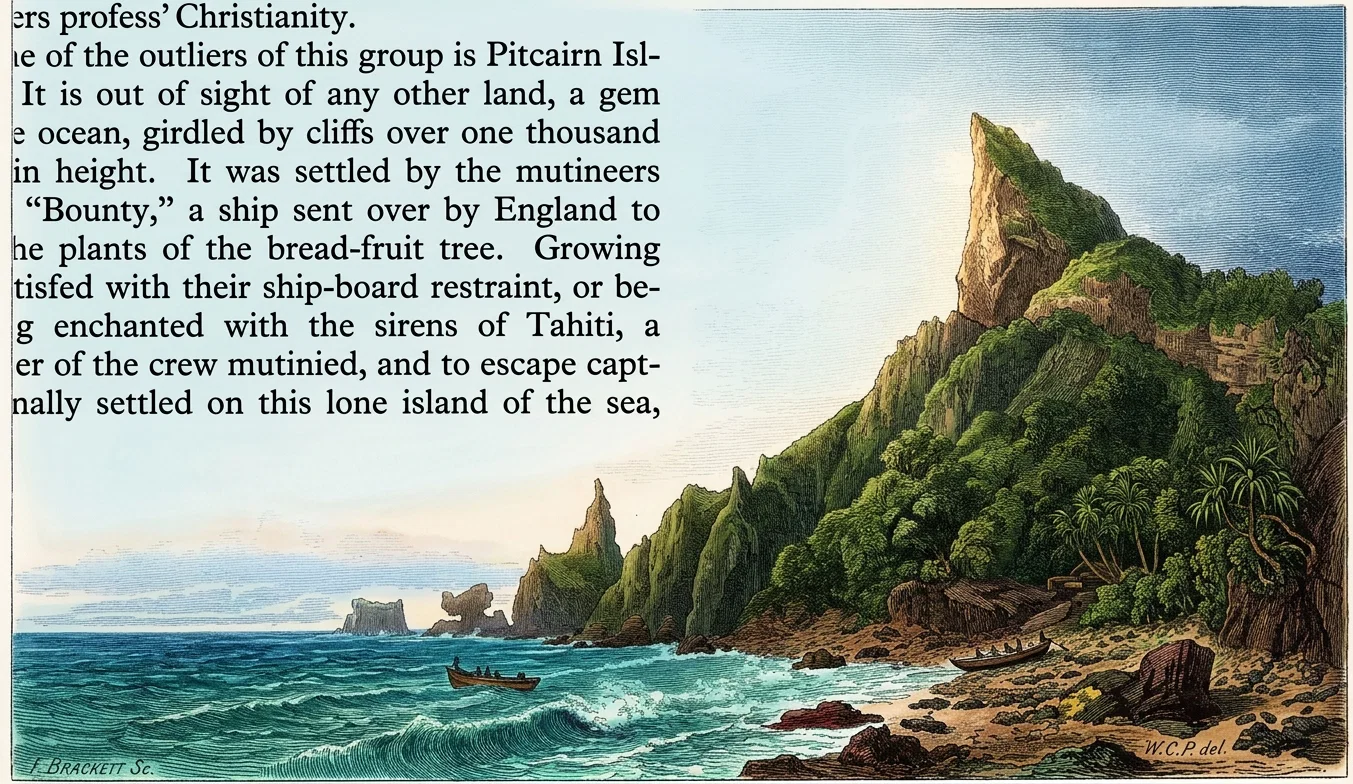
One of the outliers of this group is Pitcairn Island. It is out of sight of any other land, a gem of the ocean, girdled by cliffs over one thousand feet in height. It was settled by the mutineers of the “Bounty,” a ship sent over by England to procure plants of the bread-fruit tree. Growing dissatisfied with their ship-board restraint, or becoming enchanted with the sirens of Tahiti, a number of the crew mutinied, and to escape capture finally settled on this lone island of the sea, with their Tahitian wives. It was not until 1808 that an American ship touched the island, and in 1814 a British man-of-war came, and then the long-forgotten story of the mutineers was revived in the world.
LANDING PLACE, PITCAIRN ISLAND.
The Pitcairners became so numerous that a colony was removed to another island. At the time of their discovery, only one of the mutineers was alive, a man named John Adams. He had sincerely repented of his evil course, and was not only living a model Christian life himself, but by his example and instruction, he was leading the children of the deceased mutineers into an upright, Christian life. John Adams died, honored and