In the Capital of Hunan

6%

Review and Herald Publishing Association · Takoma Park Station, Washington, D. C. · Jul 9, 1908

FromReview and Herald, Vol. 85, No. 28.

Read the full edition

In the Capital of Hunan

R. F. COTTRELL
To an American, a casual survey of the landscape about Chang-sha presents nothing particularly strange. The Siang River, nearly a mile in width during high-water, sweeps along the broad valley. On either side the land gradually rises toward the hills and mountains. The lowland is quite largely utilized in the cultivation of rice.
On the hills, vegetation is scanty, the red soil, resembling clay, being seen in many places. Aside from a meager carpet of grass, there is little to relieve the monotony; yet one hill near by is partly covered by a forest. Here one beautiful day we had the privilege of spending several hours. Almost everything, even to the bird songs, seemed so American that it was difficult to believe we were in China.
Nevertheless, even here was to be seen a specimen of Satan's handiwork. Throughout China it seems that almost every unique, favored, or beautiful site has been preoccupied by some heathen edifice or shrine. So this quiet, attractive retreat had centuries ago been dedicated to Buddha; and on the hillside, in the midst of the forest, surrounded by a high enclosure of brick, is a large Buddhist temple.
Hither come devotees of this heathen deity to worship and to pay tribute. This sacred mount would be an ideal place, for this locality, on which to spend some time during the hot season; but when one asks the privilege, he is refused in polite Chinese manner by being told that the governor is afraid he could not extend adequate protection so far from the city.
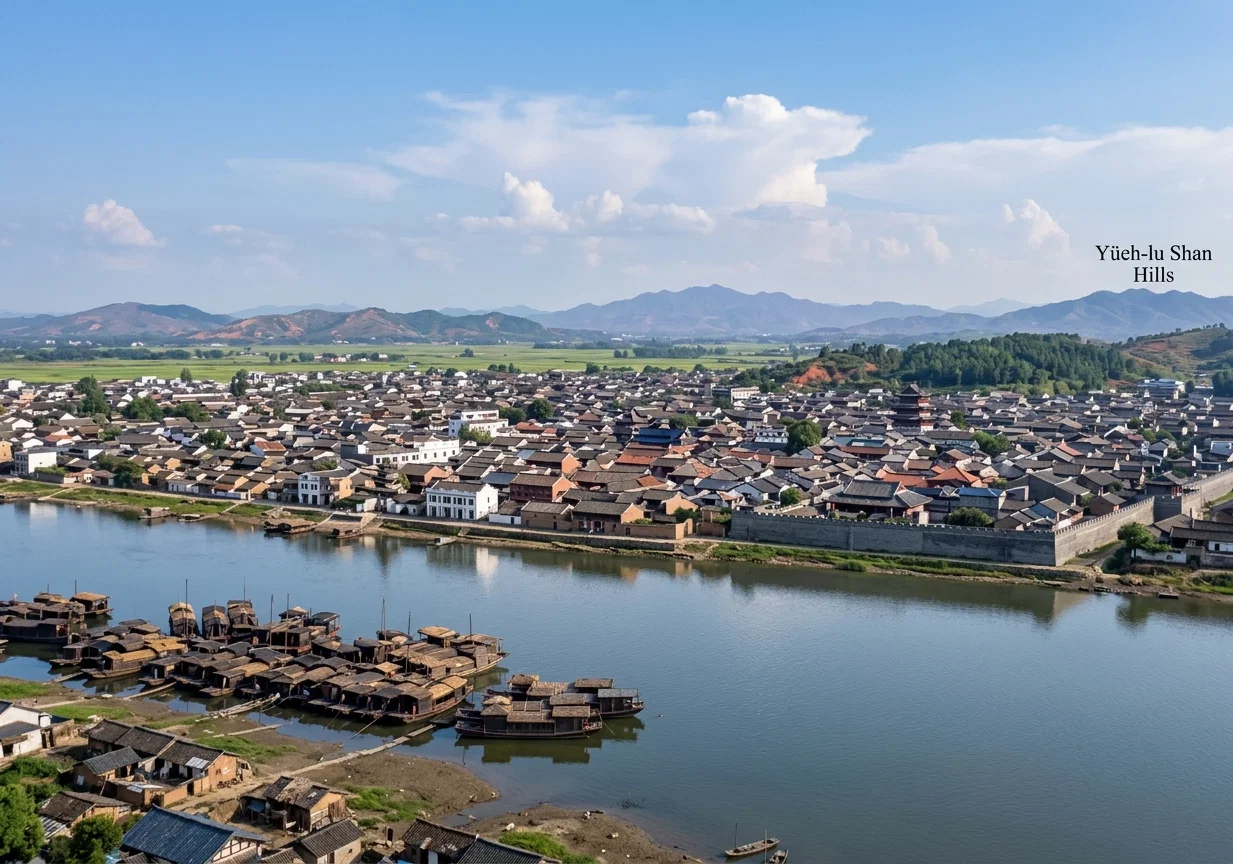
However homelike a Chinese forest may be, a native walled city is decidedly foreign. Approaching the city as one first does by river-boat, he sees a metropolis that has outgrown its artificial boundaries to quite an extent on either side. Towers of temples and shrines may be seen at a distance; while in the stream are many house-boats, and on the low, muddy shore are numerous small dwellings. Nothing appears particularly imposing except the vast number of people,—some clad, some half-clad,—the most of whom are shouting and clamoring as they surge to and fro.
In the city the streets, averaging about ten feet in width, are thronged by what appears to be an endless procession of humanity. The sedan-chair is largely used as a conveyance, while a few jinrikishas are also seen. A goodly number of wheelbarrows pass along, groaning under their loads with a squeak that may be heard for several blocks. The few drops of oil that might stop the distressing noise apparently are never applied. On hearing one of these musical vehicles from a distance of about one-half mile, and in the direction of some soldiers who were drilling, one of our number thought it was a Chinese martial band.
About ninety per cent of all the water,fuel, freight, produce, garbage, etc., is carried by suspending it from bamboo poles, which rest upon the shoulders of the Chinese coolies. The load may require one or more according to its weight, a little over one hundred pounds being considered the amount each should carry. As all who are heavily laden invariably travel at a pace that can best be described as a slow run, it is perhaps unnecessary to state that constant vigilance is the price of safety.
A GENERAL VIEW OF CHANG-SHA
A bird's-eye view of Chang-sha may be obtained from several points along the city wall. Tile roofs here and there, temple towers or spires, and occasional clumps of trees greet the eye. Notwithstanding this a person may travel through the city from east to west or north or south, with hardly a glimpse of either house or tree. Open shop fronts, exhibiting a great variety of articles, and a wide range of occupations, line many of the streets; but these various thoroughfares, together with the high, prison-like walls which surround all dwellings, except those of the very poor, almost entirely hide the houses from sight. In the enclosed courts of the rich, and in the precincts of Confucian and ancestral temples, trees, shrubbery, and flowers are cultivated with a skill which rivals that of the American florist. As the houses, or compounds, are separated from one another by these same high walls, every household is isolated from the rest of the world, and, in consequence, with but little chance in the cities for neighborhood broils.
In the country, however, the reverse of this is said to be true, as almost every village has a feud, oft-times of many years' standing.
Korea, is called the “Hermit Kingdom;” but China, shut in by the lofty Himalayas, the Great Wall, the ocean, and her hoary traditional policy of seclusion, stands without a peer as the Greater Hermit Kingdom. Her cities, enclosed also within massive ramparts, are in many ways separate, miniature nations.
Likewise the Chinese family, as has been shown, is in itself a little kingdom, self-imprisoned not only behind barriers of brick, stone, and cement, but fettered by ignorance, superstition, and an idolatrous ceremonialism that is deified and venerable with age.
Our Saviour came to earth to “preach good tidings unto the meek; . . . to bind up the broken-hearted, to proclaim liberty to the captives, and the opening of the prison to them that are bound; to proclaim the acceptable year of the Lord.” Christ commissioned his disciples, and likewise sends us forth into all the world for the completion of this same great gospel enterprise. “And who then is willing to consecrate his service this day unto the Lord?” And who, for China's spiritual emancipation will say, “Lord, I lay my all upon the missionary altar”?
Chang-sha, China.