A Trip to Hokkaido

6%

Review and Herald Publishing Association · Takoma Park Station, Washington, D. C. · Dec 3, 1908

FromReview and Herald, Vol. 85, No. 49.

Read the full edition

_A Trip to Hokkaido_

W. D. BURDEN
HOKKAIDO is the northernmost of Japan’s five large islands, and the second in size. Until recent years but few Japanese lived in Hokkaido, and even yet there are large areas where bears and other wild animals abound, and it is unsafe for one to travel alone.
The Ainu, the aborigines of Japan, being crowded out of the southern islands by the Japanese race coming in from the south, took refuge in Hokkaido; but they, like the American Indians, are a dying race.
In recent years the government has been doing all it could to develop the resources of Hokkaido. Here, on the main island, there were thousands who, because of the overcrowded condition, could get no land to farm. The government persuaded a number of young men, after they had served three years in the army, to go to Hokkaido and settle. As an inducement each man who would go was given a small tract of land, about twelve acres, a house was built for him, he was given a horse and wagon and a gun, and was kept supplied with ammunition, and he and his goods were moved there free of charge. These people settledin the center of the island, and have become quite a strong colony. The ice thus broken, others followed to get a smaller bait that was held out to them. They were given the land only, and that on condition that they clear and cultivate it all within five years. This has proved a great help to many poor families. Doubtless in all this Japan has been watching the eastward progress of Russia, and feared she would lose Hokkaido if its resources were not developed so as to make it possible to defend it.
At the present time there are over five hundred thousand persons living on the island. These must all hear the third angel’s message; and although in some respects that island is not the most inviting place to live, yet for some time we have been anxious to get our work started there. In view of our plan to open up work there next spring, I made a trip through the island recently, in company with Brother Kuniya.
It was about the middle of July when we landed, but it was still quite cool. We had been warned that it would be cold, so we put on extra clothing for the trip; but notwithstanding that, at times we had hard work to keep warm, even when walking. The great drawback to this island is the long and severe winter. From what we could see and hear, the summers are very pleasant, though short. For six months of the year, so the people told us, they are snowbound, the snow piling up from four to ten feet or more in depth. The government is building quite a system of railways through the island. There is also a more or less regular steamship service all around the coast, and to the main island, so gradually conditions for living there are made more agreeable.
The island of Hokkaido is quite rich in forests, as compared with the main island, and that necessitates a steamship service between the two. At one place that we visited, a sawmill has recently been built, which employs two thousand men. Of course the output is small compared to what that number of men would be expected to accomplish in America.
The fishing industry of the island is of considerable importance, salmon and herring being the two main products. The latter are used for fertilizer mainly, though a great many are also dried and used for food.
Apples constitute the chief fruit, and are quite good, but other fruits are not grown to any great extent. This year the caterpillar and other insects have given the orchard men a great deal of trouble.
Very little rice is grown, but other grains, such as wheat, oats, barley, and rye, do well, and are grown quite extensively. Satan has taken note of this also, and at Sopporo there is a large brewery, Sopporo beer being renowned all over Japan. Beans and onions are grown in abundance, and are among the chief exports.
Last, but not least, is the stock industry. It was a great pleasure to me to see cows and horses, oftentimes fifty or more in a herd, feeding in large pastures. Having been accustomed to stock all my life till coming to Japan, I have missed them very much. There are cows and horses in and about Tokyo, but one never sees them in a pasture. The cows are kept in sheds, and are turned out in a little yard each day for a short time. They know nothing about feeding upon sweet grass in a pasture. They are fed on chopped straw mixed with beans and potato skins and a little bran, and the milk we get tastes accordingly. Grass grows quite well in Hokkaido, and grazing land can be had at a moderate price.
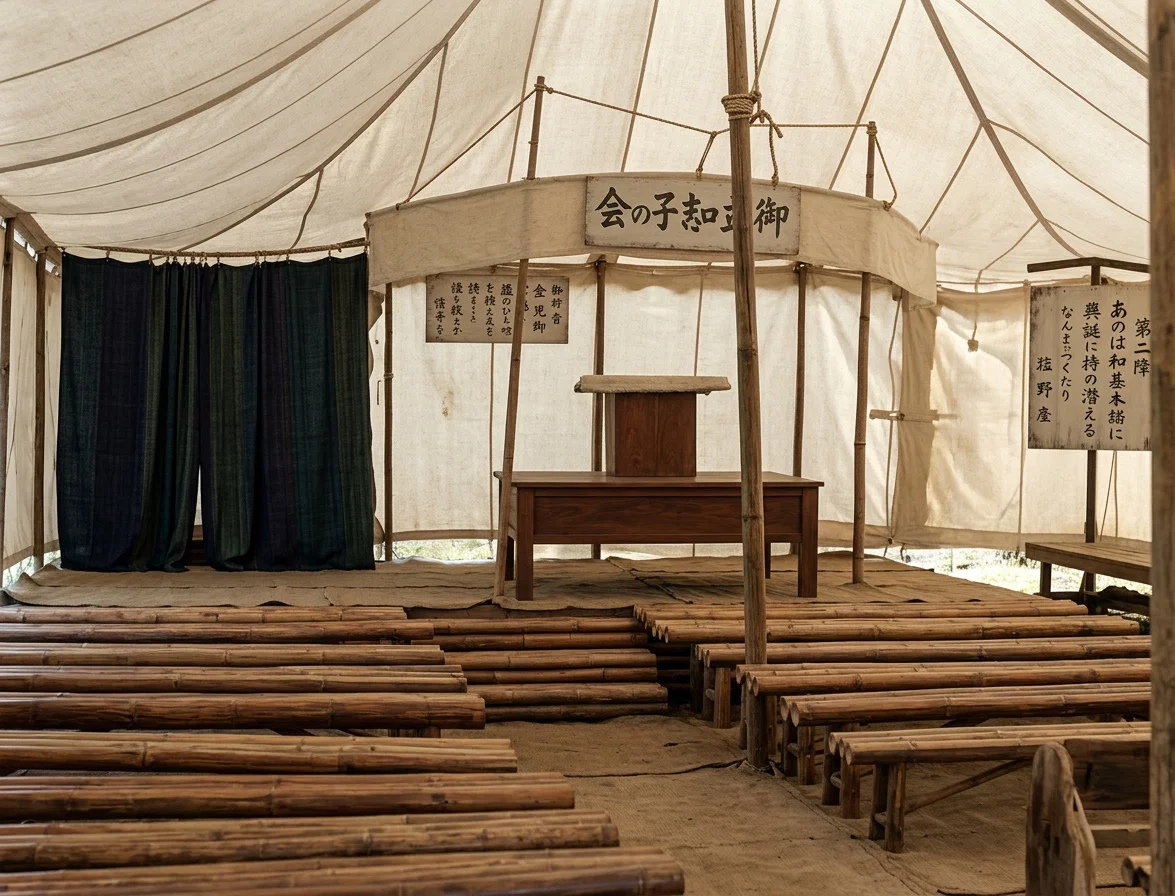
INTERIOR OF KOZU MEETING TENT
The people of the island are not generally of the best class; nevertheless they are of value in heaven’s sight, and in some ways I believe this will be a good field for missionary effort. The people, in moving there, broke away from their home ties and surroundings, and are more independent than on the main island, where they have lived for generations in one community, and where, if one becomes a Christian, he must do so against all the people of his village, and they all are his relatives.
The Ainus are generally uneducated and uncultured. They do not mingle much with the Japanese, but prefer to live in the mountain woods, in miserable huts, and to live easy. They are not lazy, neither are they industrious. They till the ground but little, preferring to hunt, fish, and pick up nuts for a living. They have an abundance of hair, not only on their heads and faces, but all over their bodies. They make good servants, and endure a great deal without seeming to tire. They are very peaceable and quiet in their manner. Surely some one should be working for them. There is nothing in particular being done for them at present, except by the Episcopal and Catholic churches.
We now have two believers living on the island, and one of these is training as a worker. Brother Suzuki, one of our workers, will soon join this brother, and help spread the truth in that island.
Tokyo.