THE Missouri religious liberty lecture tour was even more successful in reaching the public mind in the latter days of the State-wide effort than at any other time of its brief history. Doubtless the political campaign waged so fiercely in Missouri was helpful to us in securing larger audiences, although it had been the general opinion that it would be nearly impossible to prosecute the public work during the closing days of the presidential campaign. The people were alert and active, and anxious to hear all the public speakers upon questions relating to government, from whatever standpoint presented.
After leaving Glasgow we visited Salisbury, Huntsville, Moberly, Palmyra, Monroe City, Louisiana, St. Charles, St. Louis, Macon, Kirkwood, Clayton, Independence, and Liberty, the work at the last-named place—the county-seat of Clay County—closing the tour upon the one hundred fifty-seventh day from its beginning. It was with tears we bade adieu to an audience of over four hundred persons gathered at one of the corners of the court-house lawn, and announced that “our religious liberty work in Missouri had ended.” Immediately, the city attorney came forward from a group of lawyers who had been intently following the lecture, and said, “Do not say ended until you give us at least another lecture upon the subject in our court-room;” while an honest, rugged old farmer said to Mrs. Wightman, “Come back and preach all that you believe, and we’ll come to hear you.” For more than an hour we were busy replying to questions, distributing literature, and taking the addresses of those who desired to correspond with us.
Sabbath, October 17, was the most remarkable day of the tour. At three o’clock we lectured from a large dray stationed at a corner of the court-house square, to an audience of not less than five hundred persons. The attention21given was remarkable. People were present from all parts of the county; and after speaking, we answered questions and distributed literature until the omnibus arrived to take us to the station.
Leaving Huntsville just at sunset, we arrived at Moberly at twenty minutes past six, and at half-past seven were addressing an audience of fully seven hundred persons in an open-air meeting. This was the second visit to Moberly, and the interest was far greater than at the first. Several policemen helped us arrange the platform, and then became so deeply engrossed in the topic that they forgot their duty to keep the street open, which rapidly became blocked. This day gave us an aggregate of twelve hundred interested listeners, while a large quantity of tracts and leaflets was given out.
At Palmyra nearly two hundred persons listened attentively. We also enjoyed a good visit with the brethren of the Palmyra church.
At Louisiana the night was inclement, yet our audience was large. We returned to Louisiana for a second visit, in order, chiefly, to meet some of the representative men of the State living there.
Other cities—nearly all visited—gave us large audiences. At St. Louis the meeting was held in the church. Nothing beyond this meeting was accomplished, as it has been the design of the writer to enter St. Louis—a city of over half a million inhabitants—later, for a more extensive and painstaking public work. For this work the church there is exceedingly anxious.
Fully five hundred persons listened to the lecture on inalienable rights, at Macon, on the afternoon of October 31. A week after this meeting the Pacific Press branch office in Kansas City received a letter from a prominent physician in Macon, who had passed by while Mrs. Wightman was speaking. He stated that he was anxious to ascertain who the speakers were, that he desired to know more upon the subject under discussion, that he had concluded that the lecturers were Christian people, and, very likely, Seventh-day Adventists. He had inquired of an Adventist for information, and had been referred to the Pacific Press branch office. It was evident that this man was a seeker after truth. It is gratifying to know that while oftentimes an intolerant bigot or a prejudiced person will, in order to nullify unanswerable argument, place us in the category of saloon-keepers and the lawless and the vicious, some honest souls find no difficulty in classing aright those who advocate principles of justice and equality—as Christians, as Seventh-day Adventists! Is it not significant that the principles of Christian and constitutional liberty which we advocated, enabled this man to identify us not only as Christians, but as Seventh-day Adventists? He writes that he knows nothing about Seventh-day Adventists, except that there is such a people, yet the terms “Christian” and “Seventh-day Adventist” are, to him, relative terms! So much, then, for Seventh-day Adventism!
At St. Charles one of the most interested listeners was an ex-member of the Dominion parliament, a gentleman of culture and refinement. He said: “I did not dream that such movements were on in the United States. I had expected to return to Canada ere long, and re-enter the political field; but since I have received such important knowledge upon the subject of religious liberty, and your danger of losing it, I feel that it would be both a duty and a pleasure to study to become entirely proficient, and then take the field in aggressive work to help stay the tide of evil that so seriously threatens from the direction of religious intolerance.” Judge Ball, of Montgomery City, met this Dominion politician at St. Charles, and related to him how the religious liberty message had stirred the minds of the people in his city, and said: “It has set us to thinking as nothing else has. And if these people will return to give us more of these truths, I believe the court-house will be filled night after night to hear them.” Such are the impressions made.
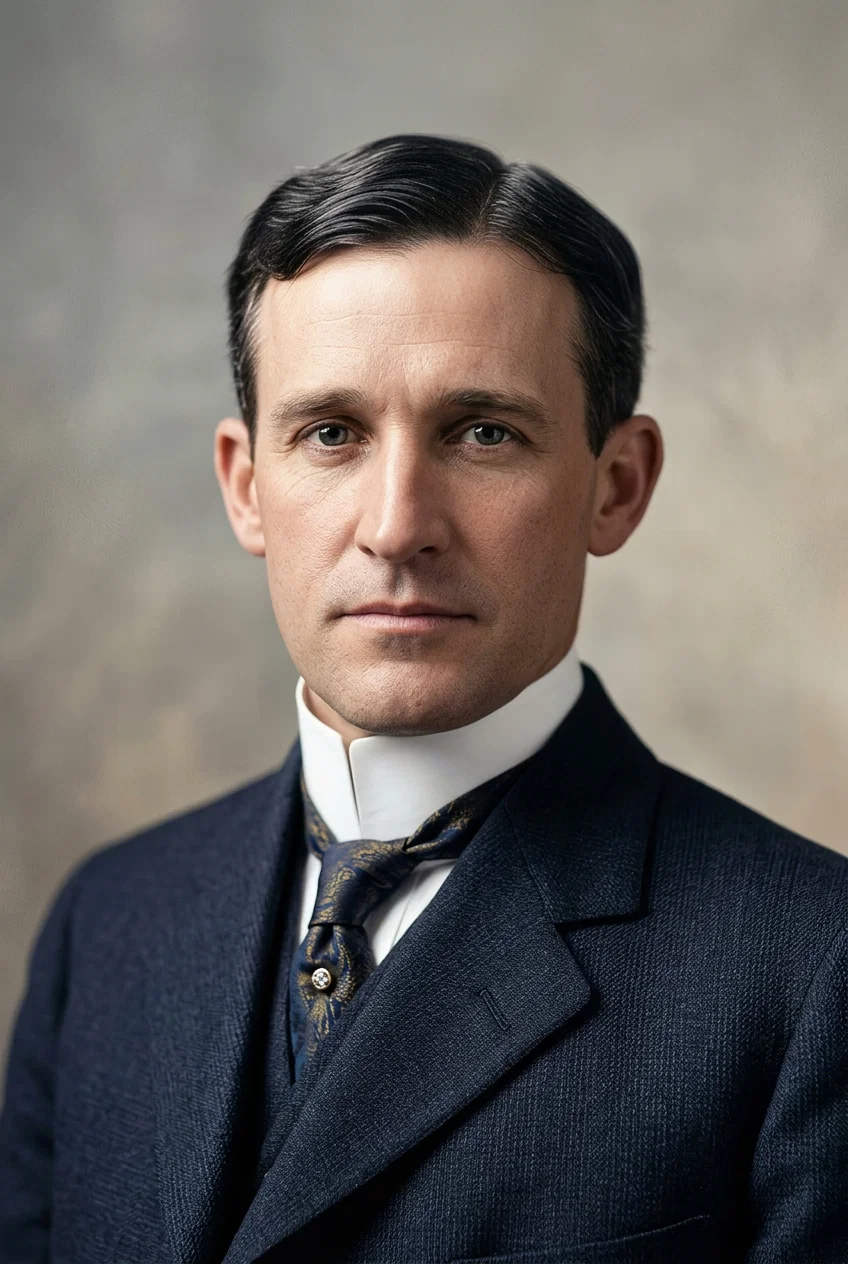
HERBERT S. HADLEY, GOVERNOR-ELECT OF MISSOURI
I can not enumerate the judges, district attorneys, sheriffs, and various officials of the State with whom it has been our pleasure and our privilege to converse. I wish that every reader of the REVIEW could read the many interesting letters we have received. One of the most prominent members of the Republican party, lawyer and ex-member of the State Senate, writes from Brunswick, asking us to return to his town and lecture in the city hall, and promises his aid and public co-operation. A prominent Democrat and ex-member of the legislature, lawyer and chief business man of a city of the southern section of the State, writes the same thing, and urges that the meetings be continued. So it will be seen that ours is in no sense a political work; it goes beyond that: it appeals to all classes of whatever shade of political belief. All are equally affected, and therefore equally interested. Influential citizens of over a score of the places visited stand ready to welcome again the religious liberty lecturers, and offer moral and financial support.
It will be noticed that Kansas City has not been enumerated in the places visited, and for this reason: It has had considerable attention and work given to it during the time of Judge Wallace’s remarkable procedure in Sunday-closing enforcement since last December, and it seemed best to defer any further special effort there until occasion may demand. The day following the close of the tour, however, we visited Kansas City, Kan., and conducted two religious liberty services in our church there, both of which were well attended, many persons being obliged to stand throughout the evening service.
A singular and noteworthy feature of the political campaign in Missouri was the signal defeat of Governor Joseph W. Folk in his attempt to secure the primary nomination for United States senator, to succeed Senator W. J. Stone, who triumphed over his political adversary by a majority of eighteen thousand votes. No political battle in Missouri ever was waged more fiercely than this. Governor Folk made an unprecedented canvass on the strength of his record of “law enforcement;” and it was at Kirkwood, in a political speech, that he qualified “law enforcement” as meaning “Sunday closing,” as “the prosecution of those who violate Sunday laws.” Both Mr. Folk and Mr. Stone are strong members of the heretofore dominant political party in Missouri, but the struggle for the senatorship engaged in by them so divided the party as to make it possible for the Republicans to elect Attorney-General H. S. Hadley governor of the State, who will be inaugurated at Jefferson City, January 1. Thus, in the defeat of Judge Wallace in his effort to secure the nomination for governor, and the defeat of Governor Folk to reach the United States Senate, two of the most formidable civic warriors for “strict compulsory legal sabbath observance,” the ablest champions for religious legislation in the civil state in Missouri, that grand old commonwealth is temporarily rid of bigotry and intolerance, and, under God, the principles of religious liberty, and its advocates, have triumphed. Governor Folk has said that he would retire to private life and the practise of law; while Judge Wallace’s term of office as criminal judge having expired, there seems no other course open to him than “private life and the practise of law.” So, in Missouri, the political skies seem to have cleared from the threatening clouds of intolerance and persecution. But, alas! the battles won to-day are often lost to-morrow. In Missouri, as elsewhere, “eternal vigilance is the price of liberty.” We are confident that Governor-elect Hadley, who has so ably distinguished himself as attorney-general of Missouri, will, as governor, fully safeguard the liberties and rights of the22people as vouchsafed to them in the State’s Declaration of Rights.
A summary of the Missouri religious liberty tour may be briefly stated: 157 days of continuous service (beginning at Sedalia, June 3, and ending at Liberty, November 7); over 3,500 miles traveled; 147 speeches delivered; over 1,500 personal visits made; 76 newspaper articles published, thus reaching an aggregate of one million readers; over 1,000 letters written; over 100,000 pages of literature distributed; while it is safe to estimate that in the neighborhood of 15,000 persons listened to the lectures. God grant that in the kingdom to come we may find some fruit from this effort.
Mrs. Wightman and the writer now turn from the pleasant recollections of the summer’s work, to take up similar duties in the needy fields of the Central Union Conference. We desire the prayers of the REVIEW readers that we may receive divine wisdom in abundant measure, not only for the duties in our new work, but also that through correspondence we may help many of the interested persons in Missouri.
It is probably unnecessary for me to state that I have written the articles upon the Missouri tour solely that others may be encouraged in the good work by the simple recital of what God has wrought in Missouri in 1908. “Be strong and of a good courage; . . . for the Lord thy God is with thee whithersoever thou goest.” God has spoken; we need not fear. So let us unitedly buckle on the armor a little more tightly for the battles of 1909. Those battles are coming—coming with a thousandfold intensity. And we must be ready.