The Mahrattas of India

8%

Review and Herald Publishing Association · Takoma Park Station, Washington, D. C. · Dec 24, 1908

FromReview and Herald, Vol. 85, No. 52.

Read the full edition

The Mahrattas of India

GEO. F. ENOCH
The Western Ghats of India were the cradle of the Mahratta race. These mountains brought forth a hardy people of Aryan descent, who gradually grew in strength until, in the seventeenth century, one Sivaji, a mountain chieftain, cunning and crafty, with a genius for sovereignty, converted the shepherds and cultivators of the Konkan, into loose but organized armies of horsemen. The empire built from this foundation always had its proper dominion in the country indicated by the three great fortresses, Poona, Satara, Kolhapur. From these centers great clouds of Mahratta horsemen spread in every direction the terror of the Mahratta name. At one time the territory from Bombay on the west to the borders of Bengal on the east, from Gujarat and Malwa on the north to Mysore on the south, acknowledged the sovereignty of the Mahratta empire, and to it paid tribute. The Mahrattas have been well called the Parthians of India. At one time they dictated a humiliating treaty to the English, but finally, about 1818, they were completely overthrown by England, and their territory became a part of the British dominions. At the present time the Mahrati-speaking people occupy the territory, roughly speaking, from Surat on the northwest to Nagpur in the Central Provinces on the east, and from thence running in an irregular line to the southwest across the Nizams, of Hyderabad territory, to Goa, the Portuguese colony on the southwest. Within this territory are about nineteen million Mahrati-speaking people.
The Mahrati is an Aryan language, but the territory in which it is spoken is bounded on the south and east by Canarese and Telegu, two Dravidian languages, which have had some influence on it. It is an analytical language, and is said to be the most difficult of the Aryan languages of India. It is a language of grammatical gender, and the verb in the indicative mode has fourteen tenses. A man and a woman speak differently when speaking of the same thing, as pronouns, adjectives, and verbs must all agree with the speaker in both gender and number. Then, as there are no definite general rules by which one can distinguish the gender of a noun, his first attempts to speak cause great bewilderment on the part of the listeners, to whom the proper genders of nouns come naturally. The other day the little daughter of a missionary, born in the country, came running to her mother and said, “Mama, Mr. —— [a beginner] spoke to the nurse just like she was a man.” Mahrati is a bright, vivid, and picturesque language, with a literature, chiefly poetry, running back several centuries. The parent language is Sanskrit, which can not be called a dead language, even now, since it is the daily vehicle of religious thought for living millions.
I have said so much concerning these facts to help our people grasp the idea that India is not one nation, but a group of nations, each with its separate history, and that it is not a country speaking a variety of dialects, but a country of many languages, each with its own literature and history.
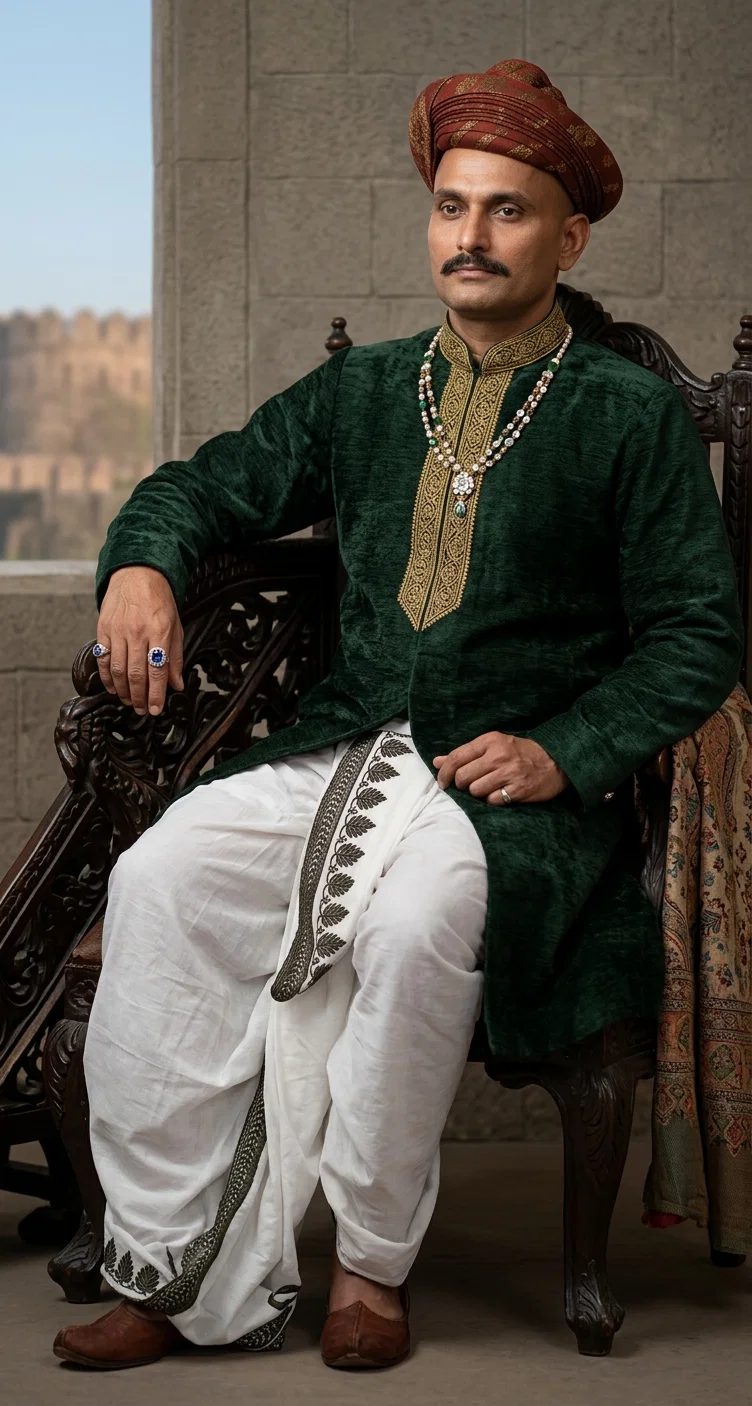
A REPRESENTATIVE MAHRATTA
By way of comparison, take the population of all the territory in the United States, west of the Mississippi River, and you will have but two million more than speak the Mahrati language. If you leave out of this reckoning the population of the Southwestern Union Conference, and substitute in its place the population of the Western Canadian Union Conference, you have two million less. Take away from the great majority of these millions their Bibles, their churches, their schools, their centuries of Christian influence, then, perhaps, you will get a faint glimpse of what faces, at the present time, one lone family representing the third angel’s message in this territory.
I most earnestly urge the readers of this article to think again over these facts,—lest we forget, and congratulate ourselves overmuch on the present showing of our denomination in the regions beyond. While attending camp-meetings in the above-mentioned territory in the States, I well remember the plea of conference officers concerning the paucity of their laborers. I would not speak lightly of this real need; but when I think of the comparatively small territory of each conference, of its hundreds of believers, and scores of strong young people, and well-equipped corps of conference laborers, besides a common language and a people with Bibles, schools, and churches; then from that vision turn to the burden of the nineteen million Mahrati-speaking people, with their strange tongue, without Christ, and for the most part in the darkest heathenism, my heart longs for our dear people to see this as it is, and share the burden with us. I am now writing of but one of the many nations of India. When we, in the same way, look out beyond India, to China, Africa, and the islands of the sea, not to mention the Catholic countries, our mind is able, in a small measure, to grasp something of the tremendous task still before us. Surely we can all see that we are now doing but a fraction of the work required of us in the regions beyond.
Your missionaries out in the dark lands feel this most keenly. Put yourself in the place of one family, the only representative of the message among nineteen million people; imagine the long, hard study required before being able to speak to the people, and a longer time still to understand their character and disposition; think of the trying climate, where cholera and plague, not to mention other diseases, are continually sweeping away many all around you, and the conditions under which you work are constantly making large drafts on your vital powers; then ask yourself the question, Is it right, in the midst of all this, to risk so much by having but one family in each of these great nations to represent the solemn responsibilities that are ours through the third angel’s message? Those who stand under these burdens give the negative answer in a most positive way. If after a few years, when one is just getting hold of the work, the health breaks, or the life is laid down under the heavy burden, and no one has been associated with the lone worker, years of labor are lost, and no one can be found who can take up the burden where it is laid down. It, therefore, seems reasonable to us in the field, to plead for companies of strong young men and women, representing the evangelical, educational, and medical branches of our work in each of these great languages of heathenism. We plead that they be sent out hastily, ere the powers from beneath gain such advantage that the work will be a hundredfold more difficult.
To do this our Mission Board must have its resources increased manyfold; for even now it is taxed to support the solitary lamps being lighted among these heathen nations. But our faith is large. We believe that the time has now come for this people to enter the heathen lands. We believe that there is now in preparation an army of young people, who will allow nothing to turn them aside from carrying the banner of Jehovah to earth’s dark corners. We believe that our people are getting ready to put their all upon the altar, so that companies of young people may be planted in the midst of these nations. And when our people have placed their all upon the altar, and it is not sufficient, then, we believe, the wealth of the Gentiles will come to us, that the work may be finished.
And from such a vision, with the prayer that the human co-operation requiredon the part of God’s people for its fulfilment, may not be neglected by them through indifference or carelessness, we turn again to our great task, and the heavy burdens awaiting us, and take them up in Jesus’ name with renewed strength and courage.
Poona, India.