The Valley of the Nile

8%

Review and Herald Publishing Association · Takoma Park Station, Washington, D. C. · May 9, 1907

FromReview and Herald, Vol. 84, No. 19.

Read the full edition

The Valley of the Nile

JAY J. NETHERY
WE are still learning more about Egypt. We came to Luxor about three weeks ago, to connect with Brother Awada in helping some of the interested ones. The people in this part of the field have had an opportunity of hearing the truth, since for five years we have had a representative of the message located here. We are glad to report that the seed sown is beginning to grow, as there are four or five who have lately declared that they are going to obey the Lord. Others are still studying, and we are sure they, also, will obey before long. We have been endeavoring to help all to see that the acceptance of the message means a separation from the world and its customs, and that it is most essential for us to understand the reason of our faith from the Scriptures alone.
The needs of the cause are many, as in other places of the earth. The greatest need at the present time is a representative for the medical work. A young man, a clerk in the National Bank of Egypt, told me the other evening that we should have medical workers in different places, as he was confident this was the way to reach the people. He has been reading the London Good Health, and is very favorable to our work, having been acquainted with Elder Wakeham’s efforts.
One afternoon we went to a village up the Nile, to visit a young man and his wife, who are excellent people. He is the station-master, and, of course, is expected to work every day. After studying with them, they felt moved to obey. The wife declared that she would keep the Sabbath, and the husband, with tears, told us that his conscience had been troubled, but if he obeyed God, he would lose his position. It means much here to some to leave the positions for which they have educated themselves; nevertheless we are glad to be able to tell these poor souls that God, who cares for them while in disobedience, will do so for them if they obey. It truly takes faith in God to obey. I am sure the Lord will open the way for these earnest people. They desire to take the nurses’ course, and talked very earnestly about the need of being prepared for the Lord’s coming. I was much encouraged by this visit. The man speaks English quite well. The government schools have done much for the Egyptians, in the way of enlightenment.
On the way to this village, we met a man who speaks and reads English well. He wants to hear more about the truth. As he is a very busy man, being a contractor, he asked if we had some good book explaining our views, as he would like to buy it. I promised to send him “Great Controversy.” This makes me think of the many opportunities there are in more easy fields of putting out our books. I hope our people may continue to take advantage of them while they last. It is not an easy matter to sell books here. Only a very small per cent of the people can read. In this time of the latter rain, we are praying for showers to fall in Egypt.
It is a beautiful sight at this time of the year to see so many green fields. Egypt looks best during the first two months of the year. The air is perfumed by the great quantity of blossoms on the orange, lemon, and other trees. Upper Egypt is very hot during the summer months. Even now the weather is getting quite warm. It was really uncomfortable the other day.
The temples of Egypt are the attraction now. These have been discovered in a state of preservation almost entire. Innumerable are the columns and statues. One palace is especially admired—the temple of Karnak, on the site of ancient Thebes, on the east bank of the river—which may be approached by different avenues. On either side of these avenues are large sphinxes of rare material and of remarkable size.
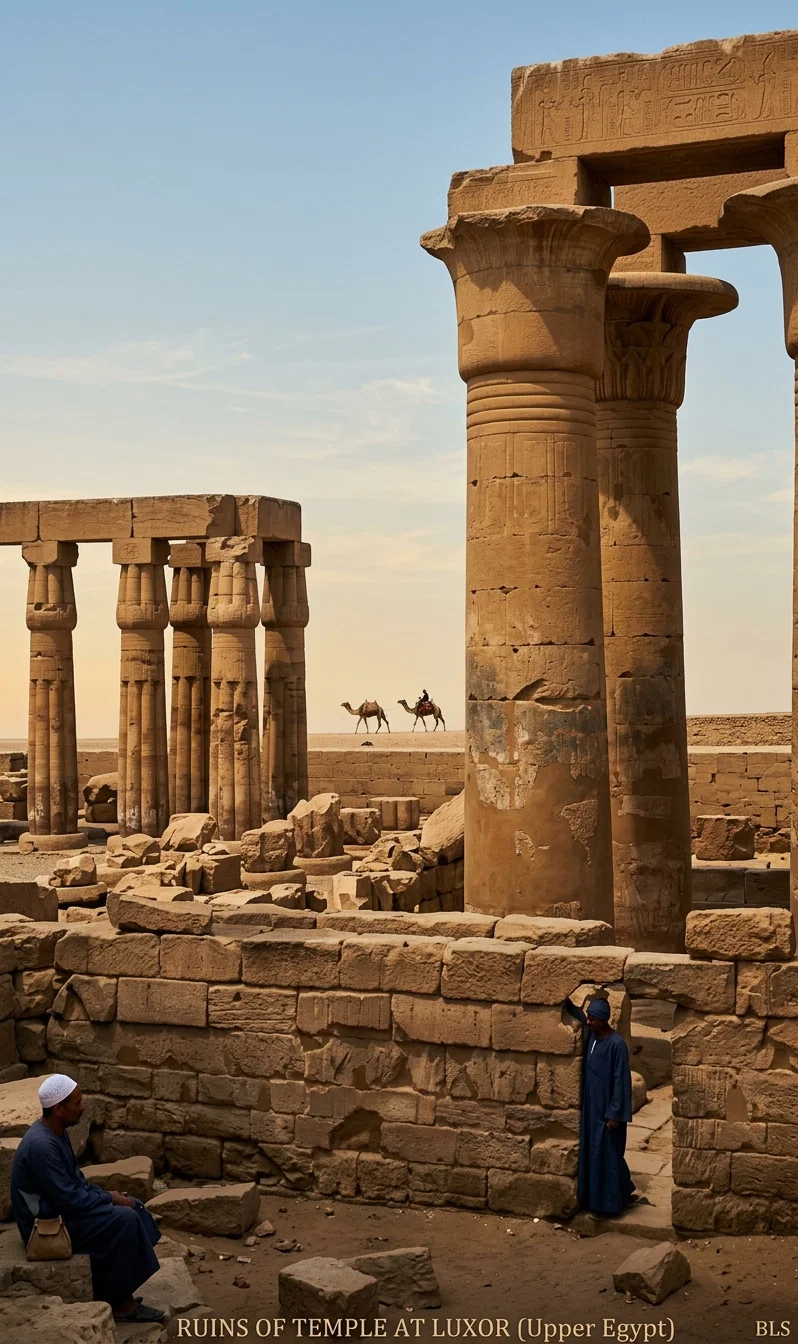
RUINS OF TEMPLE AT LUXOR, EGYPT
The old temple, with its mammoth pylons, inner courts, most holy places, obelisks, and columns, is beyond description. A hall which, from all appearances, stood in the middle of the temple, was supported by one hundred and twenty columns nine feet in diameter and about fifty feet high. It is impossible to describe the impressions received by one as he passes through these ancient monuments of the work of man. The work of man is nothing, as compared with that of God; but here we have a telling testimony of what the great men are able to achieve, their works remaining century upon century after the builders have passed away.
We visited the tombs of the kings, in the Libyan Hills, across the river from Luxor, which are hewn out of the solid rock, in a valley reached by a winding road. This valley, about four miles from the river, contains the tombs of the kings of the nineteenth and twentieth dynasties, and is called the Eastern Valley. A smaller—the Western Valley—contains the tombs of the last kings of the eighteenth dynasty. These tombs consist of long inclined planes, with a number of chambers receding into the mountain sometimes to a distance of five hundred feet. The most important are those of Seti I, Rameses I, III, IV, VI, IX, also that of the king ruling at the time of the exodus of the children of Israel. We must understand that these tombs were generally prepared by the kings themselves, years before their death. So this latter tomb is no evidence to show that the king was not drowned in the Red Sea, as the Scriptures say. Critics have taken this as an evidence against the inspiration of the Bible, without any reason. New tombs are being unearthed by English and American excavators. On our way back, we reined in our donkeys, and had a look at the Colossi of Memnon. These statues are sixty feet high, each weighing eleven hundred and seventy-five tons.
The temple of Luxor is also very interesting, although not so large as that of Karnak. From here was taken the large obelisk now in Paris. These obelisks are one solid stone, brought down the river from Assuan. The large one at Karnak is ninety-seven feet high. The one in Paris is about seventy-five feet in height.
The glory of Egypt has faded since the erection of these famous works, and nothing can restore it; but, thanks to God, individuals out of such nations can be accepted as subjects of that kingdom which is to be an everlasting kingdom.