Types of Papuans

8%

Review and Herald Publishing Association · Takoma Park Station, Washington, D. C. · Jan 11, 1912

FromReview and Herald, Vol. 89, No. 2.

Read the full edition

Types of Papuans

BERTHA S. CHANEY
The study of a native race is one which is likely to prove of absorbing interest. On seeing their curious customs and hearing their strange ideas, one can not but be led into wondering how these customs grew up, and where their unusual ideas took root.
In Port Moresby we have excellent opportunity for seeing many types of the Papuans who live in the different parts of eastern New Guinea. There are many natives at work in and around the port. They are used as day laborers on the buildings being erected; they work in the stores, where they are used as carriers, and for doing the lifting and heavy work; they work on the boats which ply up and down the coast; they work for the blacksmith and the baker; and a great many are employed as house-boys.
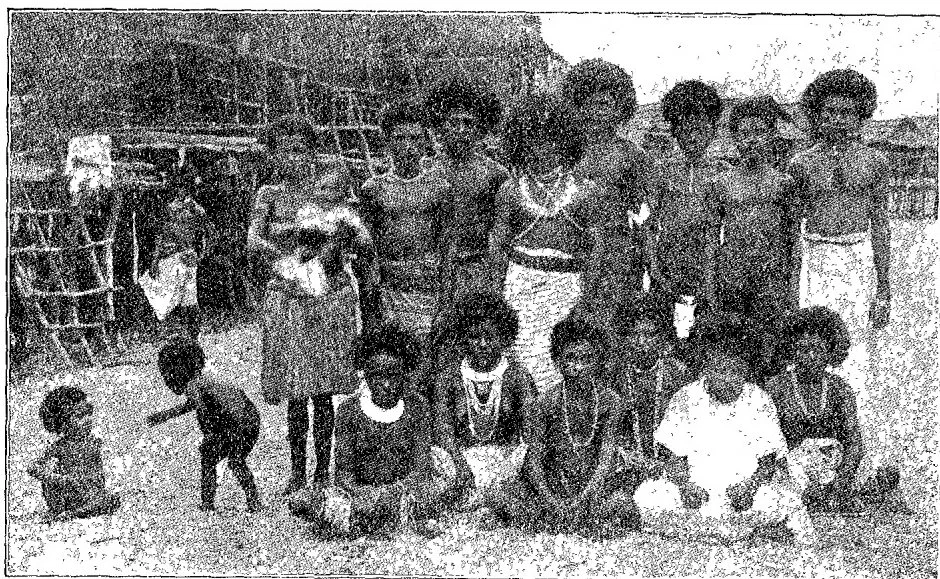
GROUP OF NATIVES AT HANUABADA VILLAGE, NEW GUINEA
Besides these who belong in port, a great many pass through, being brought from the villages along the Gulf of Papua, and indeed for some distance up the Fly River, and from inland. They are brought in, in great squads, to “sign on” for the plantation work, which is making good progress in the inland districts. And again, they must all be brought in to the native labor office to “sign off” at the end of their term of service.
There is a great diversity among them in appearance and color. Those who come from the villages along the coast of hair just over the forehead; and not so pleasant in appearance as those whose villages lie in the vicinity of Port Moresby and to the east. On the street, a few days ago, I passed a large group of men, stringing along behind their white overseer, and never anywhere have I seen a plainer lot of people. Their dark skins were rendered rough and unsightly with the ringworm, which is unfortunately very prevalent. Their features were very irregular. Many had the head shaved except for a small patch of hair just over the forehead; and not a face among them looked bright and attractive. Upon inquiry I learned that they were Kiwai boys, having been recruited from an island of that name that stretches its slender length for miles in the waters which pour out of the Fly River into the Gulf of Papua.
The above description does not fit the coastal natives who live near Port Moresby and to the east. They are lighter in color and have pleasant faces; their features are often very good; they are not so large, but have an unusually erect carriage. Many of the young women are plump and pretty, and seem to be aware of it, as they walk about swinging their grass ramies gracefully as they move. When not spoiled by the ringworm, their brown skin glistens in the sun, and the tattooing in lines and curves on their faces and bodies does not detract at all from their appearance.
The great difference in the eastern and western natives in character, appearance, and language, has led to a theory being propounded of an influx ofMelanesians at some time in New Guinea’s history. These Melanesian people have invaded the “great land,” as the Papuans call their country, and, settling along the coast, have forgotten when or why they came. They seem not to pass oral traditions down from father to son, as do the American Indians. The tribes of Papuans proper, who were living along this southeastern coast, were probably driven inland, if not absolutely annihilated by the invaders. There is even now a strong mutual distrust existing between the inland people and the coastal tribes. Brother Carr’s boys are all from inland, several days’ journey beyond the Bisiatabu plantation, and they have a great dislike to being in Port Moresby. Very few of the inland boys will come in to the port to work, and those from the coastal villages have an equal dread and fear of going inland.
These Melanesian tribes, as they are supposed to be, which are wedged in among the more savage Papuans, evidence a higher development and show greater tractability than the aborigines. But even among these there exist great differences, owing to the fact that there was little intercommunication between tribes before the advent of British law and order. Now that they are obligedto live at peace with each other, the villages intermingle much more than formerly.
All the natives love to deck themselves in beads, streamers of paper, shells, and rude ornaments of all sorts. They paint their faces, too, in odd fashions. Sometimes they sketch black rings around the eyes, which give a grotesque suggestion of spectacles. Red paint, which they make from a plant, is in great favor. Our boy takes his sauce-pan of rice out to his quarters; when he has finished his meal, he turns up the pan and uses the black to draw pretty circles around his eyes, and streaks from the corners of his mouth to his ears.
Upon first arriving in port and seeing the natives swarming over the wharf, lazily sitting on its edge, or lying about in their canoes, eating rice and fish from a common dish, chewing the disgusting betel-nut, and passing around the big bamboo tobacco-pipe from one to the other, one can not resist a feeling of repulsion for such an unattractive people. But when one comes to know them, and learns that they have human qualities and feelings; that they love their children; that they mourn for their dead; that they carry burdens of sorrow and care; and that they have some sort of moral standard,—one can not but recognize their savagery and degradation to be the greatest appeal they could make for the help which the gospel can give them.
“If thou art blest, Then let the sunshine of thy blessings Rest on the dark edges of the cloud that lies Black in thy brother’s skies.”