Turkey

9%

Review and Herald Publishing Association · Takoma Park Station, Washington, D. C. · Sep 17, 1914

FromReview and Herald, Vol. 91, No. 39.

Read the full edition

Turkey

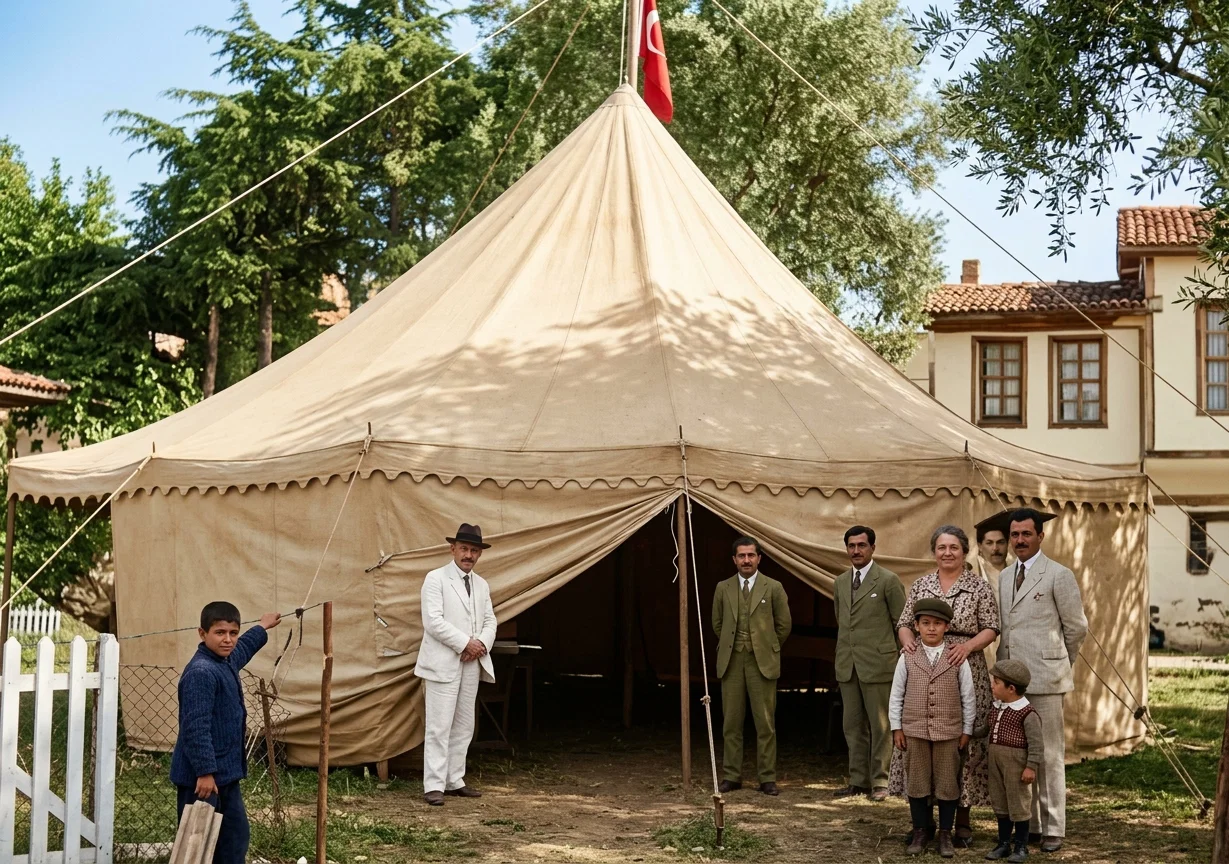
ODEMISH. — To the history of our Turkish Mission another page is added. Recently for the first time we were privileged to see a tent pitched, with special permission of the chief governor, in the center of Odemish, a city of 25,000 inhabitants, in the province of Smyrna. Two years ago a tent was pitched in Kadi-Keng, of Constantinople, but the permission for preaching under it was denied by the authorities. This was a disappointment to us then, but not a discouragement. But now, although not in a more favorable time nor in a more peaceful section, and under the same ruling power, the Lord has wonderfully opened the way before us. After a good effort in Smyrna during the winter, my husband made a tour with Brother Dickran, a canvasser, in the surrounding country to find a suitable place for the tent work this summer. When he saw that Odemish was quite a nice place, he went first to the chief governor, or kaimakam, and talked with him about it, and inquired if he would be allowed to conduct a meeting. He was asked what kind of meetings would be held under the tent. We have learned by experience that any kind of religious meetings in Turkey have to be held in church buildings recognized by the government, in Jewish synagogues, or in mosques.
THE FIRST TENT PITCHED IN TURKEY BY GOVERNMENT PERMISSION
In asking permission for our meetings we were advised to call them moral or scientific lectures. My husband explained the nature of his lectures, that they would be to teach the people love toward God and toward one another. The second question was whether our talks would be based upon the spirit or the letters of the Bible, really a strange question to be asked by a Moslem governor. He expressed his joy when told that we believe the Bible just as it is written, without separating the spirit from the letter. He then said, “If you will do so, and if you will procure an interpreter that will be able to make our people understand those good principles you speak of, I shall consider you as an angel sent from heaven.”
Once the permission was granted, my husband hurried to find ground, and the tent was pitched. It took several days for him to return to Smyrna. We then went to Odemish. During this time it was very interesting to see the curiosity of the people. All day long crowds were coming to see the tent, each one expressing an opinion about what it was to be used for. Some were heard to say that a Frenchman had come to convert the people to a new religion and offered twenty-five or thirty dollars a month a person, with a house to live in, etc. Another thing that seemed very strange to them was for this French preacher to have his wife interpret. The women here dare not sit in the same hall with the men. Even in their own churches they are separated in such a way that they may not be seen by men. In some parts of Turkey this is not so. The meetings began on Sunday evening. The tent was full. Besides Christians, there were about one hundred Moslems, and about as many women were standing outside.
On the second evening the Turkish hodja (professor) brought his students to the tent. He expressed his thanks for the subject treated, “The Need of Faith.” It gave us encouragement to hear also that the people in general were pleased. But this condition did not last very long. Three days after, a very strong boycott began against Greeks by the Turks. The whole city was in danger. Turks were against Turks that would have any dealings with Greeks. Many tobacco fields belonging to Greeks were spoiled by Turks, and their owners beaten. It was like a reign of anarchy. The steps taken by the government to stop this did not materially change conditions. On the other hand, all the Greek families thought to leave the town and go to a place of refuge at their headquarters in Smyrna, so the streets were full of cars taking the furniture of ten to twenty families each day. In the night Christians feared to come out of their houses. These things of course hindered them from coming to the tent meetings, and for several nights only a few Moslems were in attendance at the services.
Elder Frauchiger, the president of our field, visited us recently. He was on his way to the interior, coming from Saloniki, and related to us more dreadful scenes of this boycott. We had very good seasons of prayer and counseling together, especially asking the Lord to give us some souls in this town even in these times of trouble.
We were glad later to see many Christian faces during the meeting. The message is sure to gain the victory, no matter under what circumstances it is given.
We have begun special meetings for women on Sunday, also a meeting for children on Sabbath afternoons. At the latter meetings we have about two hundred children present.
In all this work we feel the hand of the Lord with us. We are sure to see some fruit in a little while. In closing, I wish to ask each reader to remember before the throne of grace this new work in Turkey.
MRS. E. A. GIROU.