Scripture and Tradition

4%

Review and Herald Publishing Association · Takoma Park Station, Washington, D. C. · Jan 11, 1915

FromReview and Herald, Vol. 92, No. 2.

Read the full edition

Scripture and Tradition

By W. W. Prescott
Two positions are held, the one contrary to the other, concerning the sufficiency of the Scriptures as a rule of faith and practice. The holder of one of these positions affirms that “Holy Scripture containeth all things necessary to salvation, so that whatsoever is not read therein, nor may be proved thereby, is not to be required of any man that it should be believed as an article of faith, or be thought requisite or necessary to salvation.” The holder of the other position declares: “I most steadfastly admit and embrace the apostolical and ecclesiastical traditions. . . . I also admit the Holy Scriptures, according to that sense which our holy mother church has held, and does hold.”
Protestants maintain the former position, including under the term Holy Scriptures that collection of sacred writings comprised in the Authorized or Revised Version. Roman Catholics maintain the latter position, meaning to include in the Holy Scriptures all that is included by the Protestants and “seven books and parts of two other books” not found in the Protestant Bible. The consistent Protestant believes that the Bible furnishes a sufficient rule of faith and practice, while the Roman Catholic affirms that tradition is “more clear and safe” than the Bible. Which view is the correct one?
Our first appeal is to the Inspired Writings themselves. What testimony do they bear concerning their sufficiency? Do they intimate that they need to be supplemented by oral tradition? Do they contain any warning concerning that kind of tradition which contradicts the written Word? They shall make their own answer:—
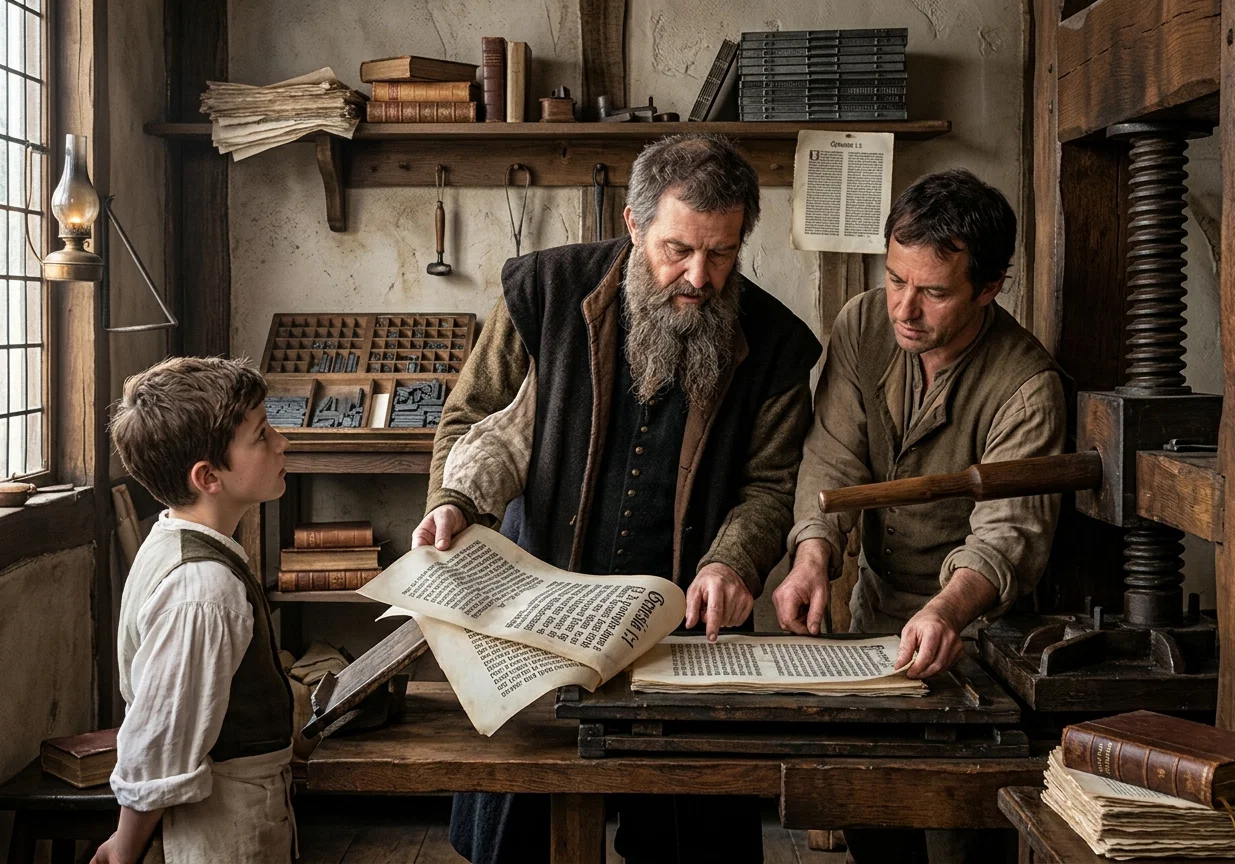
GUTENBERG AT WORK ON THE FIRST PRINTED BIBLE
“All Scripture is given by inspiration of God, and is profitable for doctrine, for reproof, for correction, for instruction in righteousness: that the man of God may be perfect, thoroughly furnished unto all good works. I charge thee therefore before God, and the Lord Jesus Christ, who shall judge the quick and the dead at his appearing and his kingdom; Preach the word.” 2 Tim. 3:16 to 4:2.
From this scripture we learn that the Sacred Writings are profitable for various uses, and that their purpose is to make the man of God perfect, “throughly furnished unto all good works.” The minister of the gospel is therefore charged to preach the Word of God as a sufficient message to those who may be inclined to turn away from the truth and “be turned unto fables.”
Through the prophet John a solemn warning is given against either adding to or taking away from the revelation made through him:—
“I testify unto every man that heareth the words of the prophecy of this book, if any man shall add unto these things, God shall add unto him the plagues that are written in this book: and if any man shall take away from the words of the book of this prophecy, God shall take away his part out of the book of life, and out of the holy city, and from the things which are written in this book.” Rev. 22:18, 19.
While this warning is given with special reference to the book of Revelation, it applies in principle with equal force to all the books which comprise the Bible.
The words of Christ to the Pharisees ought to have special weight in the discussion of this subject:—
“He answered and said unto them, Well hath Esaias prophesied of you hypocrites, as it is written, This people honoreth me with their lips, and their heart is far from me. Howbeit in vain do they worship me, teaching for doctrines the commandments of men. For laying aside the commandment of God, ye hold the tradition of men, as the washing of pots and cups; and many other such like things ye do. And he said unto them, Full well ye reject the commandment of God, that ye may keep your own tradition. For Moses said, Honor thy father and thy mother; and, Whoso curseth father or mother, let him die the death; but ye say, If a man shall say to his father or mother, It is corban, that is to say, a gift, by whatsoever thou mightest be profited by me; he shall be free. And ye suffer him no more to do aught for his father or his mother; making the word of God of none effect through your tradition, which ye have delivered; and many such like things do ye.” Mark 7:9–13.
Every Pharisee was, like the apostle Paul, “more exceedingly zealous of the traditions of my fathers.” While professing great reverence for the Word of God, he did not hesitate to transgress the precepts of that Word if he could find some tradition which would justify such transgression. Such a course was strongly rebuked by the words of Christ, and the conclusion may be legitimately drawn that every so-called tradition should be tested by the Word. This principle has been well stated by the metropolitan of Moscow in Article VIII of his “Comparison of the Differences in Doctrines of Faith Betwixt the Eastern and Western Churches.”—
“The traditions of the church are to be tried by the Holy Scriptures; and traditions respecting articles of faith, which are not to be found in them, ought not to be received; for the Holy Scriptures in many places, forbid the adding of anything whatsoever to the doctrines contained in them.”
It is worthy of notice in this connection that in his teaching and in defending himself against the charges brought against him by the Pharisees, Christ never appealed to tradition, but always to the Scriptures. Thus we find him saying: “Have ye not read what David did?” Matt. 12:3, “Have ye not read?” Matt. 19:4, “Have ye never read?” Matt. 21:16, “Have ye not read?” Matt. 22:31, “Have ye not read this scripture?” Mark 12:10, “Have ye not read in the book of Moses?” Mark 12:26, “Is it not written in your law?” John 10:34, “What is written in the law? how readest thou?” Luke 10:26. Other instances might be cited, but these are sufficient to show that it was the uniform rule of Christ to appeal to the written Word as final authority.
This is the true Protestant principle which was set forth at the very beginning of the Reformation in the sixteenth century:—
“We are resolved, with the grace of God, to maintain the pure and exclusive preaching of his only Word, such as it is contained in the Biblical books of the Old and New Testament, without adding anything thereto that may be contrary to it.”—From the Protest at the Diet of Spires, April 10, 1520, quoted in “History of the Reformation,” D’Aubigné, book 13, chap. 6, par. 13.
It is not surprising that the Reformers, who were coming out of the darkness into light, did not see all things clearly, and that in their teaching they did not repudiate all the errors of Romanism. It remains for the descendants of the Reformers, upon whom a clearer light is shining, to attain to a fuller realization of the principle laid down in the sixteenth century, and to apply to its logical limit the Protestant principle that the Holy Scriptures are a sufficient rule of faith and practice. This will necessarily lead to these results:—
1. All doctrines and practices must be brought to the test of the Holy Scriptures.
2. The statements in any creed must be regarded as entirely subordinate to the teaching of the Bible, and to be tested thereby.
3. Every doctrine and practice which on careful investigation is found to rest upon creed or tradition rather than upon the plain teachings of the Scripture, must be repudiated.
4. No teaching should be condemned as unevangelical which is based upon the authority of the Scriptures, even though it may be out of harmony with some of the modern creeds.
5. In every case the appeal should be made to the Scriptures rather than to a creed or the practice of the church.