The Coming of Christ

5%

Review and Herald Publishing Association · Takoma Park, Washington, D. C. · Apr 12, 1915

FromReview and Herald, Vol. 92, No. 18.

Read the full edition

The Coming of Christ

By Charles R. Erdman, D. D., Princeton Theological Seminary, Princeton, N. J.
The return of Christ is a fundamental doctrine of the Christian faith. It is embodied in hymns of hope; it forms the climax of faith and creeds; it is the sublime motive for evangelistic and missionary activity; and daily it is voiced in the inspired prayer: “Even so, come, Lord Jesus.”
It is peculiarly a Scriptural doctrine. It is not, on the one hand, a dream of ignorant fanatics, nor, on the other, a creation of speculative theologians; but it is a truth divinely revealed, and recorded in the Bible with marked clearness, emphasis, and prominence.
According to the familiar view outlined in this paper, the Bible describes the “second coming of Christ” as personal, glorious, imminent.

His Coming Will Be Personal

By personal is meant all that may be suggested by the words visible, bodily, local; and all that may be contrasted with that which is spiritual, providential, figurative. Of course, the spiritual presence of Christ is a blessed reality; one of the most comforting and inspiring of truths is the teaching that Christ does come to such believers, by his Holy Spirit, and dwells within, and empowers for service and suffering and growth in grace; but this is to be held in harmony with the other blessed truth that Christ will some day literally appear again in bodily form, and “we shall see him” and shall then “be like him,” when “we see him as he is.”
Nor yet did that special manifestation of the Holy Spirit at Pentecost fulfill the promise of Christ’s return. Subsequent to Pentecost, Peter urged the Jews to repent in order that Jesus, whom for a time “the heavens had received,” might be “sent back again”; he wrote his epistles of comfort based upon the hope of a returning Lord, while Paul and other inspired apostles, long after Pentecost, emphasized the coming of Christ as the highest incentive for life and service.
According to the interpretation of others, Christ is said “to come” in various providential events of history, as notably in the destruction of Jerusalem. This tragedy of history is supposed by many to fulfill the prophecies spoken by Christ in his great discourse on the Mount of Olives, recorded in Matthew 24, and Mark 13, and Luke 21. When one combines these predictions, it becomes evident that the capture of the holy city by Titus was a real but only partial fulfillment of the words of Christ. As in the case of so many Old Testament prophecies, the nearer event furnished the colors in which were depicted scenes and occurrences which belonged to a distant future, and in this case to “the end of the age.” When Jerusalem fell, the people of God were not delivered nor the enemies of God punished, nor did “the sign of the Son of man” appear in the heavens, as was predicted of the time when he comes again; and long after the fall of the city, John wrote in Gospel and Apocalypse of the coming of the King.
More marvelous than the scenes at Pentecost, more startling than the fall of Jerusalem, more blessed than the indwelling of the Spirit or the departure to be with the Lord, will be the literal, visible, bodily return of Christ. No event may seem less probable to unaided human reason; no event is more certain in the light of the inspired Scripture. “This same Jesus, which is taken up from you into heaven, shall so come in like manner as ye have seen him go into heaven.” “Behold, he cometh with clouds; and every eye shall see him.” Acts 1:11; Rev. 1:7.

His Coming, Glorious

This coming of Christ is to be glorious, not only in its attendant circumstances, but also in its effects upon the church and the world. Our Lord predicted that he would return “in his own glory, and in his Father’s, and of the holy angels.” Luke 9:26. He will then be revealed in his divine majesty. Once during his earthly ministry, on the mount of transfiguration, there was given to his followers a glimpse of the royal splendor he had for a time laid aside, and in which he will again appear.
As on the great day of atonement the high priest put off his usual robes “for glory and for beauty” and appeared in spotless white when he offered the sacrifices for sin and went into the holy place to intercede for the waiting people, so our great High Priest laid aside the robes of his imperial majesty when stooping from heaven he assumed his garb of sinless flesh, and offered himself as the perfect sacrifice, and entered into the holy places not made with hands to appear in the presence of God for us; but as the high priest again assumed his garments of scarlet and blue and purple and gold when he came forth to complete his work in the presence of the people, so Christ, when he returns to bless, and to receive the homage of the world, will be manifest in his divine glory. Heb. 9:24-28. As he appeared to Isaiah in his vision, to the disciples on the holy mount, to Saul on his way to Damascus, to John on Patmos, so will the Son of man appear when, as he promised, he is seen “sitting on the right hand of power, and coming in the clouds of heaven.” Matt. 26:64.
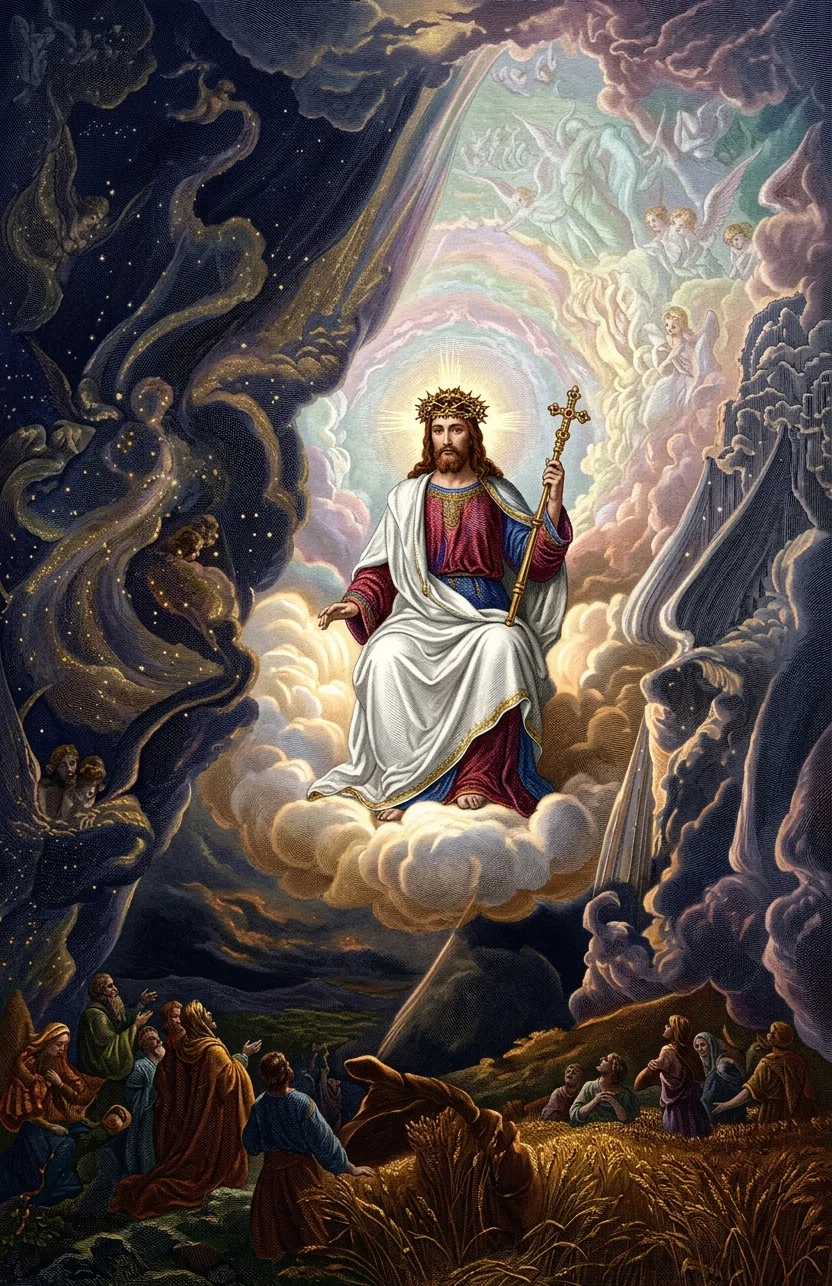
CHRIST COMING ON THE CLOUD TO REAP THE HARVEST OF THE EARTH
Nothing could be more natural than such a triumphant return of the risen, ascended Lord. What a pathetic picture Christ would present in the history of the race, if, after all his claims and promises, the world should see him, last of all, hanging on a cross as a malefactor, or laid lifeless in a tomb! “He was despised and rejected of men;” but he is to return again “with power and great glory,” attended by thousands of the heavenly host. . . .

The Resurrection

The resurrection of the dead will take place when he returns: “For as in Adam all die, even so in Christ shall all be made alive. But every man in his own order: Christ the first fruits; afterward they that are Christ’s at His coming.” The body of the believer is thus to be raised in glory. “It is sown in corruption; it is raised in incorruption; it is sown in dishonor; it is raised in glory.” . . . 1 Cor. 15:22, 23, 42, 43.

Some Christians Will Never Die

Then, too, the bodies of the living believers will be glorified, and made deathless and immortal like the body of their divine Lord. “For our citizenship is in heaven; whence also we wait for a Saviour, the Lord Jesus Christ: who shall fashion anew the body of our humiliation, that it may be conformed to the body of his glory.” Phil. 3:20, 21. Sometimes it is carelessly said that “nothing is so sure as death;” one thing is more sure; it is this: some Christians will never die. One generation of believers will be living when Christ returns, and they will be translated, without the experience of death. What “is mortal will be swallowed up of life.” They never will be “unclothed,” but “clothed upon” with the glory of immortality. “Behold, I show you a mystery; We shall not all sleep, but we shall all be changed, in a moment, in the twinkling of an eye, at the last trump: for the trumpet shall sound, and the dead shall be raised incorruptibly, and we shall be changed.” 1 Cor. 15:51, 52; 2 Cor. 5:4.
That the real coronation day of the Christian is not at death but at “the appearing of Christ” was strikingly suggested by Paul when, realizing that he was to die before the Lord returned, he gave to Timothy his triumphant farewell. “I have fought a good fight, I have finished my course, I have kept the faith: henceforth there is laid up for me a crown of righteousness, which the Lord, the righteous judge, shall give me at that day; and not to me only, but unto all them also that love his appearing.” 2 Tim. 4:7, 8. So Peter encourages pastors to be faithful, by the familiar promise: “And when the chief Shepherd shall appear, ye shall receive a crown of glory that fadeth not away.” . . . 1 Peter 5:1-4.—“The Fundamentals,” Testimony Publishing Co., Chicago, Ill., Vol. XI, pages 87-93.