Japan

6%

Review and Herald Publishing Association · Takoma Park Station, Washington, D. C. · May 6, 1915

FromReview and Herald, Vol. 92, No. 22.

Read the full edition
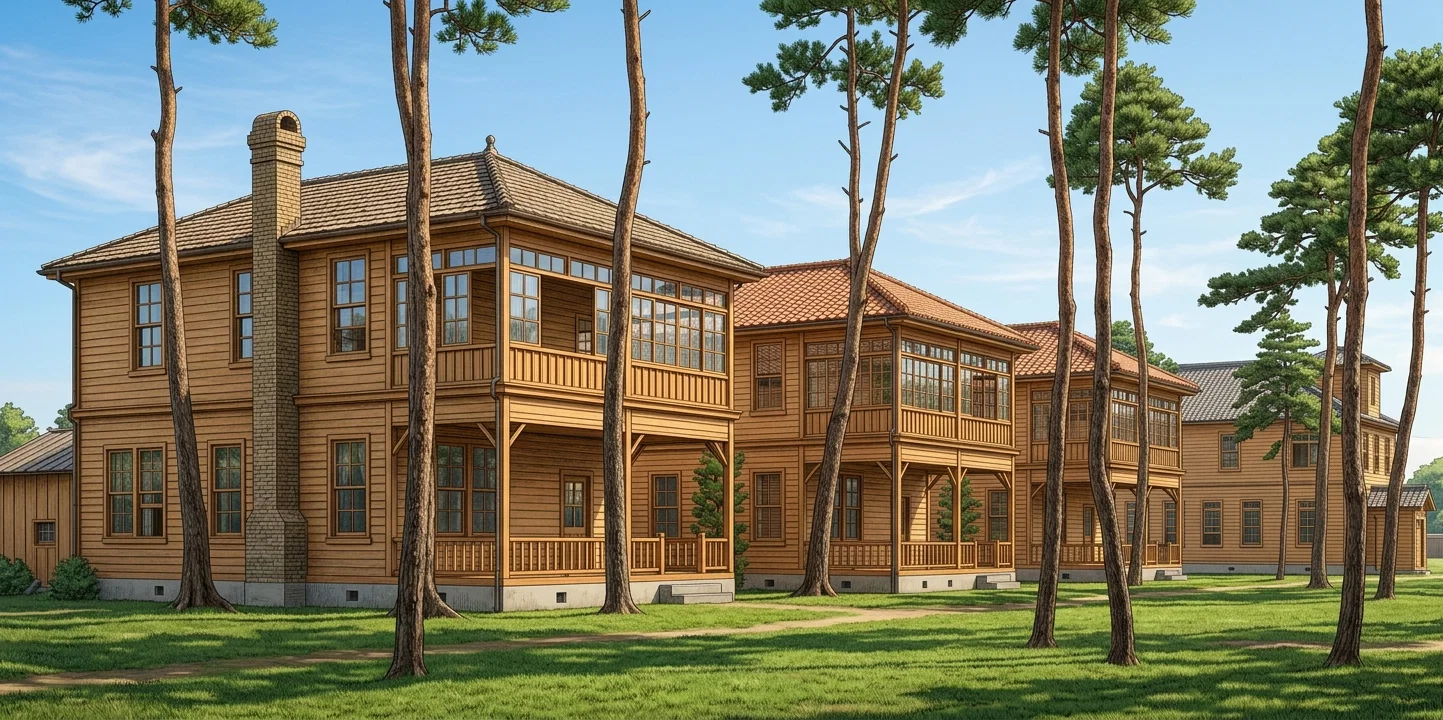
FOREIGN HOUSES IN JAPAN MISSION COMPOUND
House at left, field agent's; center, superintendent's; right, that of the professor in charge of school; school building at extreme right. These houses face the east.
FOREIGN HOUSES IN JAPAN MISSION COMPOUND House at left, field agent's; center, superintendent's; right, that of the professor in charge of school; school building at extreme right. These houses face the east.

Japan

F. H. DE VINNEY
FROM the beginning of the third angel's message in Japan the work has been carried on in rented quarters. For the first few years Elder Granger held a Bible school in his own home, first in Azabu and afterwards in Shiba, both sections of the city of Tokio.
When Brethren Wade and Burden came to Japan, they opened a school in Uyeno, another division of the city, where they continued until forced to move by the sale of the rented building. Brother Wade then leased land at Hongo, and built a small one-story house for his own use, using the front room for a school and for Sabbath meetings. This work continued for a time under Elder Field, who bought the house when Brother Wade returned to the United States.
In 1904 Elder Burden moved to Sendagaya, another suburb of Tokio, made convenient by a new electric car line, and leased land and built a good-sized foreign dwelling house, with an upper and a lower flat. In the previous year the mission began the publication of the little paper, the Owari No Fukuin (Gospel of the Last Days), the mechanical work being done by different printing houses of the city.
In 1906 the lower floor of Brother Burden's house was rented, a small press, type, and other fixtures were bought, and by the help of a Korean and two Japanese brethren, who had had some experience in printing, a beginning was made on the work of printing our own literature.
From the results of the Bible schools and other work, some young men were in the field as Bible workers and canvassers; but the need of better training for successful work was apparent, and they were called in for institute work for three months during the winter.
The press was moved into the cellar, lighted by two small windows on a level with the ground outside, and entered by a trapdoor in the floor, under which a ladder-like staircase had been provided.
The institute work occupied the sitting and dining rooms.
The type cases were set up in a bedroom, and the printers lived in the kitchen.
The editorial work, folding, etc., were done in the rooms where the institute was held, when it was not in session.
It being the only suitable place which could be procured, the meetings of the Tokio church were held in the same rooms on the Sabbath and in the evening during the week.
The institute developed into the training school, and from a session of three months into one of six months, which increased the difficulties of carrying on the work of three institutions in the same rooms of an ordinary dwelling house. But the Lord blessed, and the work prospered and developed, as every one connected with it kept sweet under the trials and did his best. The first relief from this situation came in the autumn of 1913, when a large Japanese house was secured for the school, with other buildings within convenient distance which served as dormitories for the students. The next year, the sale of the Burden house being imminent, a building which had been used as a dye-house was rented, and the printing plant moved into it. This served very well until the new quarters were ready in November of the following year. The sale of the former quarters not being consummated, for its next session the school—this year as an institute for all workers—was moved back into its old quarters.
In March, 1910, a small piece of land was secured by the mission, in Yotsua, another division of Tokio, and held by contract by one of the Japanese mission laborers, as the law of Japan does not permit foreigners to hold property under deed. But this plan of holding property was not considered best, and changing conditions made it impracticable to build upon it, though the money to do so was available through the Three-hundred-thousand-dollar Fund, and the generous apportionment made for the needs of Japan.
Some years ago an attempt was made to secure from the Japanese government a shadon, or the right to hold land by deed for charitable and benevolent purposes, by an appointed committee of the mission. This is in harmony with the Japanese law and with the treaty withthe United States, and nearly all the other missions have been given this privilege; but our shadon not being strictly made out in proper form, the authorities took the truly Oriental form of disposing of the matter by not doing anything with it. So it was decided to attend strictly to our evangelistic work as best we could under the conditions, until the government was satisfied that we were not connected with anything but purely Christian work, and had no part in politics of any description.
Two years later the matter of the shadon was placed in the hands of a lawyer, himself a Christian and an ex-judge, and application made in due form. At the request of the authorities, this was amended and changed until they expressed themselves as satisfied with the application; but all this consumed nearly two years, and no answer was made. Learning that we could hold land under 999 years' lease, we finally decided to secure land in this way, and not wait longer for the decision of the government.
(To be continued)