The Priesthood of Christ

2%

Review and Herald Publishing Association · Takoma Park Station, Washington, D. C. · Aug 3, 1916

FromReview and Herald, Vol. 93, No. 38.

Read the full edition

The Priesthood of Christ

R. W. PARMELE

A Typical Service

BEFORE God pronounced sentence upon the first pair for their transgression, he announced to them the way of escape that had been provided. He told them that the seed of the woman should bruise the serpent's head. Gen. 3:15. By this announcement they were to understand that one was to come who would destroy the devil and his works. We may readily infer that from that time forward the service which typified the coming of that Seed, was performed by them and their children.
The first mention in the Bible of a definite typical service is found in Gen. 4:3-5: “In process of time it came to pass, that Cain brought of the fruit of the ground an offering unto the Lord. And Abel, he also brought of the firstlings of his flock and of the fat thereof. And the Lord had respect unto Abel and to his offering: but unto Cain and to his offering he had not respect.”
“By faith,” says the apostle, “Abel offered unto God a more excellent sacrifice than Cain, by which he obtained witness that he was righteous, God testifying of his gifts: and by it he being dead yet speaketh.” Heb. 11:4.
“Without shedding of blood is no remission.” Heb. 9:22. Abel's offering was made in faith, and was acceptable for that reason. In the death of that innocent victim, he saw a type of the blood that was to flow from the pierced side of the Lamb of God.
Traces of sacrificial service before the exodus may also be found in Gen. 8:20; 12:7; 22:9-13; and 35:1-3. These texts indicate that the father was the priest of the family; and it is generally conceded that upon the death of the father the priesthood fell to the eldest son, as a part of the birthright.

From the Exodus to the Cross

During the patriarchal age the priesthood was not confined to any particular tribe, nor the service to any particular place; but in the organization of the church in the wilderness, the Lord directed that the priests should be of the family of Aaron, who was of the tribe of Levi; hence the term so commonly used, “Levitical priesthood.” God directed also that his people should build him a sanctuary, where alone sacrifices were to be offered.
This sanctuary was a tent about eighteen by fifty-four feet, divided into two rooms. The first room of this tent was about eighteen by thirty-six feet, and the other about eighteen feet square. There were two curtains, made of the same material and of nearly the same pattern, one serving as an outer door of the tent, or sanctuary, and the other separating the two rooms; that is, between the holy place, or first apartment, and the most holy, or second apartment. The curtain forming the partition between the two rooms Paul calls “the second veil.” Heb. 9:3.
Inasmuch as there could not be a “second veil” without a first, the apostle evidently regarded the curtain which formed the outer door as the first veil; and as Paul himself was a Jew, and was addressing his epistle to the Hebrews, we may conclude that these curtains were so regarded by the entire Jewish people. So, in this article, we will, for convenience, use these terms to designate the two curtains.
This tent, or sanctuary, was surrounded by a court. In this court of the sanctuary was an altar, made of brass, upon which the sacrifices were offered. The first apartment of the sanctuary contained the candlestick, and the table of showbread, so called “because it was ever before the face of the Lord.” (See “Patriarchs and Prophets,” page 354.) This would seem to indicate the abiding presence, in some sense, of the divine Being in the first apartment. This room—the first apartment, or holy place—also contained the altar of incense.
In the second apartment, or most holy place, was the ark—a wooden chest overlaid with gold, the cover of which was called the mercy-seat, upon which stood two cherubim made of gold. The tables of stone on which were written the ten commandments were deposited in this sacred chest, or ark.

The Service

Daily throughout the year sacrifices were offered for the sins of the people, on the altar of burnt offering; but the climax of the service was reached on the tenth day of the seventh month. Continually came the children of Israel with their sin offerings. In figure the guilt of the worshiper was transferred to the innocent lamb, as with hands upon its head the transgressor confessed his sins. Then the blood of the lamb was shed. This blood, figuratively laden with the sins of the penitent, was poured out at the bottom of the altar. Thus throughout the year the sins of Israel accumulated in the sanctuary, until upon the tenth day of the seventh month the order of the service was changed, and the “cleansing of the sanctuary” took place. Leviticus 16.
The Lord frequently met with his people, but not always in the same place. His presence was seen on Mount Sinai (Exodus 20); he came and stood at the door of the tabernacle (Ex. 29:42, 43; 33:9, 10); he was also seen at the threshold of the house (Eze. 10:4) and over the cherubim (verse 18). From the first chapter of Ezekiel we learn that he sits upon a movable throne; and the psalmist tells us that he “did fly.” Ps. 18:10. But on the tenth day of the seventh month, he appeared specially in the most holy place of the sanctuary, between the cherubim, upon the mercy-seat. Lev. 16:2.
There were many rites connected with the sanctuary service, but of these, three parts of the service were especially full of meaning; namely, (1) the offering on the altar; (2) the ministration in the first apartment; and (3) the ministration in the second apartment. These were in consecutive order, and could not occur out of turn. The offering must first be made before there could be a ministration, then the service in the first apartment must follow, and the climax was reached in the ministration in the second apartment. Each yearly round of service was in itself a complete type of the ministration of Christ (see Heb. 8:1-5; 9:23, 24; 10:1); so we may expect to find in the ministration of Christ exactly the same order observed as in the type.

Type and Antitype

In the earthly sanctuary the service began with the sacrifice on the altar, and the ministration followed in the first apartment of the sanctuary, and later in the second apartment. So the service of Christ, our High Priest, began when he offered himself for us all; then his ministration followed in the first apartment, and later in the second. This will appear as we further study the type.
Three times during the year Israel was to gather at the sanctuary. Ex. 23:14-17; Deut. 16:16; Leviticus 23. These three occasions were the celebration of the Passover, the feast of Pentecost, and the day of atonement. Let us consider the significance of these general gatherings.

The Passover

Israel's bondage in Egypt was revealed to Abraham, as recorded in Gen. 15:9-16, and he was told the length of time that it would continue. In Ex. 12:17, 41, we learn that Abraham's descendants came out of Egypt four hundred and thirty years later, on “the selfsame day.” On that night the Passover service was instituted. This was observed yearly until the crucifixion, when “Christ our Passover” was sacrificed for us (1 Cor. 5:7), on the very day of the Passover. See John 13:1. The Passover was the first of the three special occasions in the year to which we have referred; and the sacrifice of Christ, “our Passover,” was the antitype of that service.

Pentecost

Beginning from the Passover, seven weeks were numbered, and the day following was set apart for the new meat offering, when the people returned again to Jerusalem and celebrated the feast of harvest, or the feast of weeks; that is, the Pentecost, or the fiftieth. The risen Christ, with the saints who were raised with him, remained in Jerusalem for forty days, “speaking of the things pertainingto the kingdom of God.” Matt. 27:51-53; Acts 1:3. Christ instructed the disciples to remain in Jerusalem and wait for the outpouring of the Spirit of God, the promise of the Father. The record of the fulfilment of this promise “when the day of Pentecost was fully come,” is given in Acts 2:1-4. This was the antitype of the feast of Pentecost that had been observed for so many years in Israel.
Explaining this event, Peter said, as recorded in verse 33, that Christ “being by the right hand of God exalted, and having received of the Father the promise of the Holy Ghost, he hath shed forth this which ye now see and hear.” A mistaken idea has led some to believe that before this outpouring of the Spirit, Christ had entered into the second apartment, into the most holy place of the heavenly sanctuary; but such a view would spoil the type. The high priest in the earthly sanctuary entered the most holy place only once a year, and that was at the year's end, a long time after the Pentecost, and never between the Passover and the Pentecost. This thought will be more clearly developed as we proceed.

The Atonement

The blowing of trumpets on the tenth day of the seventh month announced that the time for the cleansing of the sanctuary had come. As we shall see presently, the prophecy of Daniel made known the year when the real cleansing of the real sanctuary, “the true tabernacle,” would begin; and the type made known the very day.
Thus the three annual feasts, so strongly emphasized among the children of Israel, constituted a miniature representation of the three great parts in the ministry of Christ; namely, (1) his crucifixion, our Passover; (2) the beginning of his ministry in the first apartment, the sacrifice being accepted by the Father, as announced by the outpouring of the Spirit on the day of Pentecost; and (3) the closing service in the second apartment, the year for the beginning of this work having been given in the prophecy of Daniel, and the day in the type.
The priest was to enter the most holy place only once a year (Lev. 16:2), and alone (Heb. 9:7). The Passover and Pentecost must first be celebrated, and then, after a lapse of some time, came the atonement, on the first day of the seventh month, when the high priest passed within the second veil. So in the antitype, Christ is first slain as our Passover (1 Cor. 5:7); then comes the Pentecost, at the beginning of his ministration in the first apartment of the “true tabernacle;” and after a space of time—in the type about four months—he enters the most holy place. In the earthly sanctuary the service was progressive, beginning at the altar, from which the blood of the sacrifice was carried into the first apartment, where the ministration began, and culminating on the tenth day of the seventh month in the second apartment. To believe that Christ, or any other, was a priest in the first apartment of the heavenly sanctuary before the crucifixion, would disarrange this order, and start the priest upon his ministration before the blood was shed and the offering made. See Heb. 8:3. And to teach that Christ entered the most holy place at his ascension would place the atonement between the Passover and Pentecost, in flagrant violation of the type. The divine order must not be thus changed.

Our High Priest and His Ministry

Qualifications

When Jacob felt himself cut off from God, the Lord gave him hope through the vision of the mystic ladder, evidently referring to the connection between man and God to be found in Christ. John 1:51. Christ bridged the gulf that sin had made. It is evident that he who would mediate for man must identify himself with man. 1 Tim. 2:5; Heb. 2:14; 5:1, 2. Thus he “can have compassion on the ignorant, and on them that are out of the way.”
In order that Christ might become “a merciful and faithful high priest,” he was in all points “made like unto his brethren.” Heb. 2:17. “And being found in fashion as a man, he humbled himself, and became obedient unto death.” Phil. 2:8. He learned this obedience by the things which he suffered (Heb. 5:8, 9), and he thus obtained the perfection necessary (Heb. 2:10) to qualify him for his work. (See also verses 17 and 18, and chapter 4, verses 14 and 15.)
From this it is manifestly evident that Christ could not be our high priest before he obtained this fitting for the office. Furthermore, as in the type the ministration followed the sacrifice of the victim, so the offering must first be made. In the type the priest bore the basin of blood from the altar, where the victim was slain, into the sanctuary. So “by his own blood he entered in once into the holy place, having obtained eternal redemption for us.” Heb. 9:11, 12. So it is clearly evident that the sacrifice of Christ must precede his ministry in the true tabernacle.

Change of the Law

Still another act was necessary in order that Christ might become a priest. In the type the priests were without exception to be of the tribe of Levi; but “it is evident that our Lord sprang out of Judah; of which tribe Moses spake nothing concerning the priesthood.” Heb. 7:14. So, in order that Christ might become a priest, “there is made of necessity a change also of the law” of the priesthood. Verse 12. This change no one would claim took place prior to the crucifixion. And as Christ could not become a priest without this change of the law which directed that the priests should be of the tribe of Levi, it is evident that none other could. Therefore, before the law was changed, there could be, according to the type, no ministration in the heavenly sanctuary, or the minister must have been of the tribe of Levi. And if there was a ministration carried on in the true tabernacle by one of the members of the tribe of Levi, “what further need was there that another priest should rise?” Heb. 7:11.

“Being Come a High Priest”

The law governing the priesthood being changed to admit of a member of the tribe of Judah becoming priest, that One of the tribe of Judah having qualified, by identifying himself with mankind, the sacrifice having been slain, Christ our High Priest ascended to the sanctuary and entered upon his ministry. Does the Bible testify that he began his ministry, as did the priest in the type, in the first apartment?
In Heb. 1:3 we read that after his sacrifice for us, Christ “sat down on the right hand of the Majesty on high.” But where was the Majesty on high when Christ sat down by him? In the type, God sometimes met with his people “at the tabernacle door.” Ex. 29:42, 43; 33:9, 10. He was seen by Ezekiel, as recorded in the first chapter of that book, moving about on a throne borne by four living creatures. On the day of atonement he met with them between the cherubim above the mercy-seat. Where was he at Christ's ascension?
John tells us in the fourth chapter of Revelation that he saw a throne in heaven, around which were four and twenty elders and four beasts,—properly translated, four living creatures, the same as in Ezekiel 1,—and before the throne stood seven lamps of fire. In the midst of this throne John saw Christ. Rev. 5:5, 6. There can be no doubt that the twenty-four elders were from the company who were raised from the dead at the time of Christ's resurrection, and were taken to heaven with him. Matt. 27:52, 53; Eph. 4:8; Rev. 5:8-10. They had been made “priests.”
David divided the priests into twenty-four courses. 1 Chron. 24:2-5. The priests composing those courses were not all to go into the most holy place of the sanctuary. Only the high priest entered there, and he only once a year. Neither was the golden candlestick with its seven lamps of fire set in the most holy place, or second apartment, but in the holy place, or first apartment. To be true to the type then, where must Christ have been when John had this vision of him?—In the first apartment, assuredly.
In the type the priests ministered three hundred and fifty-nine days of each year in the first apartment, and on the last day of the year the high priest himself, ministering alone, completed the yearly round of the service in the second apartment. Just as in the type, Christ, having made the offering, passed with his own blood within the first veil of the heavenly sanctuary. There our faith follows him. Then at the time indicated by the prophet Daniel, our High Priest went into the second apartment, or within the second veil, and our faith beholds him there interceding for us. Our faith centers in him. Where he is, there ourfaith has entered, and thus it is that we have “an anchor of the soul, both sure and steadfast, and which entereth into that within the veil” (Heb. 6:19)—first, within the first veil, and later within the second veil. Paul could not designate which veil, for when the ministry changed, the veil also would change; so it is left for the worshipers, by the study of the prophecies and from the period of time in which they themselves live, to determine within which veil their faith enters. The apostle's faith entered within the first veil, for Christ was then there. Ours enters within the second veil, where he is now ministering, as is shown by the type and by—

Daniel's Vision

It is not possible in the limited space of this article to consider exhaustively the prophecy that locates the time of the entrance of our High Priest into the most holy of the “true tabernacle” to perform the closing service of his ministry. For such a treatise the reader is referred to other publications by this office. A very brief survey of the prophecy must suffice us.
The eighth chapter of Daniel presents a line of prophecy, the greater part of which is explained by the angel Gabriel in the same chapter. In the fourteenth verse of this chapter it is recorded that Daniel heard the words spoken, “Unto two thousand and three hundred days; then shall the sanctuary be cleansed.” Of those twenty-three hundred days the angel said in the twenty-sixth verse of the chapter, “The vision of the evening and the morning which was told is true; wherefore shut thou up the vision; for it shall be for many days.”
In the ninth chapter it is recorded that the angel was sent again in response to Daniel's supplication, and commanded him to “understand the matter, and consider the vision.” Dan. 9:23. The angel then begins an explanation of the time prophecy given in the preceding chapter, in which he shows that the days would begin “from the going forth of the commandment to restore and to build Jerusalem.”
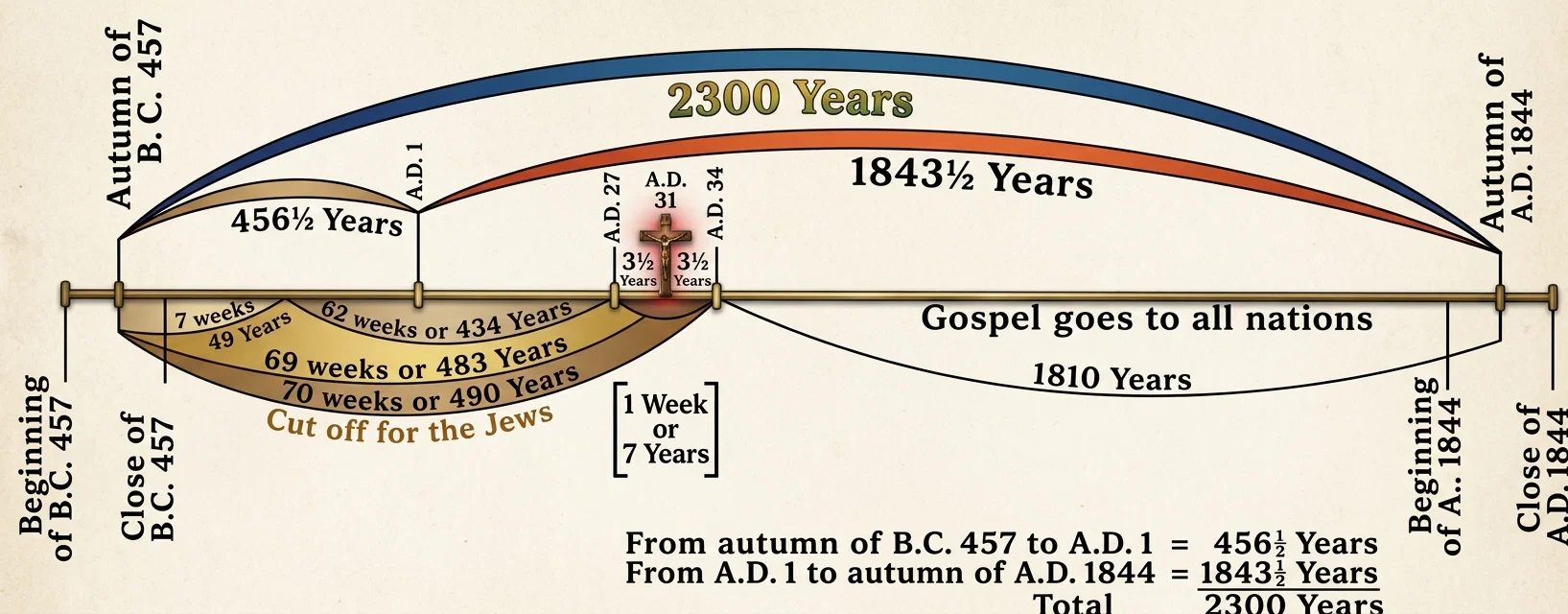
“The commandment to restore and to build Jerusalem” went forth in the year 457 B. C.,—approximately four hundred and fifty-six and one half years before the beginning of the Christian era, as is shown by Ezra 7:7-13. Each day of symbolical time should be reckoned as a year, as is shown by Ezr. 4:6. This prophecy of Daniel's being symbolical, we should understand that years are meant. Sixty-nine weeks, or 483 days, or as many literal years, would bring us to Messiah, or the anointing of Christ. John 1:41, margin; Acts 10:38. Jesus was anointed with the Holy Ghost at his baptism. Luke 3:21-23. By comparing marginal dates in Ezra 7:7 and Luke 3:21, it will be seen that the period between them is exactly 483 years, when it is remembered that a part of the year 457 B. C. had gone, which would run the time beyond the end of A. D. 26, nearly half a year into A. D. 27.
Further subdivisions are given in the angel's explanation of these prophetic days, by which the vision is “sealed,” or made sure; but this will suffice for our purpose to show that the year 457 is the proper date from which to begin the reckoning. Twenty-three hundred years from that date bring us to the year 1844 A. D., at which time, according to the prophecy, the sanctuary was to be cleansed. The accompanying diagram will make this reckoning more clear.
The cleansing of the sanctuary referred to in this prophecy could not mean the cleansing of the earthly sanctuary, for at the end of the twenty-three hundred years it had long since ceased to exist; and while it did exist, that service was to be performed annually. The prophecy could refer, therefore, to none other than “the true tabernacle, which the Lord pitched, and not man.” Of that cleansing the apostle Paul says, in Heb. 9:23, 24:—
“It was therefore necessary that the patterns of things in the heavens should be purified with these [the sacrifices they offered]; but the heavenly things themselves with better sacrifices than these. For Christ is not entered into the holy places made with hands, which are the figures of the true; but into heaven itself, now to appear in the presence of God for us.”
Thus Daniel gives the year, and the type gives the very day, when Jesus, our great High Priest, began his closing work,—that work fixed by the type on the tenth day of the seventh month.
Day after day, during all these years since Christ entered upon his priestly work, the sins of penitents have been brought to “the true tabernacle” by confession. They have been literally transferred to the head of our Offering, or Sacrifice, who is in the heavenly sanctuary. The time has now come when those sins must be transferred to the head of the antitypical scapegoat,—the devil,—who caused us to commit them, and whose guilt is not covered by the divine atonement. This is the closing work of the ministry of our High Priest, and it has been going on since 1844. How much longer will it continue?
Mercy was offered to Israel until the service of the day was ended; but he whose soul was not afflicted in that day was cut off. Our great High Priest is now engaged in the solemn work of that antitypical day. When that work is done, his mediation will close, and the fiat will go forth, “He that is unjust, let him be unjust still.” Rev. 22:11. Then from many lips will be heard the bitter wail, “The harvest is past, the summer is ended, and we are not saved.” Jer. 8:20.