The fall of mighty Rome, whose walls had for centuries contained the power of empire, left free the tide of civilization and progress to roll northward and westward. While the north was awakening to accept its new-found privileges, those nations of southern Europe whose languages and civil existence had been nourished by Latin influences, were exerting a mighty influence upon the world. These are the countries embraced in the Latin Union; namely, France, Italy, Spain, Portugal, French Belgium, French Switzerland, Algeria, and Tunis.
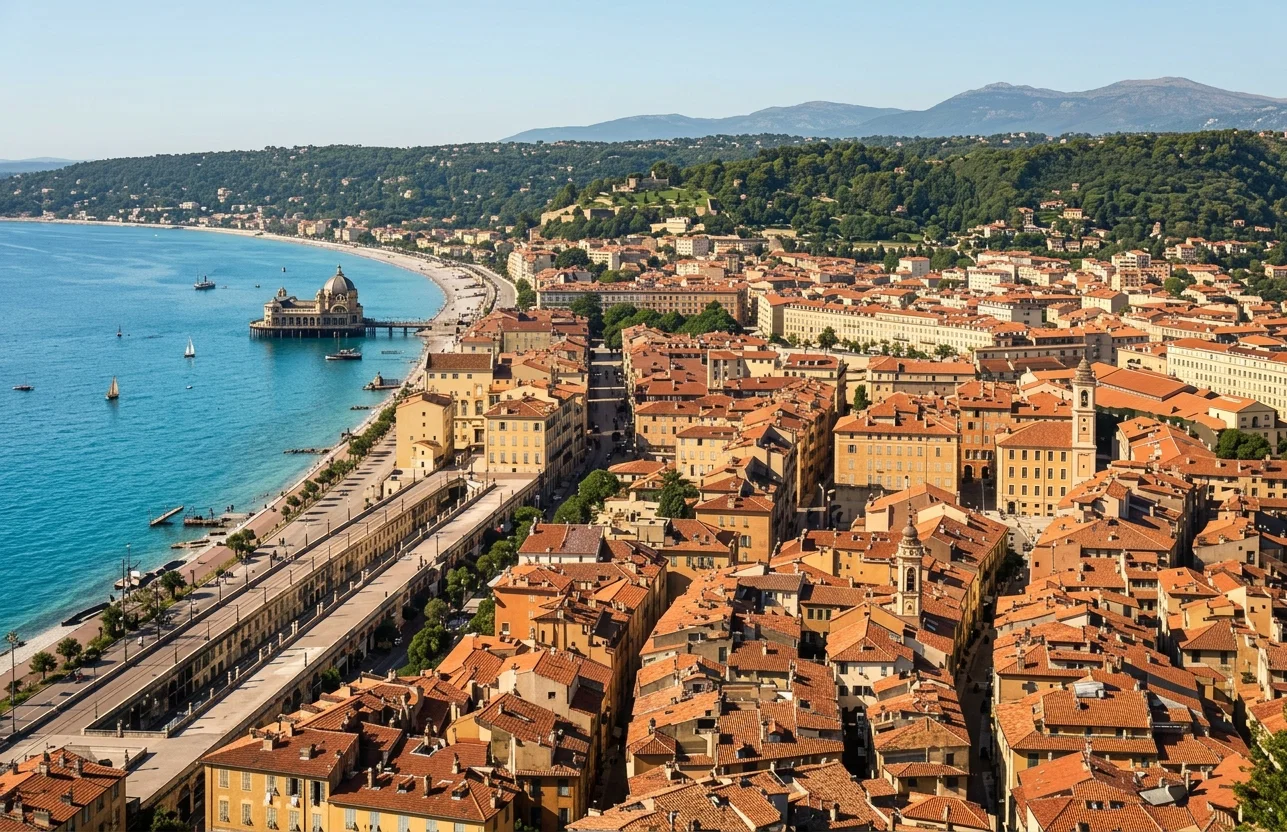
CITY OF NICE, FRANCE
At the time of my arrival, July 4, 1901, the entire number of Sabbath-keepers in that field was 451. The Latin Union was definitely organized July, 1902, the number of Sabbath-keepers being 531. During the General Conference period just past, the membership has risen from 575 to 683—an increase of 108. If such a gain was made in the last two years, with small beginnings and few workers, what a golden appearance would that field now present if work equally aggressive had been carried on since the death of Brother Andrews. Thus wrote Sister White in 1885: “We must have books and pamphlets in the French and Italian languages. We are moving altogether too slowly in this respect. Time is passing. Workers who are willing to enter these foreign fields, either as evangelists or translators, should be selected at once.”—“Mission Sketches,” 249.
Teeming with one hundred and six million inhabitants, the Latin Union is the second largest of the union conferences. Though seemingly bound in the chains of Rome, the nations of the Latin Union have been, in the last four years, turning toward the light. The Spirit of God has been breathing upon the dead bones, and they are awakening to newness of life.
France
The inauguration of the French camp-meetings last year marked a new era in the work in France. They gave birth in the hearts of the brethren to a definite determination to move forward as one body in the advancement of the truth among the people of this language. In France, to-day, with its forty millions, there is but one ordained minister, and only four other laborers. In addition, the great French colonial empire of some forty-two million people, has absolutely no worker whatever.
Here is a great nation; and she is struggling toward the light. Shall she go unaided? Shall we make no effort to augment the force of the devoted workers who are now standing one laborer to eight million? In this stretch of territory, covering over two hundred and seven thousand square miles, five laborers would be barely enough to give even a little time to visit and comfort the seven hundred and fifty-four Sabbath-keepers in this country. In one thriving manufacturing city of the south I stopped to speak words of encouragement to a few who were investigating the truth. Having preached, like Paul, till midnight, I was conducted to the home of a wealthy Catholic widow, who was waiting to show me to my room. “Shall we pray before retiring?” I asked her. She consented. Next morning, upon leaving early, she stopped me. “Sir,” she said, “won’t you pray as you did last night?” and she threw herself on her knees, raising her clasped hands before my face. As I finished, she said, “Sir, you must be a prophet. We don’t hear such prayers as those in our church. Won’t you come and teach your faith to my household and my people?” But the opportunity to return never presented itself. It would be impossible to enumerate the calls for workers which now arise from all sides in France. It is imperative that something be done for that field.
Italy
More simple-hearted and more religiously inclined than the French are the people of Italy. Though lying under the dark shadow of Rome, yet perfect freedom for the preaching of the gospel exists. This country is a stronghold yet to be won from the enemy.
Even as early as 1877 there were Adventist churches and believers in Naples. This work was neglected, and these lights have gone out. But in the ancient city of Rome Brother Everson found a regularly organized church of Italians who observe the Sabbath. These have a number of points in common with Seventh-day Adventists, though their origin and present organization have no connection with Adventists. They are a banner of encouragement hung out by God, to convince us that the truth can break the undisputed control of Satan over this land.
After the organization of the Latin Union, a call was made for a gospel worker for Rome, who would develop Italian interests. Brother C. Everson and his wife and sister-in-law, Mrs. Schell, were sent in response to this call. They have been engaged in the study and acquisition of the language. Their work has already developed many items of encouragement. Some canvassing work has been started, but hardly enough even to be called a beginning; yet what has been done is encouraging.
The total number of Sabbath-keepers18to-day in Italy is forty-five. These are mostly in the north, among the descendants of the ancient Waldenses. Of these children of the noble past, there are some 40,000. The total population of Italy, however, is 32,475,253; while the number of laborers is five. Two of these are young French brethren, just sent to join Brother Everson in the work. One is a pupil of the Paris school. Thus into the city of Rome itself, in possession of that great Antichrist, whose power is seasoned by time and fortified by the wisdom of ages, a little band of workers has pushed its way. There they are standing, one laborer to six million people. But He who can save by many or by few has heard the prayers of his people in behalf of this land, and he will yet grace his courts with those from this land who have washed their robes and made them white in the blood of the Lamb.
Spain
What little had been accomplished by gospel workers in this benighted nation, until the time of our coming, reads like the story of the miracles of dark heathendom, in the days of the apostles.
Spain was first entered in the early spring of 1903, when a committee, composed of J. Vuilleumier, J. Roberts, and B. G. Wilkinson, was chosen to visit the land and secure information looking toward taking possession.
One year later, Brethren Frank and Walter Bond, who were in London as canvassers, and who had a working knowledge of the Spanish, were selected to go to Spain. They were immediately put in relation with a gentleman whose acquaintance we had made in Barcelona. They arrived in Barcelona in July, 1903, and two months later moved to Sabadell. Here a small school for the youth was opened. Meetings were held, in the schoolhouse, the only possible place, as under the influence of the Roman Church the people refused to rent any available place for Protestant meetings. The result of their labors was that a number became interested in the truth, and three or four decided to obey. About this time Brother and Sister Robinson, who were laboring in Wales, and who also knew the Spanish, were invited to come to help. A little later I was called to administer the rite of baptism to three of the converts. It was a day of joy on earth, as well as in heaven, when three believers humbly stepped into the water to be buried to this world. And it was a night of spiritual fellowship, when, on the cement floors, and in the dim light of the lamp, the proud Spaniard stooped to wash the feet of his American brother, with tearful eye. The Spanish friends and brethren arose with the request that, wherever I should go, I should give Christian greeting from them to their brethren in the faith. To you, therefore, of like precious faith, I bring these greetings from your brethren in Spain. These first-fruits are precious in the eyes of the Great Shepherd of the sheep. May he guard them with his tender care, until they can behold a large company of redeemed from this nation, and say, “Not man, but God, this work hath done.”
Portugal
God did not forget Portugal, if we did. In 1755 his message of approaching judgment was clearly seen and read in the great Lisbon earthquake. That generation passed away, and still we did not go to explain to them these things. The next generation had grown gray before the messenger of the truths of the third angel landed upon their shores. Last fall Brother and Sister Rentfro were directed to turn their course from Spain, whither they were journeying, and go to these unwarned and judgment-bound Portuguese. It was not because Spain’s need was small, for the departure of the Brethren Bond had left Brother Robinson alone in Spain—a single worker for seventeen million people. We pray that the blessing of God will greatly rest upon this newly entered country, in the southwestern corner of Europe.
Algeria and Tunis
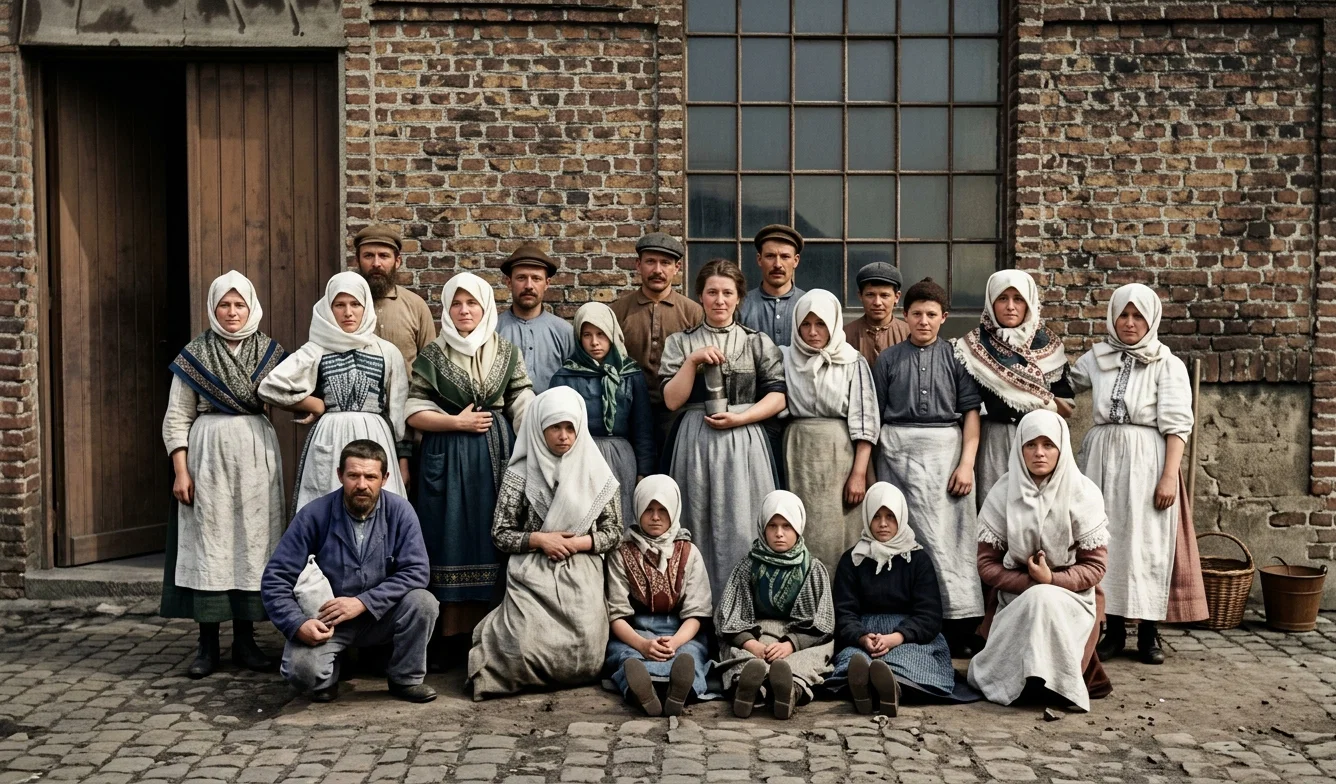
COAL SORTERS, BELGIUM
Before I leave the Mediterranean basin, there is one other part of the world that God so dearly loved which I ought to mention. That is Algeria and Tunis. With an area larger than France itself, and a population of 6,639,300, or about as much as the combined population of the Pacific and Northern Union conferences, this field still waits to receive the messengers of truth. Yet it is a favorable field. Years ago we had a company of believers at Oran, on the northern coast. But these poor brethren were left like sheep without a shepherd, and now they are dispersed, and gone.
Algeria is well supplied with railways, which bring all points of the country in touch with one another. And now that Morocco, its gigantic neighbor to the west, with its eight millions, has come under French influence, the importance of Algeria may be seen at once. This important country stands with friendly hands held out to all. Here is a splendid opportunity to reach the great Arabic race, which stretches eastward across Tunis, Egypt, and into the great Mohammedan lands of Asia. Starting in the south of Africa, God has gradually drawn the truth northward, until all that is needed in order that the messengers of the third angel may clasp hands from Cape Town to the blue Mediterranean, is the entering of the countries of the north. We trust that Egypt will secure all the help she calls for. And while ambassadors of light are hastening to the land of Ham, let us speed on the day when the Libyans to the west may hear of Him who waits to bless them with his grace.
French Belgium
Lying to the north of France is the small kingdom wherein the French race shades off into the German. This is Belgium. Its French-speaking population numbers over three million. A very difficult field is this. The vast coal-mines, the large number of glass works, have operated to diminish the morality of the country. The inhabitants themselves call it “the black country.” Only one Seventh-day Adventist worker in this country! If they only had some loving messengers, who would teach them how, by faith in God, to live a different life, what a brazen serpent might be lifted up, upon which the wounded, agonizing, and dying might lift their eyes, and be healed.
The country has for centuries been enveloped in the thick cloud of Catholic superstitions. It was to draw the people from their miseries that our beloved Brother Grin laid down his life amid them. The Lord has blessed the effort in the large city of Liege, wherein sixteen have been baptized and added to the church. After the work in Liege, Brother Grin went to Charleroi, another large city. Here our brother labored day and night, pleading with the people to turn. He gathered around him a number of interested ones. But his health was failing rapidly. His wife and friends urged him to flee to Switzerland, at least for a rest. He resolved to do so, but tarried yet a while, for some souls seemed trembling in the balance. When at last he took the train for Switzerland, it was too late. He passed to his final rest at Basel, leaving behind in Belgium a wife and two children. Though his death has been reported before, yet we stop a moment to pay a tribute to his memory. He was a noble man. By his death the church lost a devoted worker, the home a loving father, and Belgium a needed missionary. Among those whom he interested in the truth were a prominent railroad man and his wife. This lady was quite wealthy. And dying last year, she left express provision in her will that money should be placed aside sufficient to purchase land and build upon it a stone chapel for Seventh-day Adventists.
A year ago last summer, Elder Curdy was sent to Belgium to take up the work of Brother Grin. Last year he reported20aggressive work could be entered upon in many fields.
The report of the committee was adopted.
Further resolutions were introduced and adopted, as follows:—
Whereas, The Washington Training College has freely granted the use of its buildings to the General Conference during this session; therefore,—
80. Resolved, That we express our thanks to the Washington Training College for their generous help in this respect.
81. Resolved, That we express our thanks to the railways for their courtesy in the granting of reduced rates to delegates attending the conference.
82. Resolved, That we extend our thanks to the various conferences which have supplied tents for the use of the conference, paying the freight as well as loaning the tents freely.
Whereas, The book “Christ’s Object Lessons” contains truths of vital importance for this time,—
83. We recommend, That the book be studied anew by our people, and sold on its own merits, that our ministers do their utmost to renew the interest in this work, and that it be carried forward steadily and continuously; and further,—
84. We recommend, That our schools be urged to lead out in this revival.
The nominating committee made a further and final report, as follows:—
For members of the General Conference Committee: H. R. Salisbury, C. H. Jones, J. E. Froom.
Legal trustees of the Mission Board: A. G. Daniells, W. A. Spicer, S. N. Curtiss, H. W. Cottrell, I. H. Evans, G. A. Irwin, G. M. Chaffee, W. W. Prescott, C. H. Edwards.
The finance committee made a further report as follows:—
Whereas, The General Conference, the General Conference Corporation, and the General Conference Association, each are in need of funds with which to meet obligations; and,—
Whereas, There are so many calls upon our people for donations for various enterprises that we do not feel to lay this burden directly upon them; therefore,—
We recommend, That the treasurer of the General Conference be instructed to place to the credit of the General Conference Corporation, the General Conference Association, and the indebtedness of the General Conference fifteen per cent of the general funds, with the exception of the tithes, that come into the treasury of the General Conference.
In reply to a question, A. G. Daniells stated that the General Conference indebtedness was on old obligations incurred years ago in the employment of laborers and the general conduct of the work. These deficits had been carried by the legal body, the General Conference Association. These should be gradually wiped out by current funds, so that interest may be saved. As to the General Conference Association indebtedness, it was contracted in the years when the association was helping to establish and finance missions and institutions. We do not operate on this basis now, and do not launch mission work or new enterprises with borrowed money. We have all seen a better way, and faced about in our policy. He liked this plan of setting apart a percentage of regular income to wipe out these deficits.
I. H. Evans: This does not imply that one dollar given for any specific purpose shall be affected by this action. All such funds go exactly as specified. But there is the regular income from weekly offerings, Sabbath-school offerings, and general offerings, from which, in the interests of safe and progressive policy, a percentage is recommended to be applied on the past indebtedness. The Washington council, in October, 1903, recommended that this plan be followed. But the officers felt that they would not act upon it until it was before the brethren generally, so that all would understand it. As we clear away this interest-bearing deficit, there will be all the more money flowing into the fields.
The following resolution was presented from the General Conference Committee:—
Whereas, It has been arranged that the Review and Herald Publishing Association shall make a credit to the General Conference Corporation of fifteen thousand dollars on the account owing to the Review and Herald by the International Training-school Association; and,—
Whereas, Said Review and Herald Publishing Association was prepared to make this credit to the General Conference Corporation only with the understanding that said General Conference would endeavor to assist said Review and Herald Publishing Association if they came to need the same; and,—
Whereas, Said Review and Herald Publishing Association have now requested said General Conference to provide a plan whereby this fifteen thousand dollars can be returned to said association; therefore,—
We recommend, (1) That our people everywhere be requested to continue their contributions to the Washington Fund so that there may be an overflow in excess of the one hundred thousand dollars for the Washington work.
(2) That the first fifteen thousand dollars received on the One Hundred Thousand Dollar Fund above one hundred thousand dollars be turned over to the Review and Herald Publishing Association.
Motion was made to adopt, and the following explanation was made of the recommendation:—
I. H. Evans explained that for many years the Review and Herald had carried large obligations for the old Battle Creek College, representing money advanced, on which the Review Office had paid interest. He explained the efforts the college had made at various times to reduce the amount owing the publishing house, which had given credits to reduce the account, and had entered into various arrangements to favor the college. All this simply amounted to the publishing house granting favors and making transfers until there was a balance of fifteen thousand dollars coming to it. At the College View council last September propositions were brought forward as to handling the college property. There it was proposed that the Review and Herald of Washington should forgive the balance of the debt. But they could not give away their assets unconditionally. It was agreed that if the taking over of the business by the new association could be handled so that they would be able to build in Washington, they might be able to forgive the fifteen thousand dollars against the college property. But this was doubtful, they felt. The brethren in the council then said, Let us encourage all to make an overflow of contributions to this Washington fund so as to help the publishing work if need be, and then have the Review and Herald carry out the suggestion of giving the credit of fifteen thousand dollars to the General Conference Corporation, which has taken over the title to the college property. The college obligations would have to be paid anyway, and by this means the overflow on the One Hundred Thousand Dollar Fund will not only help to establish the new publishing house in Washington, but by just that amount reduces the sum to be raised on the old college obligations.
A. G. Daniells was sorry for the necessity of the recommendation. He had hoped the new association would get on its feet without having to call for any help; but the difficulties in realizing on the old properties had hindered. The printing-office must somehow get its business established in quarters where it can work to advantage, and we must stand ready to help it get a start. He still hoped the matter would turn more favorably, and felt assured that the Review and Herald would not take a dollar more than is necessary.
W. W. Prescott called attention to the fact that the move of the publishing house was but a part of the general move to establish the headquarters in Washington, under the guidance and counsel of the spirit of prophecy, and he further wished all to see that this was not really proposing to give the publishing house anything to help it out of any hole it had fallen into. It is simply to pay over to the publishing house what they have allowed on a bona fide debt due to them from the conference. And if the General Conference raises this fifteen thousand dollars, it will actually pay bona fide obligations due from the General Conference to the publishing house on account of its claim against the college.
The recommendations were adopted.
The committee on distribution of labor made the following further partial report:—
We recommend,—
29. That Elder C. McVagh, of Pennsylvania, make Ontario his field of labor.
30. That Elder B. F. Stureman, of East Michigan, labor in Quebec, under support of the East Michigan Conference.
31. That the Kansas Conference support an Italian laborer in Greater New York.
32. That Elder C. A. Hansen, of West Michigan, labor in India, the West Michigan Conference contributing one thousand dollars toward his support in that field.
33. That Elder E. E. Andross return to England, taking the presidency of the British Union Conference, made vacant by the removal of Elder Olsen.
34. That Elder Eugene Leland, of Ontario, be invited to take the presidency of the Vermont Conference.
35. That the Colorado Conference provide a Bible worker for Great Britain, with support.
36. That Brother Homer Carr, of New York, be invited to connect with the educational work in Ontario.
37. That Elder C. N. Sanders, of East Michigan, make the Cumberland Conference his field of labor, the support to be provided by the East Michigan Conference.
38. That Edward Collier, of West Michigan, labor in Ontario.
39. That Elder W. R. Andrews, of the Maritime Conference, go to the New York Conference, and that the New York Conference send a man to the Maritime Conference, with support.
E. R. Palmer, in behalf of the special committee appointed earlier in the session, presented a memorial and appeal, which was unanimously adopted by the conference.
At this point, Sister E. G. White came into the conference, and read and spoke with reference to dangers abroad to-day in the specious deceptions and sophistries of spiritualistic philosophy. Cheering19five baptisms at Liege. The believers in Belgium number twenty-two.
French Switzerland
or the French-speaking part of Switzerland, is the last, but not the least, of the Latin Union fields. In population it scarcely numbers a million, yet it is in this field where the first work was done in Europe. The present membership is 454, distributed in thirteen companies. The total number of Sabbath-keepers is 457. The amount of tithes paid for the last two years is $7,250.50.
Though its population is nearly equal to that of some of our more important State conferences, such as Nebraska, West Michigan, etc., yet it has only one ordained minister, against their ten or fifteen. All along the shores of Lake Geneva are many places which have never heard the sound of the message. This small, fruitful, yet unworked conference would be very grateful if additional help in the form of experienced laborers could be furnished them.
The great need of this field is new, fresh French literature. The canvassing work here has long been a successful branch. But the territory is small, and easily covered. Consequently, the ground has been worked and reworked with such French literature as we have. The few workers, answering to so many calls, have been already quite overburdened. But new literature is now in process of preparation, and it is hoped that more can soon be prepared.
In fact, the distribution of our literature throughout the whole extent of the Latin field is a matter over which consecrated souls should seriously ponder. The vast republic of France ought to be bristling all over with the arrows of our literature, shot in by faithful canvassers and colporteurs; and the kingdom of Italy should receive the same treatment. This will require financial aid at the beginning, but later these expenditures will be repaid tenfold by the devotion of converted souls. The retail value of publications sold in 1903 was $5,785.16; in 1904, $3,322.28; a total for the two years of $9,107.44. This, it will be noted, was encouraging for the Latin Union. But we are confident that with more agents for our publications, and with careful management, this can be materially increased.
Educational Work
The educational work in this field is second to none in its encouraging outlook. From the moment of my arrival, the young people took courage, basing their hopes upon the fact that I had formerly been connected with the educational work. Two short schools were held in Geneva, the city of Calvin, and also in Paris. From these schools seven young people went out to conference employ, in work other than canvassing. Nearly all of these are being blessed in their labors. But the time having come for a permanent school to be established, diligent search was made throughout France and Switzerland for a suitable location. A desirable place presented itself at Gland, upon the banks of Lake Geneva, about twenty-five miles northeast of the city of Geneva. One hundred acres, with about forty acres in fine oak timber, overlook the beautiful blue sheet of water known as Lake Geneva. Four large buildings, with a number of smaller ones, are on the place. Their adaptability gives us room for a school, a handsome sanitarium, and a health food factory. A school has been carried on there this last year, with about twelve or fifteen students in attendance. Thus the educational work has been solidly planted in the Latin Union. We earnestly pray that our Heavenly Father will guard it from all dangers, that he will water it, and cause it to so grow that its branches may bend over and let their rich fruit fall upon all fields.
Medical Work
The medical work has an older history. Hitherto the medical center of the Latin Union has been in Basel, a German city. With the exchange of the Basel property for the property at Gland, however, the medical work removes its seat to a French-speaking center. This work has one need, which has been repeatedly recognized, but which still waits to be met. That is the need of a legally qualified physician for the growing French work. Four years ago, upon my arrival in that field, the General European Conference passed a resolution asking for a medical worker who would legally qualify as a doctor to work in France. This resolution was repassed the following year, and its justice recognized by the brethren in America. Still nothing has been done, and this crying need still exists. There are many noble souls in France who would gratefully receive our treatments for the relief of their maladies.
Dr. De Forest is in Switzerland; but Switzerland is a charge large enough to swallow up all his effort. Moreover, occupied since his arrival in acquiring the languages, and in developing the present work, he has not received the legal qualifications as yet. And so France is still waiting.
In closing, let me lay once more upon your hearts the burden of these great fields. Not only in themselves do the dense areas of drooping grain, with but few husbandmen to gather them in from loss, piteously speak to our souls, but vast colonial extensions silently wait, unnoticed and unseen, until some sympathizing helpers hasten to the rescue. Spain has sent out her thousands of colonists, and Italy as many more. From the islands of the sea a repeated and urgent message has been sent into mission headquarters for a French teacher. Argentina appeals for a French evangelist. Canada needs French workers.
Madagascar, that great island of French dominion, with its four millions of souls, has heard nothing of a returning Saviour. Outside of France lies the great colonial empire of the French itself, with over forty million people. I appeal to the delegates of this conference if this work should not receive serious attention. “Destroyed for the lack of knowledge” must be the sad decision pronounced upon the fate of these peoples, unless soon they will be blessed by receiving shepherds to lead them to the fold. May God bless his people with a deeper consecration to the missionary work. May his power overshadow and fill the lives of his workers until the abundant fruits of the various countries shall proclaim, across the separating frontiers, that the time has come for God to arise and declare, “It is finished.”