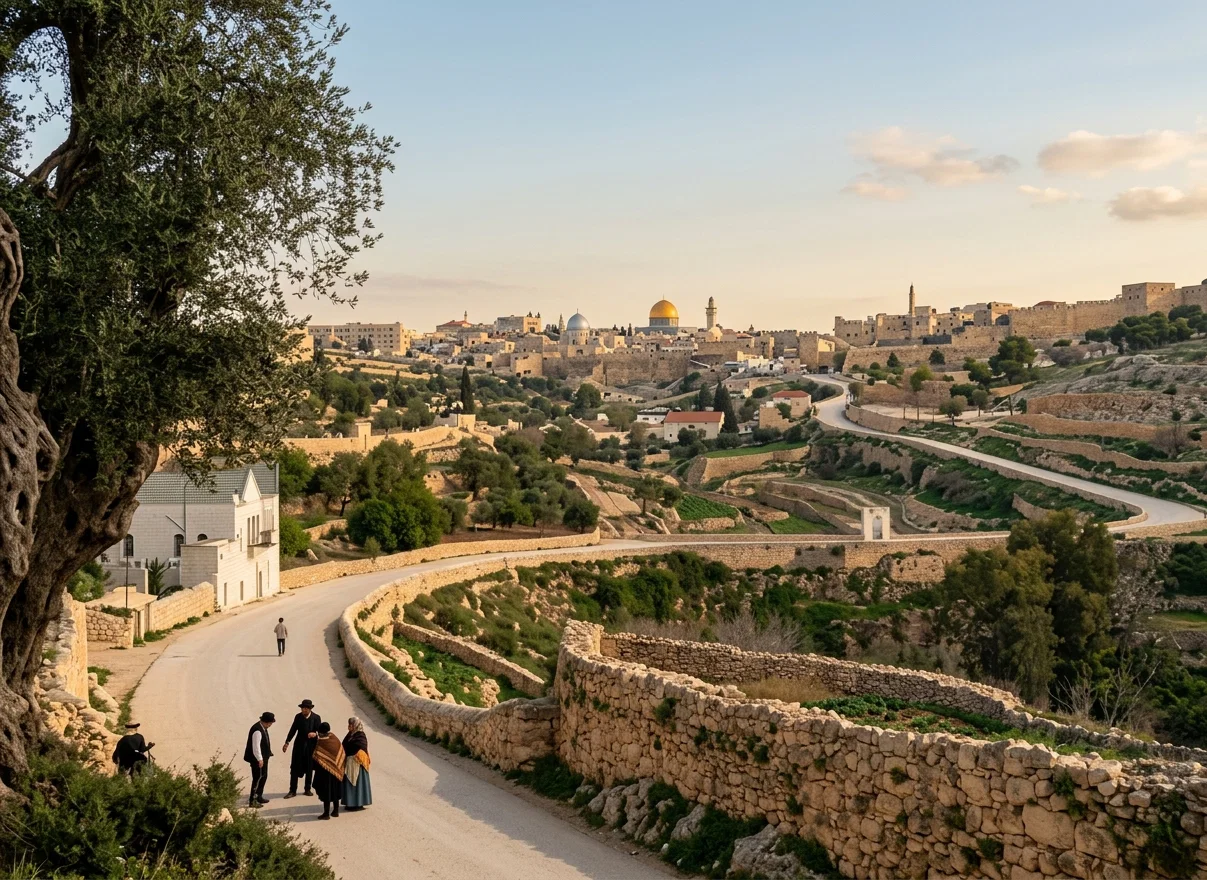
FORMING the background of this view are the distant outlines of the walls and buildings of the historic city of Jerusalem, a center around which cluster so many weighty truths of history and of prophecy. The importance of the locality was foreshadowed as early as the days of Abraham, when he was directed to Mount Moriah as the place of his expected sacrifice; and to all that time has since revealed of interest concerning it, is added the prophecy of the descent of King Jesus upon the Mount of Olives, which is to divide asunder and become a great plain upon which will descend the holy city, the New Jerusalem.
As a city, Jerusalem first became of historical interest in the time of David, who captured it from the Jebusites, and made it his capital. In Solomon's reign it attained additional renown as the site of the temple, the most beautiful and famous building ever erected by man. Destroyed by Nebuchadnezzar in the reign of Zedekiah, it was rebuilt by Nehemiah, and experienced varying fortunes until the time when the Jewish nation, having finally rejected the Messiah, suffered the destruction of their capital, and the extinction of their nationality by the Roman army under Titus, A. D. 70. Some centuries later the city passed under the dominion of the Ottoman power, under whose rule it has since remained save for a comparatively short period after it was retaken from the Turks by the Crusaders.
Many passages of Scripture are based upon the glory of Jerusalem as the seat of God's government on the earth, as the following: “Walk about Zion, and go round about her: tell the towers thereof. Mark ye well her bulwarks, consider her palaces; that ye may tell it to the generation following. For this God is our God forever and ever: he will be our guide even unto death.” Ps. 48: 12-14. “Beautiful for situation, the joy of the whole earth, is Mount Zion, on the sides of the north, the city of the great King,” etc.