The northern coast of Spanish Honduras forms the southern shore of the V-shaped bay known as Bahia de Honduras. British Honduras forms the other side of the bay, and Guatemala has about fifty miles of coast between the two.
This coast, unlike that of British Honduras, which is protected by numerous reefs and many small islands for many miles, is entirely exposed to the waves continually rolling in from the Caribbean Sea. If it were not for the Bay Islands lying off this coast, and affording a shelter for vessels in time of storm, it would be a very dangerous coast to travel, as the northern sweep across the gulf with great violence every winter. While the islands afford a place to which the vessels and smaller boats can flee for safety, they are too far from the mainland to afford any shelter to the coast. The nearest are seven miles off, and Utilla, the next nearest, is eighteen miles distant. Honduras has about three hundred and fifty miles of coast on the north, and perhaps twenty-five on the Pacific side, in the Golfo de Fonseca.
The mountains are usually quite near the coast, and in some instances there is not room for a road between them and the sea. Consequently the rivers are mostly short and small. Many small creeks also empty their waters into the sea.
They all form bars at their mouths, which are usually easily passed during the dry season, yet occasionally an animal goes down in the quicksand; the rider is obliged to get off in the water, and the horse and rider seek safety as best they can. Again it is necessary to unsaddle, and get into a dory, and let the animal swim across. In the rainy season these creeks and rivers are all flooded, and traveling is almost impossible, and dangerous at best.
Many small towns are scattered along the coast, usually situated on or near one of the many creeks. The inhabitants are a mixture of Spanish, negro, and Indian. They are of all colors and shades. The Carib and the Mosquito Indians are the only coast tribes that have maintained their tribal individuality.
These tribes usually build their towns separate from the other populace. Either one of these tribes would make a good field for missionary labor. The Carib Indian has nearly all the characteristics of the African, but the Mosquito Indian is short and stout, has straight black hair, and is copper-colored. Neither is ever found away from the coast. Fish compose a large part of their diet, and this may explain why they have so many skin diseases. Here, as in all lands, the port towns are more corrupt and more given to vice than are the towns in the interior.
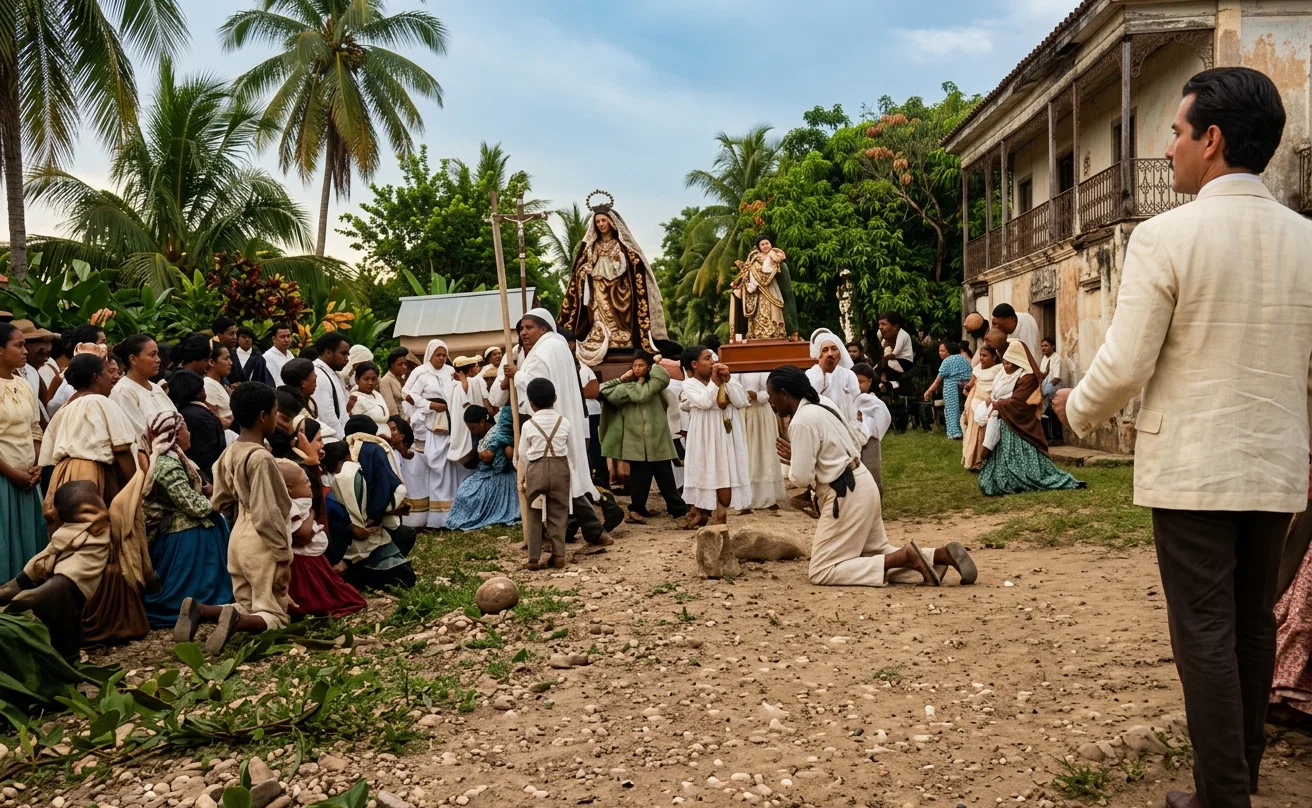
A RELIGIOUS PROCESSION IN HONDURAS
The religion of the people is Catholicism. All the larger and many of the smaller towns have their church. The church is usually much the largest building in the town, and each one is supplied with from one to six bells, which make a great deal of noise on important feast-days. The furniture in the church is usually very meager,—an altar, a few images and pictures of the saints, but never any seats. The men seldom go to church. The women kneel before the images to say their prayers. Many candles are burned before these images and pictures of the saints. Each house is also provided with the cross and one or more images and pictures, and on feast-days and in cases of sickness candles are burned at home also. The burning of candles before the images is supposed to have great power in driving away evil and curing the sick. When any one is about to die, a priest is called if there is one near enough, and for a sum of money, varying according to the possessions of the one about to die, he is granted a pass through purgatory. After death the body is taken to the graveyard, which is called in Spanish El Campo de los santos, or the camp of the saints, and is interred. Then begins a nine days’ prayer for the deceased. I was once called on to say these prayers for a man who had died, and so had a good chance to present the true state of the dead. But when I was through, I was told that what I had said was all good, but that if I could not say the prayers, some one would have to be found who knew how.
The Catholic religion, like all heathen religions, is virtually a worship of the dead. With them people are supposed to become saints only at death. When asked if I believe in saints, I reply, “Yes, in living saints.” This gives me an opportunity to read portions of Paul’s letters directed to the saints of God, and to tell my questioners that these saints were living people like ourselves. Then I sometimes present God’s message to us now, to get ready to go to the home Jesus has gone to prepare. It is almost impossible to imagine the ignorance of those who have never been allowed to read the Bible. Many have never seen one. I do not suppose there is one Bible to a thousand homes in this dark land. Most of the people have heard of the Bible, but suppose it to be a very bad book, with which it would be dangerous to meddle. Novels of the lowest type are eagerly devoured. There is not a religious paper published in this country. The local newspapers contain many extracts from the writings of Greek philosophers and other infidel authors, and as a result there are many skeptics and atheists.
When a colporteur passes through a village, a few, through curiosity, may venture to buy Bibles, yet, believing they are doing wrong, they may, perhaps, experience a similar sense of guilt to that which those better instructed have felt on buying the first novel. Most of the Bibles thus sold are usually gathered and burned by the padre (father). A very few, however, are concealed and read occasionally, and once in a while a family is found that has really begun to defy the priest and read the Bible openly.
Our work in this field can hardly be said to have touched Central America proper. The only ones for whom work has been done, are the Protestant people of Belize, the Bay Islands, and the English-speaking people of this coast. I am thankful for the privilege of spending my life in uplifting this people. Believing that our influence will be greater if the people see that we are here to stay, we have thought it best to build a small house, as rent is very high, and the houses are very poor. It is now nearly done, and we expect to move into it this week. God has blessed us in getting a healthful and desirable location in a suburb, and on the road leading to the interior.
The last time Elder Goodrich and I were in Utilla, the people kindly contributed money to buy a horse for the work here on the coast. The greater part was given by those not of our faith, as our brethren there are all very poor. The horse has already proved itself useful in my work here.
Brother Moncada, a lawyer of this place, and his wife are both awaiting baptism. I believe they are the first-fruits14of the message among the Spanish people of this country. Brother Moncada has a printing-press that he is very anxious should be used in spreading the message.
A missionary physician would find a good opening here in La Ceiba to do good as well as to make a good living. If some one of our physicians could locate here, I believe treatment rooms would be a profitable investment as well as the means of opening many hearts to inquire into our faith. There is nothing of the kind on this coast, and yet there is a call for such a work.
Several hundred dollars’ worth of books and papers have been sold on this coast during the last year. Two Sabbath-schools have been organized. A few have begun the observance of the Sabbath. All our people are taking our papers, and nearly all are paying tithe. May God water the seed sown, that many more may be willing to receive the seal of the living God.