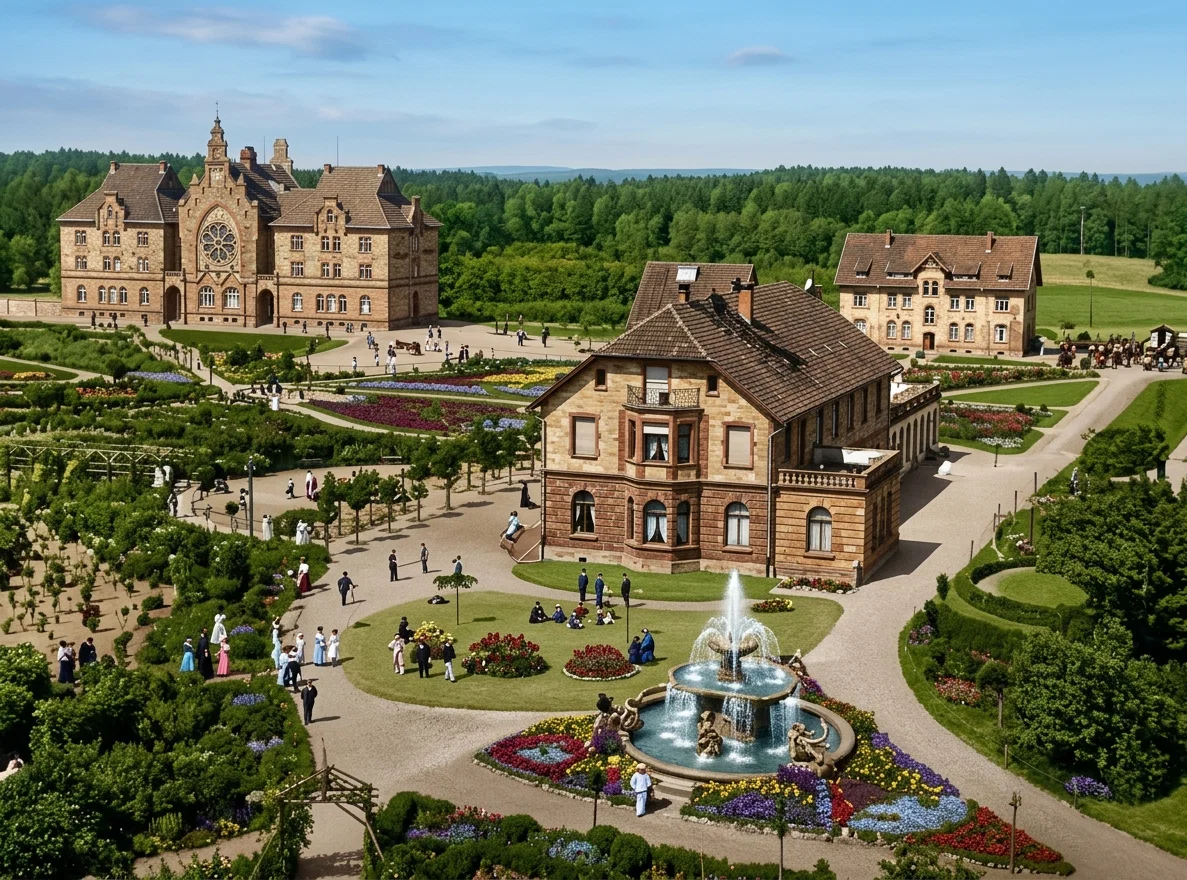
THE German word “Friedensau” signifies a place of peace. This is the name given to the place selected by our brethren in Germany for the headquarters of their educational and medical work. Friedensau is in the country. It lies east of Berlin and south of Hamburg, in the vicinity of Magdeburg.
I believe that the enterprises established at this place, and the work they are doing for our cause in Europe, should be understood by all our people. Those who are acquainted with the small beginning of the undertaking, the many difficulties that have been met, the signal victories that have been gained, and the blessings that have been received by many of our fellow men in that part of the world, are able to appreciate the blessings of God which have attended the work from its inception.
In the fall of 1899 the brethren purchased a farm of some ninety acres, at a cost of about twelve thousand dollars. Most of the ground was then under cultivation, and had been for perhaps centuries. There were a few small ancient buildings on the place. One of these was a small brick mill that had been used for grinding grain. A pretty little stream flows through the place, and this supplied power for the mill.
It was my privilege to attend a camp-meeting at Friedensau in the autumn of 1900. At that time the brethren had just begun to develop the place. A school had been opened, and a small food factory had been started in the old mill. The school was under the direction of Professor Lupke, who has remained with the enterprise until the present time, and is still the head of the institution. When the school opened, there were no real school buildings. The classes were held in a part of the mill, and the students lived in the mill loft, and in temporary sheds called “barracks,” erected for the purpose.
THE FRIEDENSAU SCHOOL AND SANITARIUM
In the illustration accompanying this article there may be seen the school building now being used. This is a brick structure of three stories, with a good basement. The class rooms and chapel occupy the center of the building. The gentlemen’s dormitory is on the right, and the ladies’ is on the left. This building will accommodate nearly two hundred students on the plan of housing students in that country. The chapel will seat four hundred or more. It is a comfortable, practical, creditable building for school purposes.
The students who attend this school come from all parts of Germany, from German-Switzerland, Holland, Russia, Austria, Hungary, Bulgaria, Macedonia, Syria, and Egypt. Every one who comes must present letters of commendation from some minister or church officer. Before they are admitted, the board of
directors pass upon all cases. It is the policy of the Board to secure the most promising young people in all the countries named above, and give them the education and training they need to fit them to labor for the extension of our cause in their native lands. One beautiful feature is the fact that poverty does not prevent any worthy and promising young person in those countries from attending this school and securing the very best that can be given. Provision is made by the establishment of varied industries for those without funds to pay their way, at least partially, by work. Then each year the Hamburg publishing house generously appropriates from three to five thousand dollars of its profits to the students’ aid fund. Thus provision is made for the young people of Russia and other countries where the young know nothing but the severest poverty, to rise to a place of
usefulness and honor in the cause of God. This is a grand, good work.
The sanitarium is only a few rods from the school. This institution will accommodate fifty or seventy-five boarding patients. Dr. Hoenes, who stands at the head of the medical work, is a member of the school faculty. The sanitarium is really a part of the educational enterprise. Those who are suited for the work are given instruction in nursing. As a result of this work, good nurses are being placed in Berlin and other large cities as medical missionary nurses. They are meeting with success as nurses, and are doing good missionary work as well.
The sanitarium has developed steadily and substantially from the first. At the time of my recent visit every room was occupied, and some were living in tents. No doubt other sanitariums will be established in different parts of Germany, but this institution will remain a valuable part of the educational work at Friedensau.
The food factory has done well from the start. At first our health foods were not known in Germany. The sales the first year were very small, but during 1904 they reached twenty-five thousand dollars. The manufacture and sale of foods representing this value provide employment for many of the students the entire year. The mill has been repaired, good machinery has been installed, and the factory now presents a busy, thrifty appearance.
In addition to these leading enterprises, there have been provided a steam laundry, a good dairy, an electric-lighting plant, water-works, and a fire station. The steam laundry has been fitted up with a full equipment of machinery. The dairy is a large concrete structure.7with modern sanitary arrangements. The electric plant provides light for all the buildings, and the water-works carries water of excellent quality secured from artesian wells, to the various buildings. The large vegetable garden will provide vegetables of every description for those at Friedensau.
All these enterprises represent an investment of about one hundred and twenty-five thousand dollars. This entire amount has been furnished by our people in that part of the field. No loans nor contributions have been made by our people in America, unless it may be a small amount from the sale of German “Christ’s Object Lessons” in America. If I am not mistaken, the indebtedness on the entire enterprise is about fifty thousand dollars. This is being paid off quite rapidly, now that the building operations are finished, and the required facilities are provided.
The best part of Friedensau can not be expressed in writing, nor understood by reading. That is the personal experience of the founders, directors, students, workmen, and patients. This part of the movement can be known only by experience, and this is for those only who go there. But all are able to see that God has done great things for our people in Germany. We can see that he is still able to spread tables in the wilderness, and is doing it. We can rejoice with our brethren across the sea, and pray for the continued prosperity of Friedensau, that it may be a great blessing to our fellow men until our work is finished.