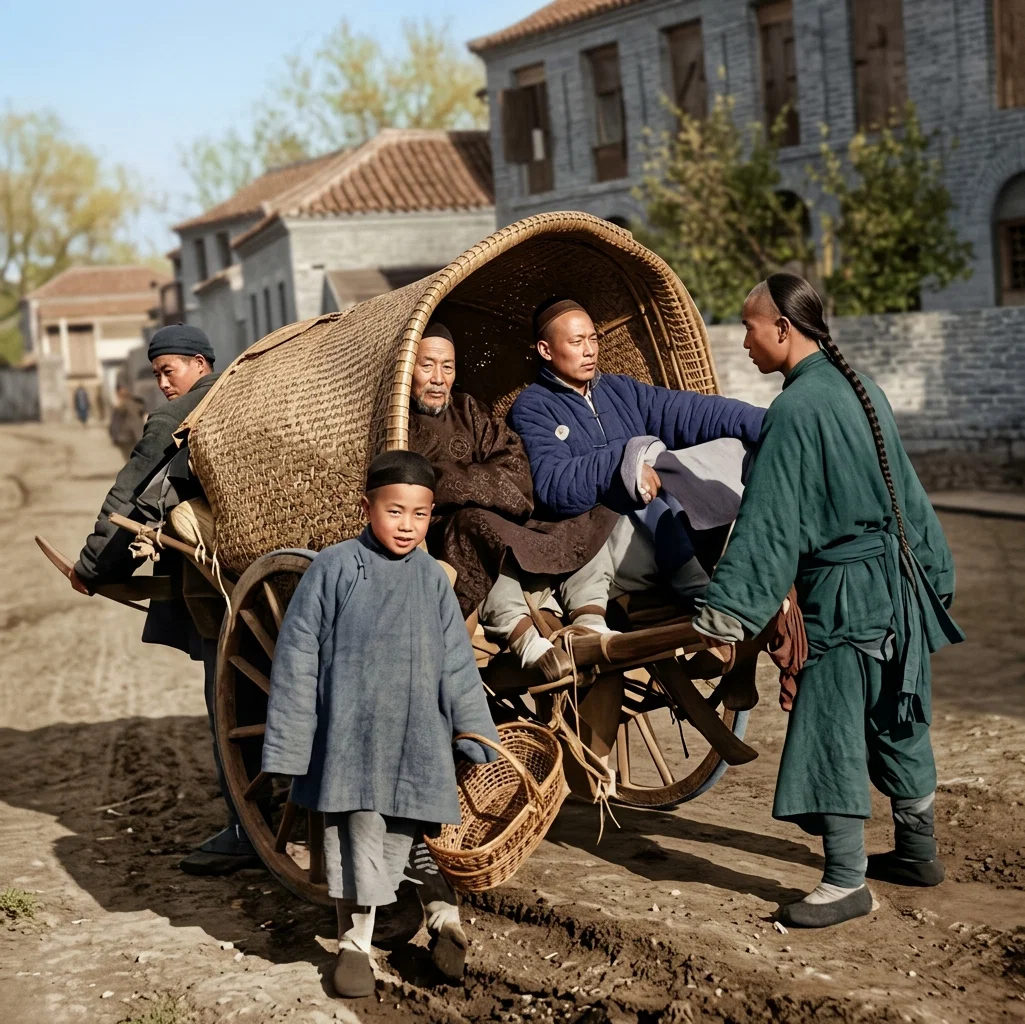
Throughout China there are narrow, beaten, one-wheel tracks. Sometimes they are beside the main cart road, and sometimes they take a shorter cut; but they always wind in and out more or less, for no road or path is straight in China. It is thought that the evil spirits can not follow over a winding path, and so China spends many years of time going the long way around. Yet, after all, some evil spirit finds most of the poor darkened souls, binding them in sin, often by the opium habit, which is one of the greatest curses of China.
A CHINESE WHEELBARROW
Over these winding paths travel most of China’s passengers and freight. Man himself is the burden-bearer. When it rains, the wheelbarrows stop for shelter, and wait until it dries off, which is surprisingly soon after the sun shines out on these ancient tracks. Barrow follows barrow day after day, till even in the very stones of the bridges are left the marks of years and centuries of travel.
One morning as the clouds of threatened rain cleared away, a neighbor Chinese woman and myself seated ourselves on either side of a wheelbarrow, and off we rolled over the country road in North Honan. We were bound for a journey of about thirty li, or ten English miles. A pleasant country this is to see in the spring, as the level plain in every direction is springing into life with the green fields of wheat, and here and there are villages, with their trees and gardens.
The Chinese salute every one wherever they happen to meet. They may have never met, and may never meet again, but this pleasant, though often meaningless, exchange of words, spices up the toilsome journey. For instance, our cart meets another going in the opposite direction. The man pushing us sings out, “Going south?” The answer is an affirmative, followed by, “You’ve come from the south, have you?” this remaining unanswered as the distance widens between them.
Arriving at our destination, which is a small village, we are ushered into one of the earth houses. Then at once a reception begins. First, it is the village children; then, all the people, old and young, must come to have a look! for a woman who was not born in China, and whose feet are not bound, is very much of an attraction to those who never saw such a person.
We stop with a family who heard the gospel and discarded all their idols several years ago. Several sick people come for attention, and keep us busy until the darkness of night leaves us with only a flickering light, such as the Chinese use. This light is made in a saucer-like lamp, the wick consisting of little white strings of pith taken from some kind of plant and dried for this use. The oil is kerosene of poor quality, and with no burner or chimney, this gives a smoky light, not so good as candle-light.
The crowd having dispersed, I have an opportunity to talk with the woman whom I came especially to see, and invite her to come and be my helper in the mission.
The Chinese are a very hospitable people, and many kinds of food are set before me, but only plain bread and gruel that I am able to eat. A courtyard full of people wait outside to hear the gospel, and by moonlight I tell them, as best I can, the gospel story, contrasting God’s truth with Satan’s deceptions. This over, I am tired enough to rest until the early dawn brings again a train of the neglected sick ones. These keep me more than busy till noon, and then there are more waiting than when I began.
As rain threatens, we are compelled to start on our journey home. It is pitiful to leave them; but they can come to the mission dispensary, and China is full of such as these. They try to stop us several times; but supplies also are nearly gone, and it is of no use to stay.
Poor, neglected people, often in need of the most simple measures! The native treatment is worse than nothing. Often they are stabbed with long needles, which are even thrust into the eyes. This may be to let out the demon which causes the disease, but it results in loss of eyesight, abscesses, etc. Simple measures often work wonders. A large part of the diseases are of the eyes.
On our way home we pass a procession of the always-squeaking wheelbarrows. There are seventeen, and the sound resembles a great swarm of bees.
Back to the station, we reflect that the need of China is great, and we are, O, so small! How we must hasten to get this language better, that we may not be crippled as this growing work fills up the measure of our time and strength. May the Lord of the harvest send forth reapers, for the field is fully ripe.