Malaysia

5%

Review and Herald Publishing Association · Washington, D.C. · Jan 12, 1905

FromReview and Herald, Vol. 82, No. 2.

Read the full edition

Malaysia

R. W. MUNSON
Some people have an idea that this is a howling wilderness, but no greater mistake has been made. It is a well-organized and well-governed country.
The astronomers who came here two years ago to witness the sun eclipse, brought with them from America tents, cooking utensils, food, and all the paraphernalia necessary to campers in a wilderness. Their astonishment when they arrived here and found well-equipped and well-managed hotels, perfectly appointed houses, and an up-to-date society, can be imagined. They found also a well-equipped railway, which transported them and their instruments to the town in the interior where they intended to make their observations.
I speak of these things to show what erroneous ideas foreigners have of this old colony of the Dutch. For centuries they have been employing and ruling this land, greatly to its advantage in many ways, and life is just as secure here as in the lands of the West, and in many ways more comfortable.
You will be interested to know something about the climate and its peculiarities. In the mid-tropics it is, of course, warm from January to December, with varying degrees of heat and rain. It is a humid climate, and in some parts the rainfall is excessive, while in others it is light. In one island there will be distinct hot and wet seasons, while in another these different seasons are not very pronounced. The farther one goes from the line, either north or south, the more noticeable are the rainy and dry, or hot seasons.
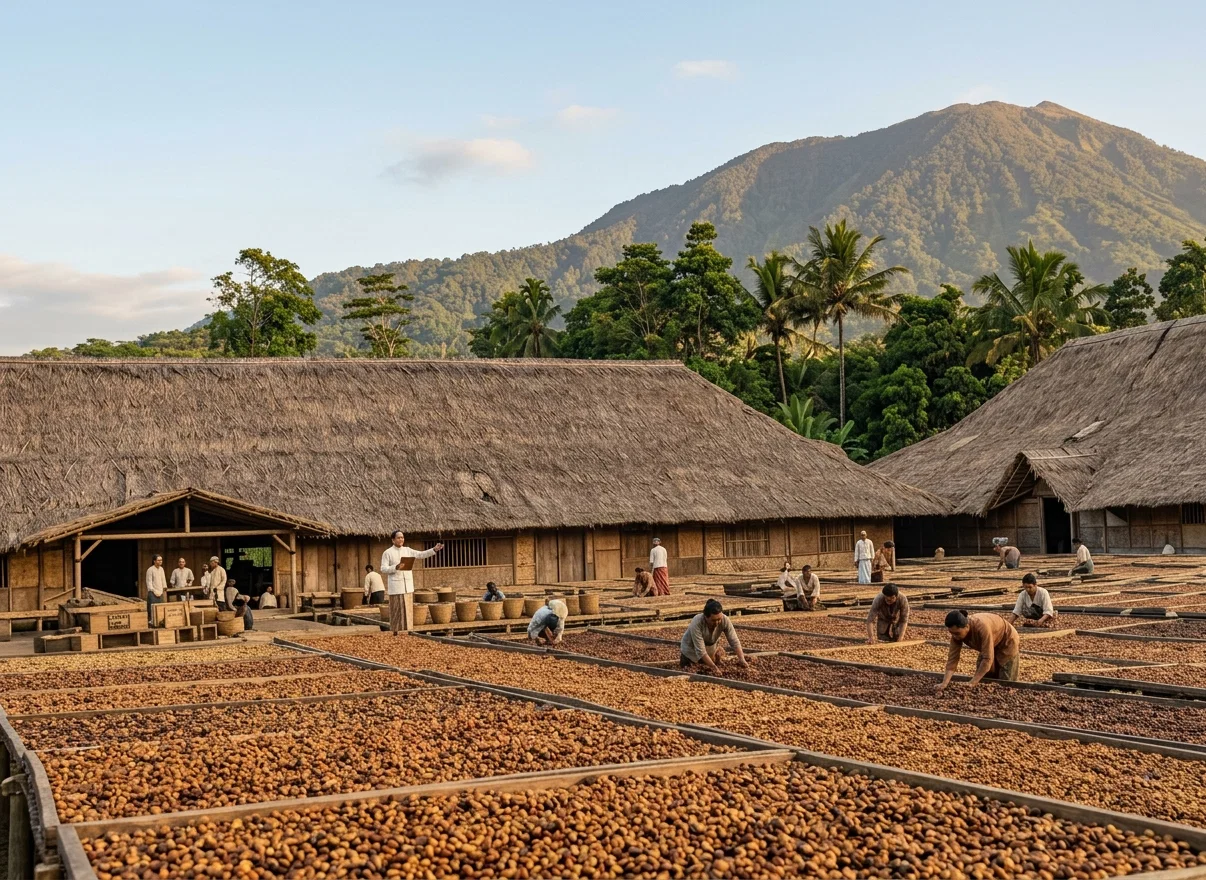
(COFFEE DRYING, JAVA
Here in Padang the rainfall is very heavy, taking the whole year together. Because of this heavy rainfall the climate is the coolest and most enjoyable of any seacoast town in the Indies. A wide plain, composed, particularly along the sea, of sand, forms a great filter bed from which we get the finest water in the world. It is as clear as crystal and absolutely tasteless, as good water always is. Malaria is rarely met with, the nights are cool, and the air pure and fresh, coming, as it does, from either the mountains or the sea. For those who require a cooler atmosphere a few hours' ride on the railway will bring them to Fort de Kock, which is three thousand feet above the sea-level. The mean temperature of Padang approximates eighty degrees Fahrenheit. In some places it is a little higher, but I think nowhere will it exceed eighty-two or eighty-three. The days are warm, and the nights cool. Here in Padang we always sleep under a woolen blanket the greater part of the night. During the rainy months, we have to dress and sleep much as we would in America in the cold season.
The dwellings are all built for the heat, having wide verandas, extending eaves, large windows and doors, and plenty of shade. In this part of the country the houses are built of planks, and have palm-leaf thatch, although many have corrugated iron roofs. The bath is a most important and essential feature of the daily routine, and a most delightful one it is. The bath room is a separate building, near the well as a rule, and supplied with a cement floor, and a large tank that will hold from one hundred to five hundred gallons. This tank is kept filled by a servant, one of whose duties it is to either pump or bail the tank full every day. Here the bather stands and pours the water over his body with a large bath cup, and by the application of soap and water, or water alone, as need requires, he is able to obtain both pleasure and profit at slight expense of either time or money. I have tried many ways of bathing, but none of them compare with that in vogue here in the tropics.
Of course in such a climate, fires are required only for cooking the food. This work is done in a separate building upon a raised platform of bricks and mortar, with openings in the ledge for pots and kettles, supported upon iron cross-bars. The smoke finds its way out of the top of the ventilators made in the roof for the purpose of letting out the smoke and the odors from the cooking food.
The races of the archipelago are all Malayan, but each possesses a type of its own. The Malays proper inhabit the Malay peninsula, the greater part of Sumatra, the northern coast of Java, and the western and northern coasts of Borneo. In north Sumatra are found the Battaks; in the island of Nias the race which gives its name to the island; in Java the Javanese; in Borneo the Dyaks; in the Celebes the Bougis (pronounced Bougeez); in the lesser islands to the west varying types resembling in general, the Malay. The Filipino differs in no important particular from the prevailing type. In New Guinea the Papuan races begin to show themselves, and they present a marked contrast to the Malay character.
The Malay is short and stocky, with straight hair, flat features, and broad, flat nose. The Papuan is tall and rather lank, with long crinkly hair that stands straight out from the scalp, forming a head which, in its full outline, is entirely out of proportion with the rest of the body, suggesting to the mind the ball of thistle-down, which is so familiar to Western eyes.
Just as they are in complete contrast to each other in physique, so are they in natures. The Malay is reticent, undemonstrative, and self-contained, while the Papuan manifests the effervescence of character that is peculiar to negro races. What would call forth no manifestation of emotion from the Malay would throw the Papuan into the most violent expression of merriment or grief. The Malayan uses his powers of speech to hide his real thoughts, while the Papuan tells all he knows.
Although these two types, found in the same latitude and within the same region, differ so widely in many ways, yet they are strikingly alike in one respect. They are both sinners; they are both selfish, as sinners always are; and they are both sadly in need of the gospelof Jesus Christ. The tokens of Satan’s power over them are abundantly evident. They are both alike susceptible to kindness, and are capable of loving those who love them. Both alike are within the range of the gospel, and both have yielded to the power of the truth. Christ died for both, and his command, “Go ye into all the world, and preach the gospel to every creature,” includes both these races; therefore I trust that all who read these words will remember that they too have a responsibility to discharge to these unfortunate people in this highly favored land.
Although the Malay is quiet, he becomes, under certain circumstances, a perfect fiend incarnate, and then he “runs amuck,” killing indiscriminately all who come in his way. It is a form of madness apparently, in which despair is usually the operating cause.
Besides the Malays and Papuans, there are many negritos in the archipelago. They are unlike the Papuans, and their origin is a mystery. They number twenty-five thousand, more or less. They are dwarfs in stature, thin, spindle legged, and have a head like a negro’s, with flattish nose, full lips, and thick frizzly black hair. They are a low type of humanity, but are far superior to the dominant races in one important particular, and that is sexual morality. They are monogamists, allow no divorce, and inflict severe penalties for unfaithfulness.
Many Chinese have long found this fertile region a rich pasturage for their energy and frugality. There are two classes of Chinamen,—the babas and the pure-blooded Mongolians. The former are a mixture of Chinese and Malay blood, and they all speak Malay as their mother tongue.
Not a few Tamils, or “Klings,” as they are locally termed, Japanese, Arabs, and even a few Turks and Asiatic Jews must be added to complete the list.
Of course the European is taken for granted; for he is the ruling power here. It is his genius and ability that have developed the trade and industries of the entire region. Whatever his vices, and however bad his influence in the realm of morals, it is due to him that we can preach the gospel in security here. The absence of cannibalism, family and tribal feuds, and savage warfare testify, to some extent at least, to the spiritual character of the missionaries’ labors.
There is much more that might be said, and we hope to give further information concerning this important region at some other time.
Padang, Sumatra.