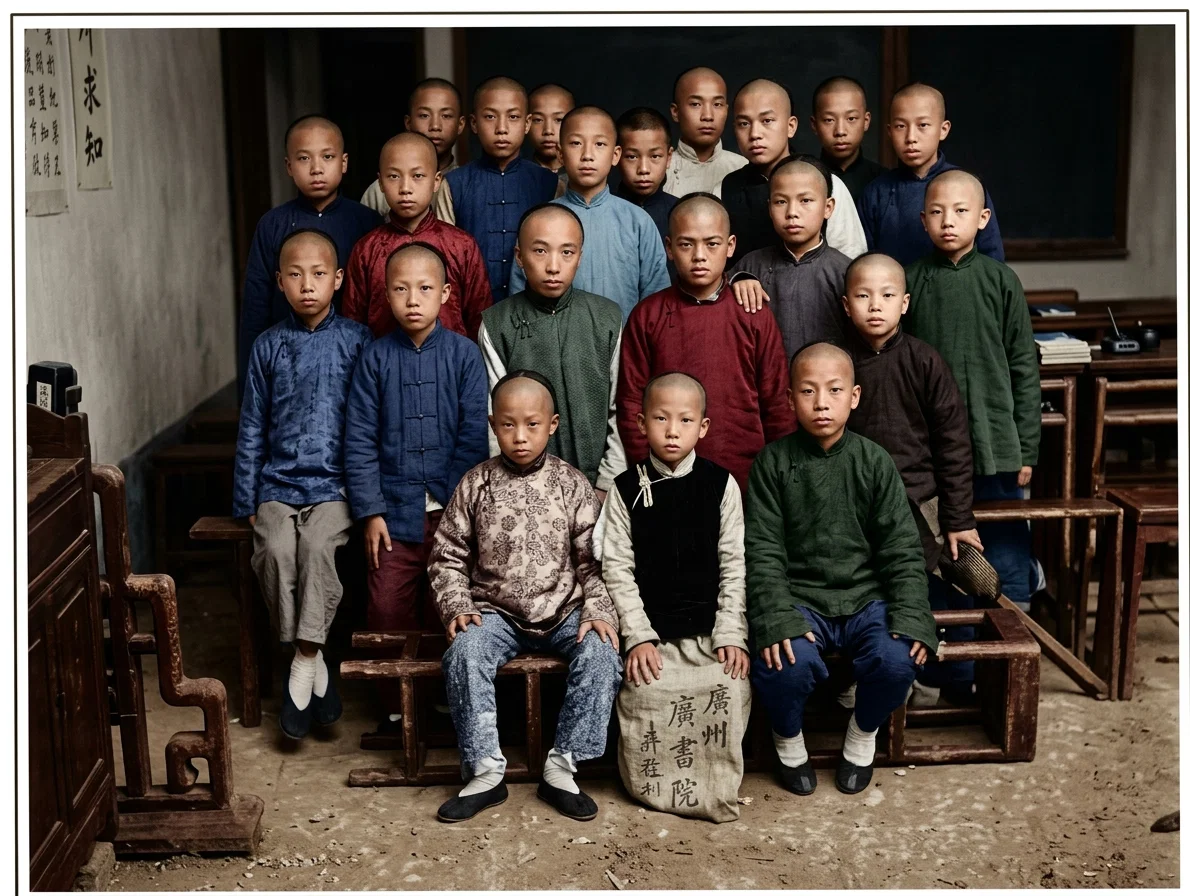
ON Aug. 11, 1904, we opened a boys' school near our mission hall, in Canton, China. The first term of five months closed January 13. Nearly all the schools here close at about this time, as many of the pupils return to their country home to spend Chinese New-year, which this year occurred on February 4.
During the first three months, a division of the school was conducted in the Chinese language, by a native teacher. The hours for study were from seven to nine and from ten to twelve in the forenoon. The first half-hour in the morning I spent with them in singing and Bible study. Later it was thought best to discontinue this division until after New-year, and instead the students of English were given daily lectures on physiology and hygiene, conducted in Chinese by a native preacher who is also a doctor. He was formerly an assistant in Dr. Kerr's Canton Medical Mission. He also preaches to the boys for one-half hour on Sabbath morning.
SOME OF THE BOYS
The hours for study in the English division were from one to five in the afternoon, five days in the week. The first half-hour each day and one hour on Sabbath were devoted to singing and Bible study, conducted by Elder J. N. Anderson. Afterward the school was divided into two parts, Brother A. C. Tidbury teaching the advance division, and I taking the beginners. A number of the pupils had never learned a word of English, and I found it convenient, if not necessary, to make explanations to them in their own language. I also required them to translate sentences from English into Chinese, and vice versa. The total enrolment in the English department was over forty, but the average attendance for the term of five months was only about twenty. These students were required to pay in advance at least one month's tuition fee of two dollars, Mexican.
Brother Tidbury has also conducted two private classes in English — one in the forenoon, and one in the evening. The members of these classes did not attend the afternoon school. Next term these private classes will be discontinued, and he will teach both sections of the English school — one in the forenoon, and one in the afternoon. Already a number of pupils have applied for admission, and probably we shall have a better attendance when school reopens.
Some of our pupils manifest an interest in Christianity, and we hope that by another year we may be able to report conversions. In these days, when China is opening wide her doors to Western education, shall we step into the opening providence and give these bright young men a knowledge of God, whom to know aright is life eternal (see John 17:3), or shall we sit idly by, and let this golden opportunity pass? Surely now is the time to work. But where are the teachers? Where is the money to carry forward this work? Our hearts have been made glad as we have seen so many good schools established by our people in America. In them we hope young people will be quickly fitted for the world's harvest-field, and that some of them will soon come to China to work as teachers and preachers. But as it has cost much money to establish schools there, so money will be required to establish and carry forward the educational work in this land. We are endeavoring to make our English school as nearly self-supporting as possible, yet have fallen somewhat short of this thus far.