A Brief Description of the Town in Which the General Conference Is Held
DURING the next three weeks the attention of the readers of the REVIEW will be turned largely to the General Conference at Takoma Park, and it seems appropriate to give in this issue some idea of the town itself. The article which follows is taken from an illustrated booklet issued by the Takoma Park Citizens’ Association, and we are indebted to Mr. Ben G. Davis, the treasurer of the town, for the use of the accompanying illustrations. The writer of the booklet says:—
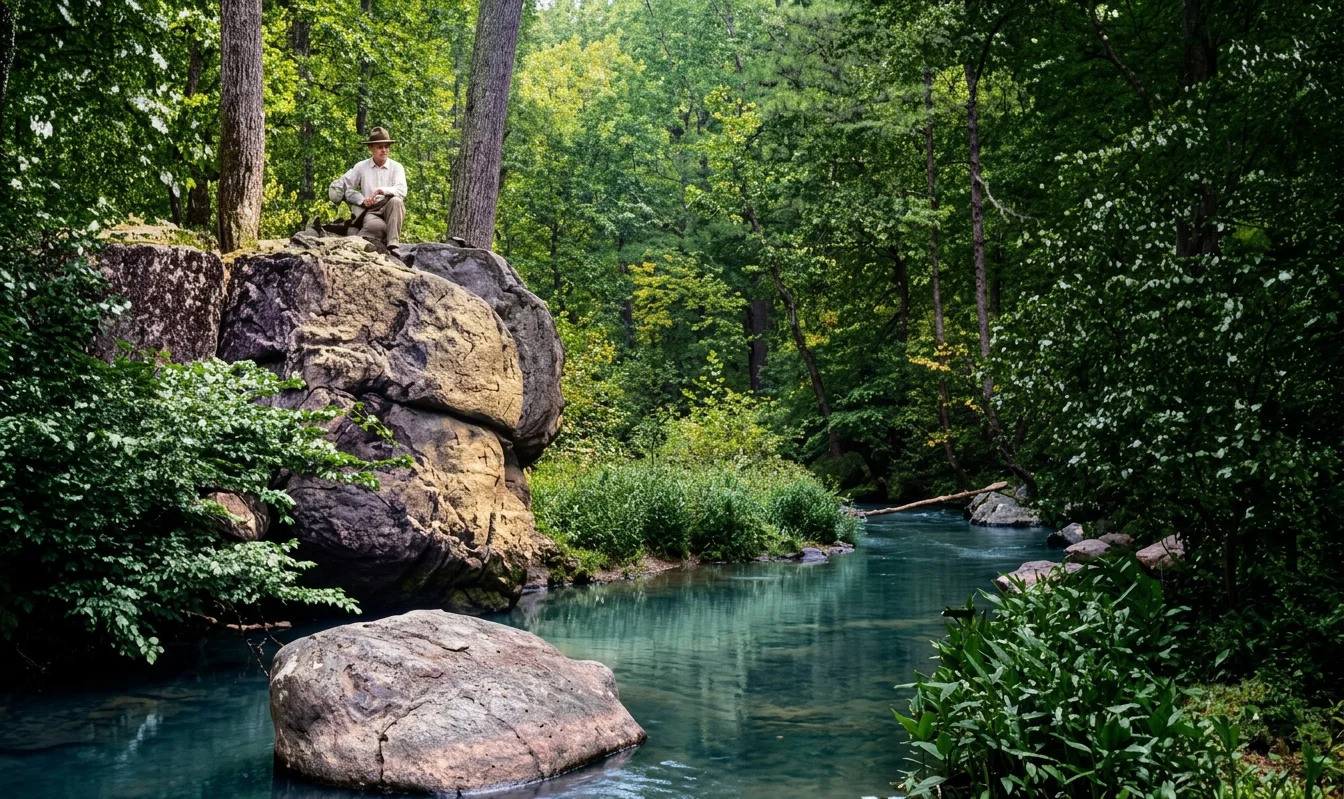
ON THE SLIGO
TAKOMA PARK! There is a touch of nature in the very name itself—a suggestion of woodland and wild flower, of winding roads, of hill and dale! Each musical syllable brings forth a vision charmed with the song of the wild bird, perfumed with the breath of the blossom, invigorated with the life-giving tonic of pure air! There is a dream of nature primitive, the forest trees, the giant oak, the sturdy pine, that, to the fragrance-laden atmosphere of spring adds its health-giving, balsamic breath! There is the rippling cadence of a crystal stream that leaps and dances over rock and boulder, laughing its merry way through sylvan depths, through gorge and field! And in the vista rises up the noble dome of the nation’s Capitol!
The word “Takoma” is of Indian origin, and signifies “exalted,” “a high place.” And in this instance never was name more worthily bestowed. Nature, the greatest of landscape gardeners, the greatest of painters, seems to have concentrated her efforts upon the superb beauty she has bestowed upon this lovely region. The undulating character of the ground gives a diversity of scene that is enchanting and restful, especially to one whose vision has become warped and narrowed by the geometrical lines of city streets and squares. A summer walk or drive through Takoma Park is a positive pleasure. The scene is kaleidoscopic, ever changing, now amidst the brilliant greens of an almost virgin forest, an instant later enchanted by panoramas of field and glade, hill and sky, chasing away into the dreamy, hazy purples of glorious distance, while ever and anon beautiful villas and cottages, with well-kept lawns, peek out invitingly from bowers of shade and flower; evidencing the existence here at least of the true, restful, typical American home. In autumn, when the brush of Nature has scattered color with a lavishness that knows no bound, Takoma Park is indescribable. It presents a picture gorgeously hued in every conceivable tint and color,—a picture that awes the artist who would copy it, but that glorifies and inspires the lover of nature whose privilege it is to dwell in its midst.
In the region of the Sligo, a stream of never-ceasing beauty that adds inimitable charms to Takoma Park, nature again shows her wonderful handiwork in a series of pictures that vary in tone and color and atmosphere with every glance. Wandering along the beautiful, shaded roads and paths that skirt the stream, charmed now by rocky heights, now by immense boulders against which the waters rush and foam or leap away in miniature cascades, one can easily imagine one’s self in the heart of the mountains, away from civilization and care, in glorious contemplation of nature and her handiwork. The beauties of the Sligo are never-ending.
Takoma Park lies less than five miles directly north of the city of Washington, and so near the division line between the District of Columbia and Maryland that one portion of the town owes allegiance to the federal city and the other to the State of Maryland. It lies at an altitude above Washington that varies according to the locality, from three hundred to four hundred feet. The advantages of the greater altitude need no comment. It is a striking fact that during the most sultry and torrid days of a Washington summer, the thermometer at Takoma Park registers from ten to twenty degrees cooler, and the tempering influence of the luxuriant shade and pure air renders the difference even more apparent. Takoma Park is located within the very depths of a densely wooded country, and its dwellers have at the start that for which in less fortunate suburbs a generation of time is required—ample and abundant shade.14
Along with its other bountiful gifts, nature has bestowed upon Takoma Park one of priceless value—water of the finest quality. It makes its appearance in springs that are crystal-like in their clearness, and from which sparkling rivulets flow down the valleys. Takoma water is noted far and wide. It is a fact that can be well attested that many invalids have been greatly benefited by its use. The virtue of the water simply consists in its purity. Those who live in health must have good air and good water. These two elements are pure and priceless at Takoma Park.
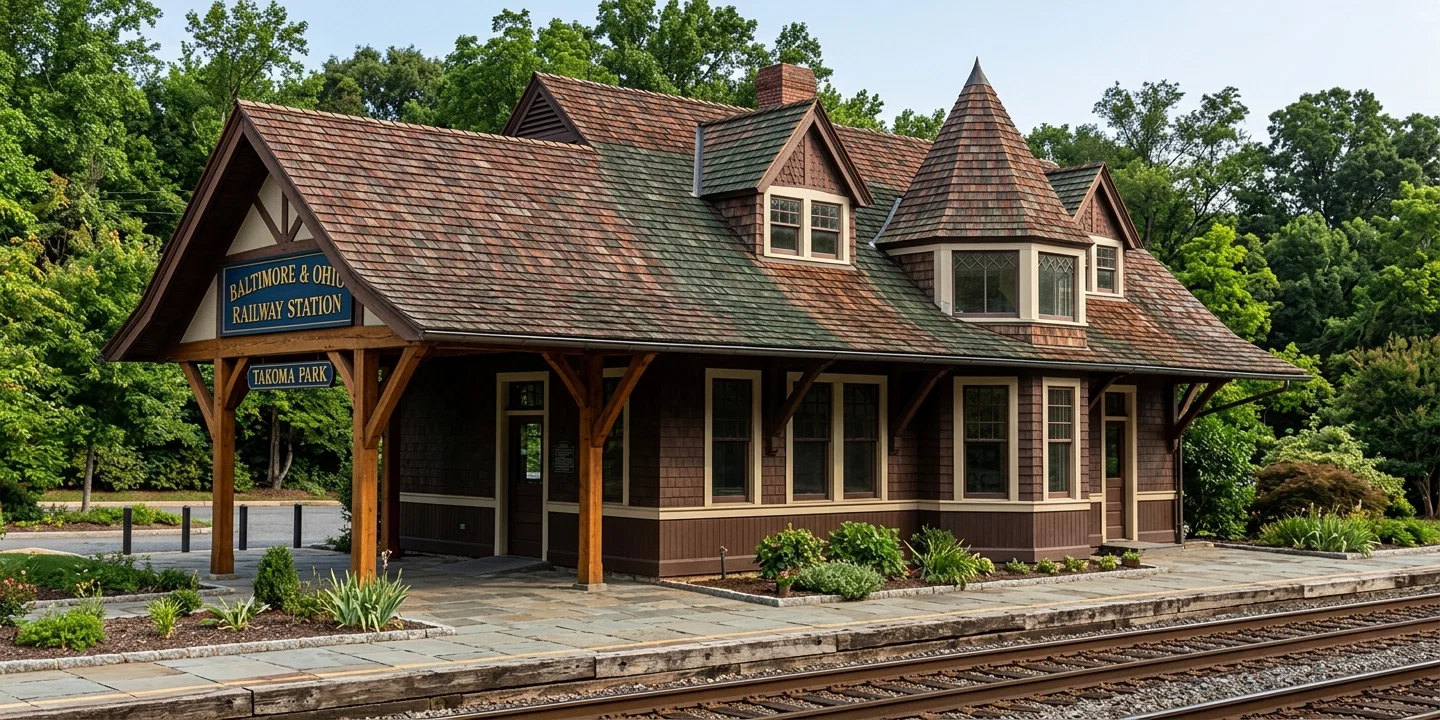
Another feature in which Takoma Park excels as a suburban town is that of easy access to and from the city of Washington. The resident who prefers has at his service the daily suburban trains of the Metropolitan branch of the Baltimore and Ohio Railroad, whose picturesque waiting station is one of the features of the Park. Or it is his privilege to avail himself of the more frequent service by electric car over the Brightwood electric road, a part of the extensive system of the Washington Traction and Electric Company. Over this road passengers are carried from Takoma Park to any part of the city of Washington or of the District of Columbia for the same rates of fare as prevail in the city—five cents per trip, or six tickets, allowing six trips, for twenty-five cents. Thus in the matter of cost of transportation the citizen of Takoma Park enjoys equality with the resident of Washington itself.
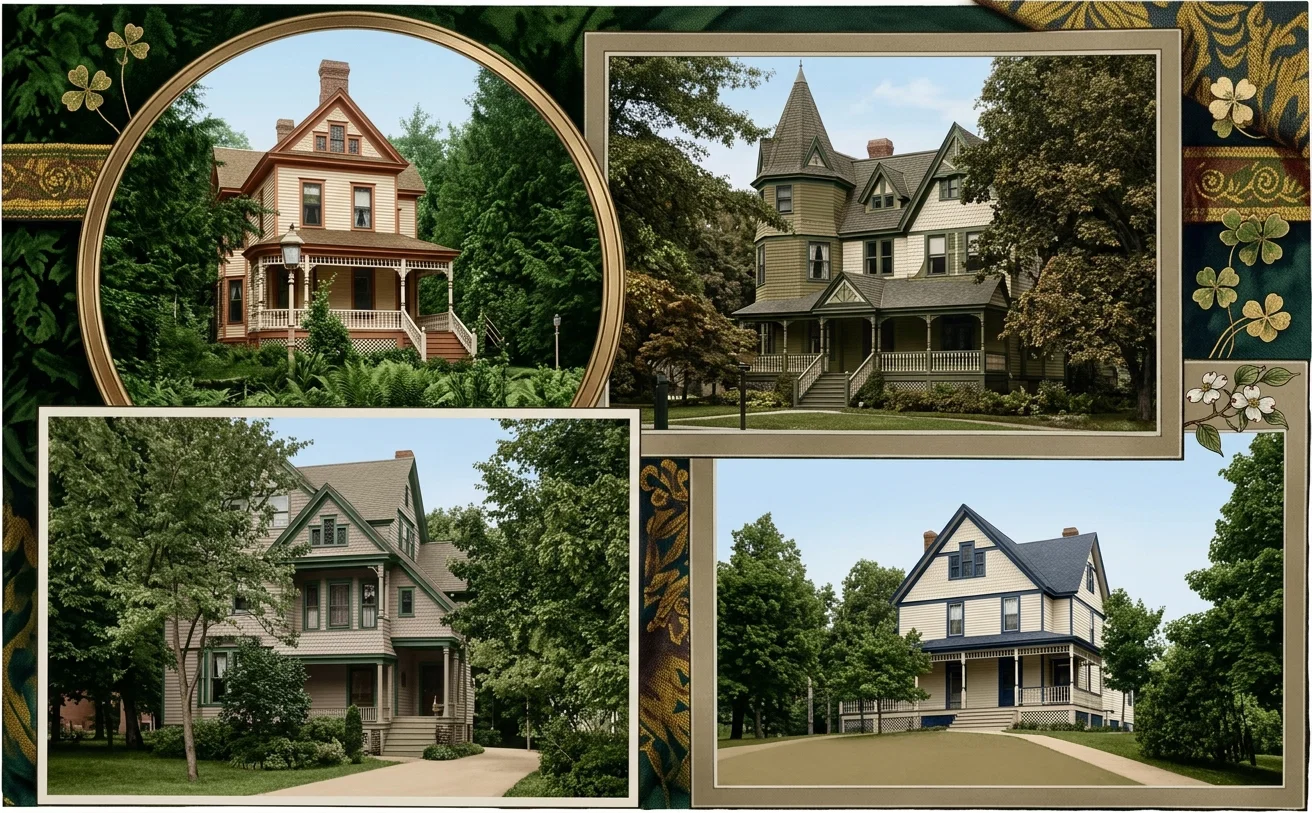
ATTRACTIVE HOMES AT TAKOMA PARK
Takoma Park is the ideal place for children. Here they are exempt from the narrow limits of streets or the circumscribed areas of sunless back yards; here their physical being is safe from accident, and their moral being from the uncertain and unpreventable association of undesirable companionship. Plenty of outdoor room, plenty of pure air, plenty of God’s sunshine, broadens their chests, expands their lungs, and reddens their cheeks, while contact with nature, the birds, the flowers, the rocks and rills, cultivates the brain, awakens the intellect, and forms the only true basis for a genuine and lasting intelligence.
BALTIMORE & OHIO RAILWAY STATION
A description of the homes of Takoma Park would fill a volume. In point of architecture they present a most pleasing variety, and evidence the exercise of much taste and pains in their construction. Whether cozy cottage or pretentious villa, there is the same inviting picturesqueness, enhanced not only by natural surroundings, but embellished by lawns and walks and flowers that give completeness to an ideal landscape. Add to these attractions the advantages and conveniences of modern improvements—gas, water, sewers—and nothing else need be said as to the desirability of Takoma Park as a place of residence.
A recapitulation of the well-authenticated facts herein presented sets forth the advantages of Takoma Park as a place of residence, briefly, as follows: Its especially advantageous location, being in the direct line of the wonderful growth of the national capital; its high altitude, lying, as it does, from three to four hundred feet above the city of Washington, thus insuring pure air and a much more comfortable temperature during the heat of the summer; its profuse shade and remarkable variety of trees; a wonderful beauty in natural scenery; absolutely perfect drainage, due to the contour of hill and dale; a well-established form of municipal government; a perfect system of water-works and sewers; and the cleanest, most healthful water in the world; gas, thus affording, with the water and sewers before mentioned, opportunity for all modern conveniences; churches, schools, and business houses; two means of frequent and rapid transportation to the heart of the city; three hundred homes, forming a sturdy nucleus for the greater growth that is coming—and finally, a population of intelligent, progressive, up-to-date people.