Sixteenth Meeting

3%

Review and Herald Publishing Association · Washington, D. C. · Jun 1, 1905

FromReview and Herald, Vol. 82, No. 22.

Read the full edition

Sixteenth Meeting

The sixteenth meeting was called at 2:30 P. M., May 19, G. A. Irwin in the chair.
Prayer was offered by Smith Sharp, and the minutes of the previous meeting were read.
The committee on plans and recommendations submitted a further partial report, as follows:—

Deputation to the President

15. Resolved. That the following-named persons constitute the deputation to wait upon President Roosevelt:— A. G. Daniells (President), Washington, D. C.; W. W. Prescott (Vice-President), Washington, D. C.; W. A. Spicer (Secretary), Washington, D. C.; I. H. Evans (Treasurer), Washington, D. C.; S. N. Haskell, General Missionary; G. A. Irwin, Australia; O. A. Olsen, England; G. I. Butler, Tennessee; A. T. Jones, Michigan; L. R. Conradi, Germany; H. W. Cottrell, Massachusetts; J. N. Loughborough, California; R. M. Kilgore, Georgia; A. J. Breed, Washington State; R. A. Underwood, Canada; W. S. Hyatt, South Africa; J. O. Corliss, California; E. T. Russell, Nebraska; Luther Warren, Chicago; J. E. Jayne, New Jersey; W. H. Thurston, Canada; N. P. Nelson, Texas; E. E. Andross, England; W. J. Stone, Indiana; W. C. White, California; W. A. Westworth, Scotland; M. C. Wilcox, California; E. W. Farnsworth, England; C. H. Edwards, New York; J. N. Anderson, China; J. L. Shaw, India; F. W. Field, Japan; J. W. Westphal, South America; W. H. Wakeham, Egypt; A. J. Haysmer, West Indies; K. C. Russell, Washington, D. C.; W. A. Colcord, Washington, D. C.; J. S. Washburn, Washington, D. C.; G. B. Thompson, Washington, D. C.; S. B. Horton, New Orleans, La.

Malay Mission Territory

16. Resolved, That we include the Straits Settlements, the federated Malay States, and the kingdom of Johore in the territory of the Malaysia Mission field, under the Australasian Union Conference.
The report was adopted.
On motion, it was—
Voted, That the executive committee be asked to appoint such a committee as was called for in the report of the Southern Union Conference to look into the financial affairs of the Southern Union Conferences and its institutions.
The Chair called for the report of the Lake Union Conference, which was presented by Allen Moon, the president. A brief summary follows:—
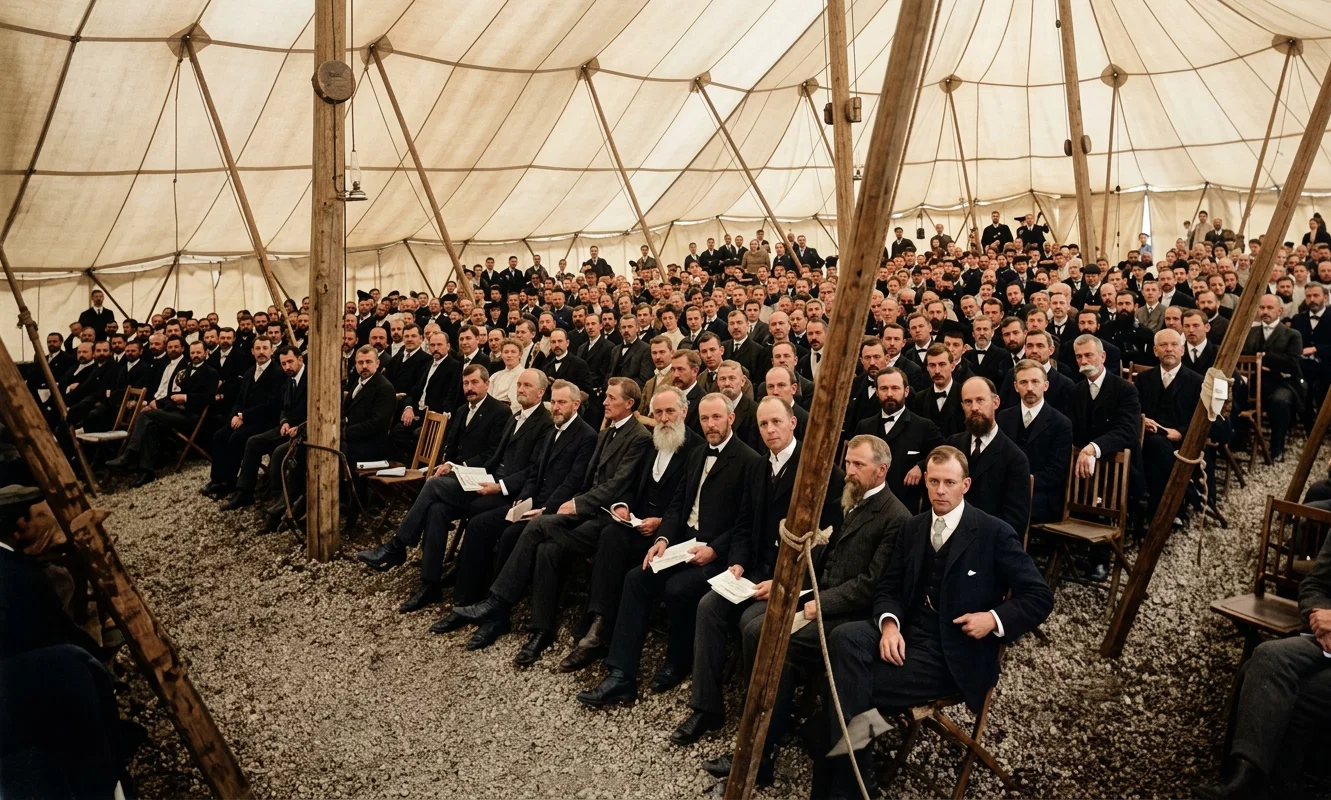
THE GENERAL CONFERENCE IN SESSION

Lake Union Conference

The five States of the Lake Union have a population of 15,985,581. The eight conferences report 456 churches, with a membership of 16,044. The tithe for 1904 was $131,987.72, or about $8.22 per capita. Its offerings for missions, reported from all sources, amounted to $22,476. There was some decrease in tithe last year, attributable to damage to crops in Northern Michigan and Wisconsin. The Northern Peninsula had been a separate mission field, but has now been included in the territory of the North Michigan Conference. This conference has received aid from the East and West Michigan Conferences and from the Lake Union Conference.
There is a good degree of spiritual life among believers in the conference. It has ninety-eight ministers and thirty-nine licentiates, besides Bible workers and canvassers. As a result of all the labors in this territory, over sixteen thousand souls have been gathered out of a population of fifteen millions. There has been inequality in the distribution of labor; for instance, Illinois has one third of the population of the Lake Union Conference, but has only one tenth of the membership, and the Illinois staff of laborers is correspondingly small.
The Lake Union territory has within it sanitariums at Battle Creek, Mich.; Madison, Wis.; Moline, Peoria, Chicago, and Hinsdale, Ill.; and Connersville, Ind., while many are engaged in treatment-room work in various cities.
There are schools doing college work at Berrien Springs, Mich., and Mt. Vernon, Ohio, and intermediate schools at Cedar Lake, Mich.; Bethel, Wis.; Sheridan and DuQuoin, Ill.; Boggstown, Ind.; and Holly, East Michigan. An excellent class of young people are training for service in these schools.
The laborers of the Lake Union desire unity in service on the basis of the truth of God, and then to inspire all to renewed zeal and consecration for the accomplishment of the work, not only in the local territory, but in all the world.
The Chair called upon W. H. Thurston to present the report of the Canadian Union Conference. The following is a brief summary:—

Canadian Union Conference

The Canadian Union territory embraces the provinces of Ontario, Quebec, New Brunswick, Nova Scotia, Prince Edward Island, and Newfoundland. Area, 662,350 square miles; population, nearly 5,000,000. Conferences: Ontario, Quebec, Maritime (New Brunswick, Nova Scotia, and Prince Edward Island); mission field, Newfoundland. Churches, 39; isolated, 93; total members, 990. Ministers, 12; licentiates, 4; Bible workers, 4; canvassers, 8. There were 62 accessions to the membership during the term.
The Lornedale Academy is located in Ontario, fifteen miles from Toronto, and the Farmington Academy in the Maritime Conference, fifteen miles from Oxford Junction. These academies are in their second year. They were started amid difficulties, but the brethren were determined to provide a way for the training of their young people. Church-schools, five.
In 1903 the Knowlton (Quebec) Sanitarium was established by the Quebec Conference, Dr. W. H. White in charge. About twenty-five patients can be accommodated, and the institution has been generally full of late. It is exerting a wholesome influence. It is a training center for workers also. Treatment rooms have been started in Lindsay, S. Baker in charge. Dr. C. V. S. Boettger and his wife have a hygienic institute in Ottawa, doing good work. A French sister, V. Gobeille, has successful treatment rooms in Montreal.
The tithe for 1904 was $8,034, an increase of $629 over the previous year. The book work requires attention. The retail value of books sold was $11,481. On account of heavy freight duties, distances, and expense, it is recommended that the Canadian Union depository be discontinued, the local conference tract societies re-established, dealing directly with the publishing house. Ministerial laborers are needed in various parts, and funds for the partial support of a French worker, who could be sent into the field in Quebec if three hundred dollars a year could be secured. The great French-Catholic field is destitute.
Following a solo by Elder L. C. Sheafe, the report of the Central Union Conference was called for, and presented by E. T. Russell, the president. A brief summary follows:—

Central Union Conference

The Central Union includes six States, the territory of New Mexico, and the Black Hills region of South Dakota. Area, 616,531 square miles; population, 9,000,000. Churches, 355; membership, 12,042. Unorganized companies, 96. Total Sabbath-keepers, 14,136, an increase during the term of but 342. This low record is due to revision of church lists. During the term many additions were made, and forty-three new churches were organized.
During the two years, three intermediate schools and two intermediate and industrial schools have been established. Ministers, 75; licentiates, 62; missionary licentiates, 100; canvassers, 55. Tithe for 1903, $114,523.19; for 1904, $112,242.98. Amount appropriated to fields outside the Central Union, $20,804. Offerings to missions, $70,434. Book sales, $78,708.
Union College has had an average enrolment of from three hundred and fifty to four hundred students. Most of the industrial departments are more than self-supporting. Religious interests have been excellent. The Stuart (Iowa) Industrial School has averaged sixty-five students. At the opening of the school year half the students made no profession of religion. By the middle of the year all had made such profession, and with two exceptions, the experience seems genuine. It has been wonderful to see the changes wrought, and this with no revival effort. Another industrial school has been established at Palisades, Colo. Intermediate schools are planted at Thayer, Kan.; Hemingford, Neb.; Hygiene, Colo.; and College View, Neb.
The Colorado Sanitarium (Boulder) had last year one of the most successful years in its history, financially and religiously. The Iowa Sanitarium (Des Moines) has similarly prospered, graduating twenty-two nurses during the term. The Nebraska Sanitarium (College View) has had from thirty to forty patients on the average. The religious interest has been excellent. About fifty nurses are employed. The Kansas Sanitarium (Wichita) is not fully completed, but is receiving patients. The institution has twenty acres of agricultural land. There are four health food factories, and seven treatment rooms, in the Central Union, two private sanitariums, and four or five vegetarian restaurants.
Iowa is supporting twelve workers in other fields, and places half its staff and tithe at the disposal of the General Conference. Nebraska voted five workers and their support for three years. Kansas offered two laborers, with support. Colorado is supporting two laborers in Africa, and offers two more for needy fields. Missouri offers two workers for mission service.
We praise God for putting it into the hearts of the brethren in this union conference to respond so liberally. At the same time we acknowledge that more should have been done in all departments. Our conference is located in rich agricultural territory, which gives us an abundance of resources to develop and use to the glory of God.
The meeting adjourned.
G. A. IRWIN, Chairman, W. A. SPICER, Secretary.