WHILE not the most populous, the mission fields of the Pacific between the Americas and Asia are the most widely extended of any mission field in the world. Reaching from Easter Island, one hundred and ten degrees west longitude, to the northwest point of Sumatra, in ninety-five east longitude, are thousands of islands, great and small, inhabited by many diverse races, numbering approximately fifty million souls.
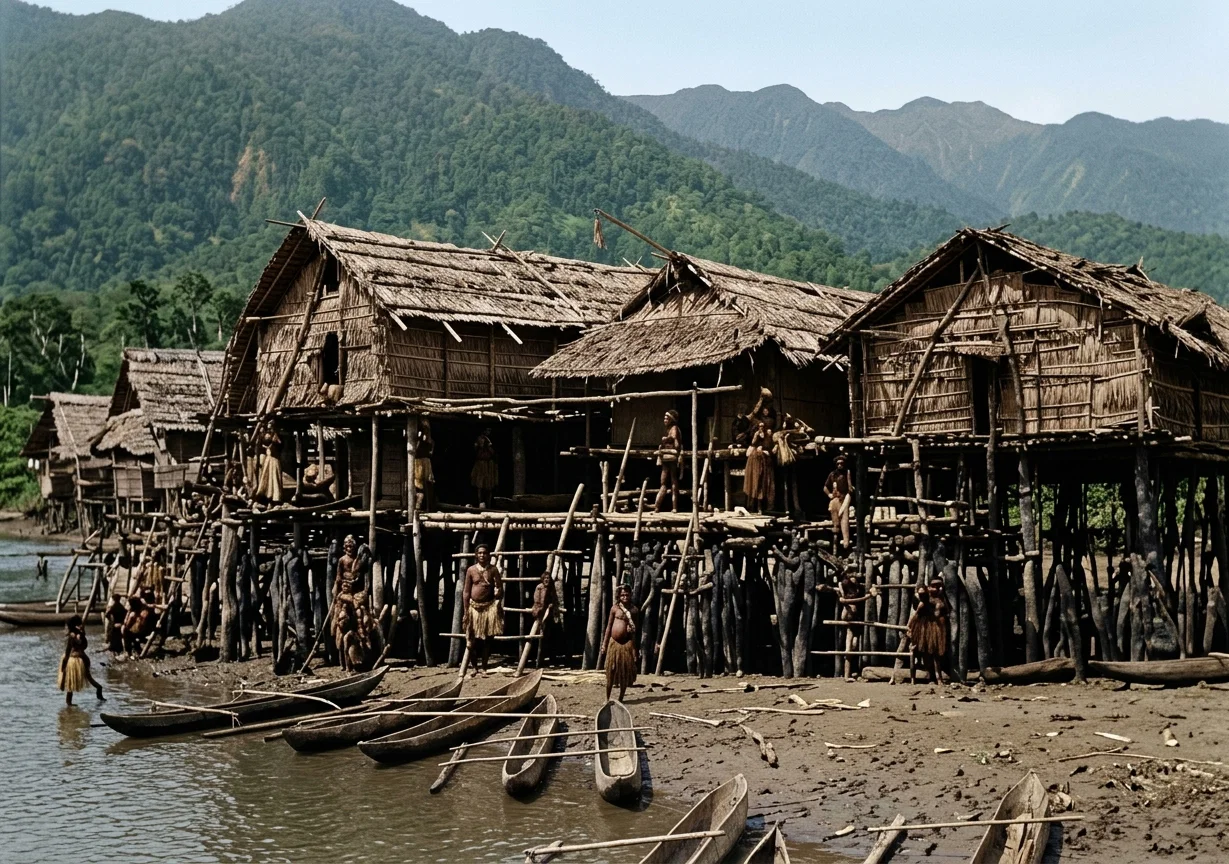
A NEW GUINEA VILLAGE
Of this great multitude of human creatures, many millions are Mohammedans, large numbers are pagans, savages, and cannibals, while interspersed among them are white men representing many of the European nations.
For the sake of convenience, this great oceanic field is divided into Polynesia, Melanesia, Micronesia, and Malaysia. Polynesia includes the island groups east of the one hundred and eightieth meridian. The term Melanesia refers to the savage islands north and northeast of Australia. Micronesia, meaning “small islands,” includes the islands between the Philippines and the one hundred and eightieth meridian, while Malaysia comprehends the thousands of large and small islands between Australia and Asia—Sumatra, Java, the Philippines, etc.
In most of the islands as far west as Fiji, Christianity was introduced many years ago; but, in the general apostasy, the native races have suffered as much as any other people, and are in the same pressing need of the gospel as when they were first discovered.
The opening work of the third angel’s message in the islands was done by one of our brethren from California, who held a series of meetings in Honolulu, about 1885. The next year Brother Tay went to Pitcairn Island, and gave the message. In 1890 the missionary ship “Pitcairn” was built, and sent out to the South Seas, since which missions have been established in the principal groups of Polynesia. Previous to 1901, the work in the islands was directed from America, but since that date has been under the Australasian Union Conference. At the last General Conference, the East Indian field, or Malaysia, was placed under the direction of the Australasian Union Conference, so that now all Oceanica, except the Hawaiian Islands, is subject to the above-named conference.
In a communication given two years ago through the spirit of prophecy, the statement was made that “upon the Australasian Union Conference rests the burden of giving the third angel’s message in the islands of the Pacific.” Australasia has accepted the burden, and is trying to make the work in the islands self-supporting as far as its limited resources permit.
Eastern Polynesia
Since the last General Conference, we have organized the islands in the eastern Pacific—Society Islands, Cook Islands, Pitcairn, the Marquesas group, the Austral Islands, Gambier, and the Paumotus—into the Eastern Polynesian Mission, and have held two conferences with delegates from the different groups. This arrangement has proved a blessing to the work in various ways.
In the Society Islands our membership does not show a great increase, as quite a number of the older brethren have died. The work of getting the truth before the natives is onward, and the plan of the workers is to push the work constantly into new fields. Since the last General Conference a new church building9has been dedicated in Tahiti. The book, “Christ Our Saviour,” has been translated, and is ready for the press. The work will be done on our press at the Avondale School in Australia. The superintendent of the mission hopes soon to open up the work in the Marquesas Islands, a group as yet scarcely rescued from paganism. He expects soon to visit Pitcairn, where a new church building is ready for dedication. One or two new workers are being developed among the believers in the Society group.
The school in Raiatea in this group is doing good work. At the close of our council at that place last year, five of the students were baptized. The location of this school is an ideal one, being situated in a beautiful valley, five miles from the wicked town. This school is recognized as the central school of the Eastern Polynesian Mission field, and has students from three different groups. This school is helping to solve the problem of saving the youth and children to the cause.
In Rarotonga, Cook Islands, we have about fifty Sabbath-keepers. The native brethren have been sorely persecuted for their adherence to the Sabbath, but most of them have continued faithful, and some new ones are accepting the message. A very neat church building, twenty feet by forty feet, was dedicated one year ago. A church-school, having twenty-three scholars, is doing excellent work for the children. An abridged translation of the book of Daniel is going through the Avondale press, and will soon be ready for the market.
Cook Islands
In Mangareva, Gambier group, a leading white man and one or two others have accepted the truth. This, being one of the dark spots of Polynesia, demonstrates the power of the truth to save from the depths of sin.
Tongan Islands
This is one of the island groups first evangelized by the London Missionary Society, but has shared the general apostasy from the spirit of true Christianity. All the natives profess Christianity, but are more difficult to reach than almost any others I have met. However, we have here a small church, composed largely of white people, who are revealing the fruits of the Spirit. In the matter of tithes and offerings, they stand among the best. Last year a church-school was opened, which is doing good work for the children and youth. Several of our tracts have been translated into the Tongan language, and are doing their work of warning.
Samoa
In this group we have a well-equipped sanitarium. As the result of the work done by literature and the medical workers, a white man of worth accepted the truth last year, whom I had the privilege of baptizing a few weeks ago. At the time of my visit there in March last, a Samoan half-caste began the observance of the Sabbath. An edition of “Christ Our Saviour” has been printed for use here, and is being readily received by the natives.
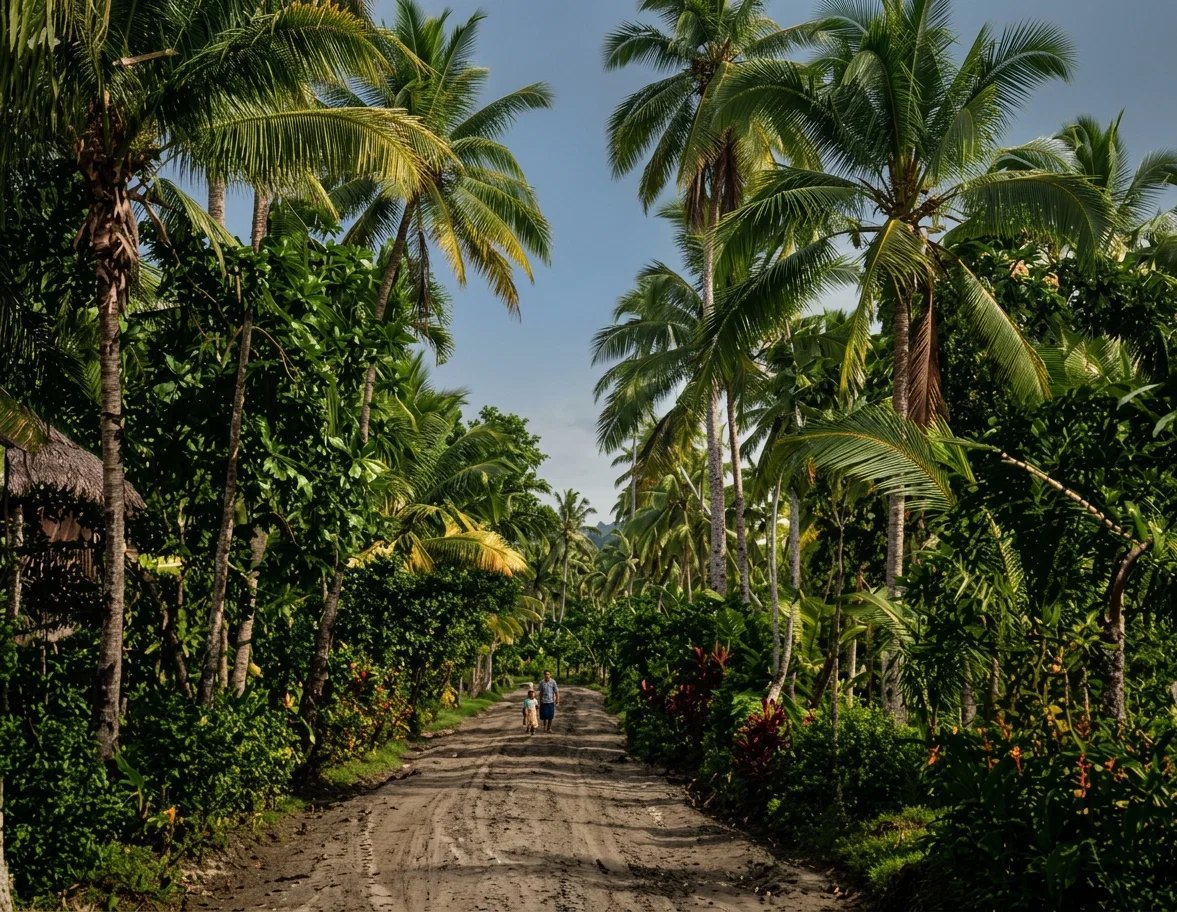
THE ROADWAY TO THE SAMOAN SANITARIUM
Fiji
The work done in this old cannibal archipelago, which was at one time the terror of the South Sea, is of a most interesting character. Including children and youth, there are now nearly two hundred Sabbath-keepers in this group, which has a population of about one hundred and twenty-five thousand. A monthly paper, the Rarama, printed in the native language, is doing excellent work for the natives. The work of printing this is done on a small press right in the field. Good-sized editions of tracts on the Sabbath, the second advent, and other subjects are also doing their work. An abridged edition of “Great Controversy,” also a book of Bible readings, has been translated into Fijian, and are meeting with ready sale. One native man, formerly a Wesleyan minister, is doing excellent work in giving the message. Two or three native young men assist as teachers. Two young natives from this group are being educated in our school in Australia, who expect to become missionaries in Melanesia.
One of the most interesting features of our work in Fiji is the proposed industrial school for native youth. A site, consisting of four or five hundred acres, was secured at a very reasonable rental. From here we hope to send out workers to New Guinea, Solomon Islands, New Britain, and other heathen islands.
East India
We have now come to the time when work must be vigorously entered upon in this great and populous field. Here in what appears on the map to be a small group of islands are thousands of islands, inhabited by millions of people, the majority of whom are either Mohammedans or pagans. Java alone has twenty-five million inhabitants. In these islands also are thousands of Dutch people, many of whom are educated and wealthy. The Philippines, with a population of from seven million to ten million, should immediately be entered by our workers. A doctor has already offered to go there as a self-supporting worker. Canvassers from Australia will soon be in the field. The Malay Peninsula properly belongs to our mission, and the General Conference will be asked to make it a part of our field.
Sumatra
In west Sumatra we have a church of twenty members, principally Chinese. Work was begun there about five years ago. It was an interesting sight to me to see here old men and women, once idolaters, who had cleared their houses of idols, and were worshiping Jehovah. This is a very difficult field to work, on account of the enervating climate, the low spiritual condition of the professed Christians, and the paganism and Mohammedanism of most of the inhabitants of this great island of three million people. But God is blessing the efforts of our missionaries. It was here that the young Chinaman received the truth who was instrumental in the conversion of the educated Chinese brother in Amoy, China, within the past year. Matter is being prepared by our Sumatra missionary to be translated into the Malay for circulation among the Mohammedans.
Our missionary in this field has been looking up a site for another mission, and writes as follows of a new field which should be opened:—
“I saw the resident this morning, and got a grand report from him. The people in question are just Malays that have not been contaminated by Islam or apostate Christianity. They inhabit the most beautiful country, at an altitude of from two thousand to three thousand feet above the sea. They are an agricultural people. They occupy forty villages, and number twenty million. The resident offered me much encouragement. He is going to visit them within the next three months, and will interest them in building a house for the missionary, and a schoolhouse, and will assure them that we will supply the teacher. He is confident that we will have success from the start. They are a quiet, peaceable people, of good temper and few evils. He assured me that by the end of the year the Kesan country will be accessible by carts from the point where we leave the river.”
The writer further says: “I am impressed that it is a great opportunity, which we must not neglect to improve at once.”
Singapore
This important mission field, being a city of nearly a quarter of a million souls, located in a very favorable position with reference to the Malay Peninsula, Siam, Netherlands East Indies, and the Philippines, has already been10entered by one of our ministers and his wife and a canvasser, all from Australia. This canvasser is doing well in Singapore and the Malay Peninsula. A bitter spirit of opposition has been started against our work by the other missionaries; but still the work moves on.
The first fruit in this mission was the conversion of a Chinese woman. A letter just received from our missionaries in this field tells of an educated Cingalese Tamil, who has just begun the observance of the Sabbath, and who has refused a good position in order to do so. It also tells of finding a lady, formerly from Rumania, who, with her mother and grandmother, has always kept the Sabbath. Our laborers there are kept exceedingly busy, visiting, nursing, teaching, giving Bible readings, and holding meetings. There is probably no other city on earth having representatives from so many nations as has Singapore. Already our workers are calling for a doctor, nurses, and a printing-press, which we hope to supply soon. A letter received only last night tells of two nurses from the Wahroonga Sanitarium who are now on their way to that important field. The Lord is going before us to prepare the way, and with hope and courage we enter upon the great work of warning the large number of pagans and Mohammedans in that wicked city.