While I am deeply sensible of the magnitude, the importance, and the urgency of the work to be done in this great field, yet I confess to a feeling of peculiar pleasure in being permitted to lay before this conference the needs and claims of China as they have appealed to me during my comparatively brief stay there.
Standing, as she does to-day, an object of absorbing interest, and even grave concern, to the whole world politically, industrially, and commercially, China might well engage our attention from any of these considerations. But viewed from the standpoint of the message we bear our chief concern can only be the problem of her evangelization.
The first Protestant missionary to set foot in China was Robert Morrison. He entered the empire in the face of tremendous and most forbidding obstacles. The feeling against all foreigners was decidedly hostile, and it is marvelous how this man, almost single-handed, performed the gigantic task of translating the entire Bible and preparing a dictionary of the Chinese language; and all this time he was confined within the limits of the “foreign factory,” living in a godown, aided by a single Chinaman, whose secret but determined efforts in behalf of Morrison were a capital crime.
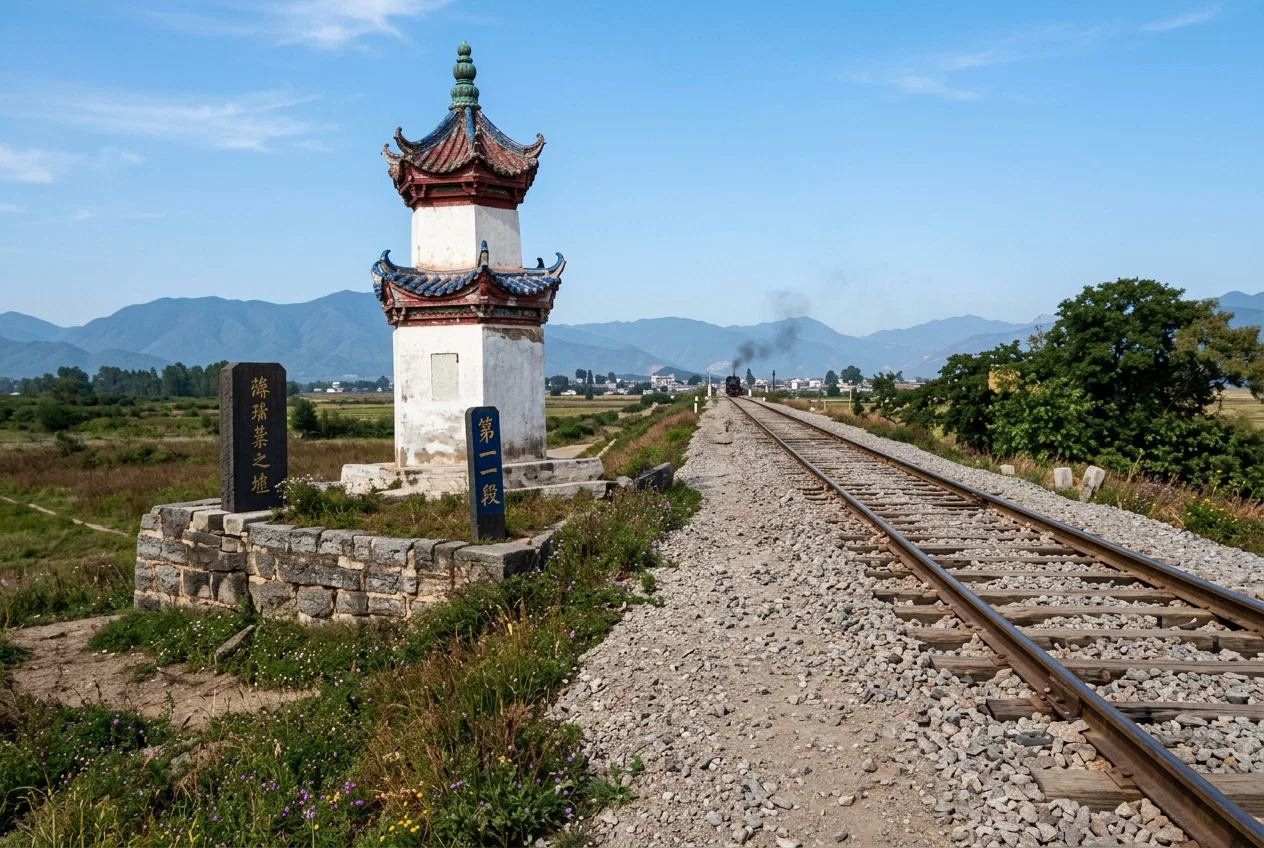
THE FIRST RAILROAD IN CENTRAL CHINA
Thus the Protestant missions in China began with the Bible as a foundation. And to this fact must be ascribed whatever success has been attained. In the year 1900 the total foreign force was 2,727 workers, assisted by a native force of 5,112, and representing fifty different missionary societies. The total number of communicants is estimated at one hundred thousand, while the baptized number about doubles that figure, being distributed in all the eighteen provinces. Since the uprising of 1900, all the preceding figures have been largely augmented, and the auxiliary agencies, such as schools, Bible societies, hospitals, etc., have come to be mighty forces in the work. Last year two million copies of the Scriptures entire, or in portions, were distributed by the agents of the three Bible societies. All things considered, these evangelical forces are quite evenly distributed throughout the eighteen provinces. The Word of God in a written form is winning its way into the homes of this people, rich and poor, in a most remarkable way now, in these busy days of the Lord’s active preparation.
The Inauguration and Present Status of Our Work
As we enter upon a brief review of our work in China, we must all feel that we entered this field at the eleventh hour; for not until the year 1901 did Seventh-day Adventists address themselves with any definite active purpose to the giving of the third angel’s message to the masses of this empire. At the General Conference held in the spring of that year, it was voted, upon our own request, to send Mrs. Anderson and myself to that field. In the following November, Miss Ida Thompson was recommended by the Mission Board to accompany us. By advice of the Board, we went to Hongkong, since Brother La Rue was there, and for the additional reason that we needed a temporary stopping place, which would afford us an opportunity to study the situation, preparatory to entering actively upon our work for the Chinese.
It is scarcely necessary to say that Hongkong is not China, nor even a part of China, but a distinctively English colony. Here Brother La Rue, by his own choice and the sanction of the Mission Board, had been carrying on ship mission and colporteur work since 1888. Almost alone, this veteran of the message wrought a splendid work among the sailors and soldiers and other seafaring people. Not only in Hongkong, but in Shanghai, Japan, Singapore, Borneo, and at the ports of call between Hongkong and Palestine, this faithful brother sold hundreds and even thousands, of our standard books, supplemented by the distribution of a vast amount of our other literature. This was his work. But in addition to this, he saw an opportunity in his acquaintance with Mok Man Cheung, a colonial court translator, to do something for the large Chinese population of the island of Hongkong. The result of his effort was the translation of two tracts, which were scattered by the thousands, but without any apparent fruits.
On our arrival, we found Brother La Rue an old man of four-score years. And, while still young in spirit, and well-preserved, he was taken, just after our arrival, with a severe attack of pneumonia leaving him in a condition which clearly made it our duty to stay with him and share the burdens he had so bravely assumed. That whole year yielded us little or nothing in the way of preparation for work among the Chinese, but we were permitted to see eight persons, with one exception members of the British navy, baptized, largely as the result of this brother’s work. Others heard the message, one at least of whom was baptized later.
The last of October, 1902, our force was increased by the coming of Brother E. H. Wilbur and his wife, who a month later entered the city of Canton, the metropolis of all China, and thus were the first missionaries under the direction of a Seventh-day Adventist Board to actually enter the Chinese empire. A month later—Jan. 1, 1903—Elder Erik Pilquist and his wife, being released by the British and Foreign Bible Society, connected with our mission, and at once began work in the province of Honan in central China. In November of that same year, they were re-enforced by six new workers,—the Drs. Selmon, Drs. Miller, and the two nurses, Miss Simpson and Miss Erickson.
To speak briefly, our work in China has now entered three provinces; namely, Honan, Quangtung, Fukien. In the province of Quangtung we have, in the city of Canton, one station, manned by Brother E. H. Wilbur and his wife, Mrs. Anderson and myself, and Miss Ida Thompson, together with Brother A. C. Tidbury, a young Englishman lately out of the British navy, who teaches in our Anglo-Chinese school. With the assistance of four native helpers, we are carrying on a girls’ school, two boys’ schools,—one English and one Chinese,—and regular public meetings in one chapel. Bible work is also carried on among the women. So far, none have been baptized, though several are waiting baptism upon my return. We are all able to do some work in the Chinese language, yet each one of us devotes about three hours daily to the study of the language.
The work at Amoy, in Fukien Province, is at present carried on as an outstation of the Canton Mission, though it is probable that Brother and Sister Hankins are by this time on the ground, preparing to look after that mission which gives us entrance to millions. At the time of my last visit there, three had taken a stand for the truth, with Brother Keh, who has already preached the truth extensively in those parts.
In the province of Honan, distant from Canton in a straight line about nine hundred miles, we have four stations, with two foreigners at each station, except at Dr. Miller’s, where, since the death of his companion, he now remains alone. Brother Pilquist, being already familiar with the language, was able to enter at once upon active work. He reports forty-one baptisms for last year, with a church organized at Losan. Sister Pilquist has a girls’ school, and22works for the women. Extensive work is also carried on in the surrounding villages, in the way of preaching and distributing Bibles and other literature.
At the other three stations, active work is being carried on in waiting on the sick, teaching the word, both by the missionaries and by their native helpers. As with us in the south, all the workers devote regular hours to the study of the language, and encouraging progress is being made, which fact in itself is of great value, since it is by no means infrequent that missionaries to China meet with sad failure on this very point. Our working force consists of twelve foreigners, all laboring in the Chinese, and for the Chinamen. These are assisted by nine native helpers.
A beginning has been made in the preparation of literature. In addition to the two tracts put out by Brother La Rue, we have now ready for distribution a tract on the Sabbath, a second one setting forth God as the true and only God, based on the first chapter of Genesis, while a third tract, intended primarily for school work, deals with the first seven chapters of Genesis on the catechetical plan. Other tracts are ready for publication, and still others are in preparation. We wait only for means. The small hand-press donated to the mission is now being set up by Drs. Miller and Selmon, on which we hope to print a large quantity of small tracts and leaflets. The Chinese have profound respect for letters, and our literature must necessarily act a most important part in that field, though it is important for us to remember that beyond a peradventure, it will have to be put out at a financial loss. In general, Christian literature in China is sold at about half the cost of production.
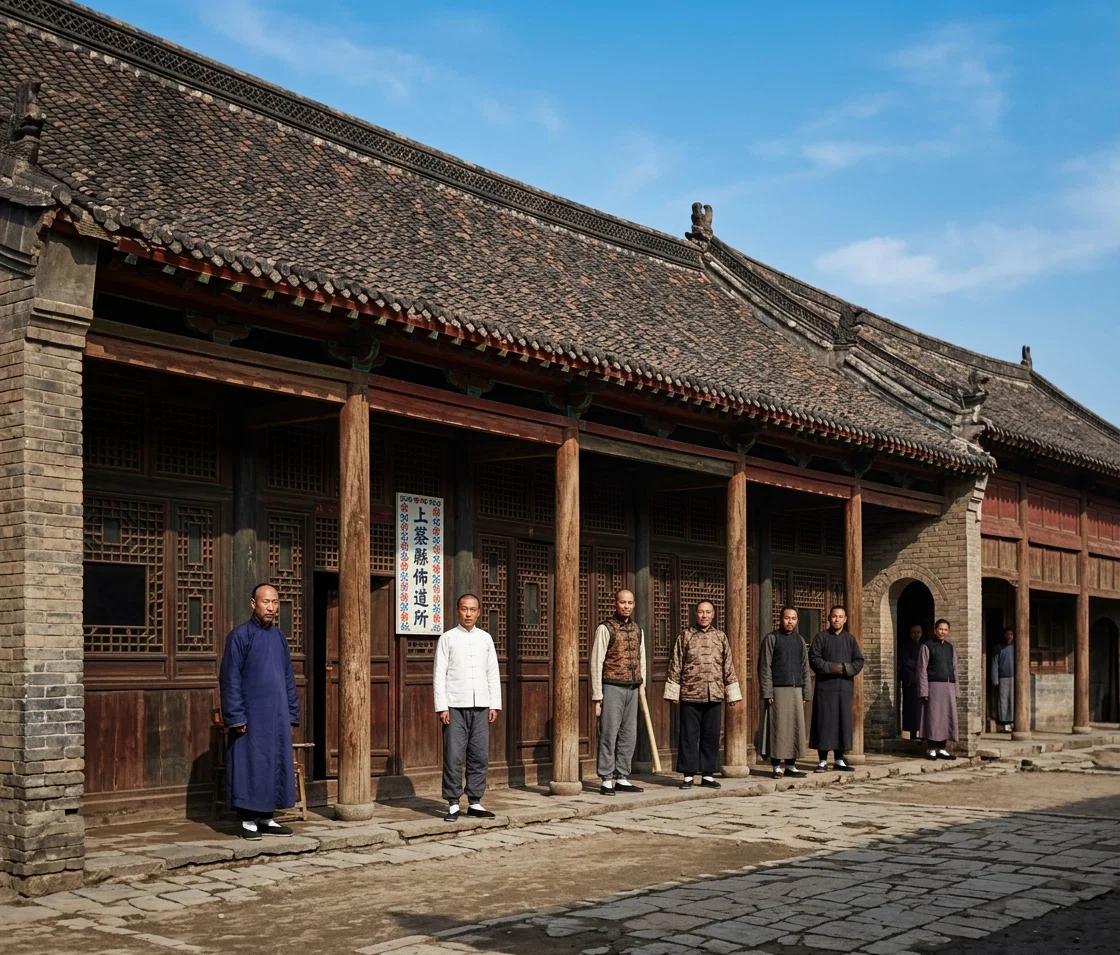
THE SHANG-TSAI HSIEN MISSION
Prospective
While our work in China is small, and only in its beginning, yet it is a beginning. We have entered three provinces, with an aggregate population of seventy million. Do you ask what remains?—Beyond are fifteen additional provinces, with an aggregate population of 325,000,000. Besides these, on her northern and western borders lie China’s great dependencies, in point of area even larger than the eighteen provinces of China proper. These are known as Manchuria, Mongolia, Turkestan, and Tibet. We must strengthen the work which is as yet but slenderly manned, and as fast as God gives us means and consecrated leaders, press on into the unoccupied provinces. I say leaders, because, while native workers can and must be trained to do a vast proportion of this work, the responsibility of directing and molding must fall to the foreign missionary. The conditions in China call for a very careful selection of workers. The mastery of the language, especially of the characters, is in itself a life’s task; and if by close, persevering work, a person acquires a good working knowledge of it in from three to five years, he has made a good showing. All the languages of China are not equally difficult. The Mandarin, which, to speak broadly, is used by fifteen out of the eighteen provinces, is perhaps the least formidable. But in any case it requires an active memory and a mind trained to habits of close application. After that comes the study of the people and of their customs and habits, more difficult than the language itself. To stand alone as leaders against a surging tide of heathenism, craven superstition, and insidious philosophy, requires character that rests on the rock of eternal truth. It is quite impossible to understand the full meaning of this until one has stood alone with his God, thousands of miles away from friends and home, and felt the ceaseless waves of spiritual darkness beating up against him. But God has swung wide open the door of entrance and opportunity to every province of this great empire, and years of careful preparation urge us to enter without delay.
In behalf of the members of the China Mission, I wish to express appreciation and gratitude to you for the loyal way in which you have extended sympathy and support to the work in that field. And I will further say that our confidence in you, and our faith in the message, remain unshaken. As the horizon of our vision is extended, the work grows larger with the passing of each day; yet we know that the mighty promise of our God concerning the land of Sinim abides unchangeable, and while we have made but a mere beginning, our hearts swell with grateful emotions, as we reflect on the measure of success our Father has thus far vouchsafed to us. The work, the means, the agencies, are all the Lord’s, and we have every reason to believe that he has in preparation a host of workers, who have heard or will hear the call and the command of our ascended Jesus, and, like the apostle Paul, respond, “I was not disobedient unto the heavenly vision.”
Since the beginning of our work three years ago, we have been called upon to lay to rest two of our laborers,— Brother Abram La Rue, at the ripe age of eighty-one, and Mrs. Miller, who passed away March 14 of this year, after spending less than eighteen months in the field where she had elected to give her life’s work. We can but bow in sorrow at our great loss in this sister who was just entering upon her labors. While, in our short-sightedness and human limitations, we may fail to read aright the purpose of our Father in this loss, yet we know that his love and his wisdom embrace in all, that all is well, and that in the great spiritual economy of God there are no mistakes, and there is no waste. Life begets life, and every kernel of grain that falls into the earth will surely spring forth and yield fruit.