The Bengali Christian Convention

4%

Review and Herald Publishing Association · Takoma Park Station, Washington, D. C. · Jan 3, 1907

FromReview and Herald, Vol. 84, No. 1.

Read the full edition

The Bengali Christian Convention

A Sign of the Times
W. W. MILLER
SOME weeks ago the editor of the REVIEW AND HERALD apologized for giving so much space to reports of the National Reform Convention and the Catholic Church Federation. Such an apology seems unnecessary, for surely all who are watching the unfolding of events which will soon bring bitter persecution upon loyal Seventh-day Adventists are only too glad to acquaint themselves with the advancement which is being made in this direction.
India, as well as America and other countries, is making rapid progress. In company with Brother J. C. Little and Babu Mitter, I attended a convention held in Gopalgunj, East Bengal. This is the place where Lolgopal Mookerjee and his wife started a mission last spring. Some of the members of the Scotch mission which is located in Gopalgunj became interested, and began to observe the Sabbath and attend Brother Mookerjee’s meetings. This enraged the leaders of the Scotch mission, and they requested us to buy land and move our converts off their ground. We replied that we were not buying converts by offering them land. Many, however, were expecting us to do this, as such has been the custom of some of the other missions.
Hundreds of people visited our mission to see what new enterprise was being started, for Brother Mookerjee was putting up several small buildings, and giving work to quite a number of laborers. Tracts and Bible readings were given to those who came. Many of these tracts were carried to other villages. In this way a great number of persons became interested, and quite a number began to keep the Sabbath, on account of which we had many calls for workers to visit the surrounding villages.
All this seemed to alarm the leaders of the other mission. A convention was called, and delegates came from nearly all the different denominations. Forty-one went from Calcutta, most of whom were ministers and mission workers.
The program announced that on the last day of the meeting five speakers would present the Sunday question, after which time would be given for five-minute talks. We armed ourselves with tracts, and went to hear what they had to say. The house was crowded. On either side of the room were two rows of benches. One side was occupied by the Bengali women, all of whom kepttheir faces about half veiled. We were seated toward the front on the opposite side, but nearly all the congregation sat on the floor, in the center of the room. The musicians sat on the ground in front. Their instruments were very appropriate for such a meeting, and reminded us of those sanctioned by the old blue-laws of Connecticut. Then, it was the drum, and the jew’s-harp; here, it was the tum-tum drum and cymbals.
Only three Europeans were present,—Brother Little, the secretary of the Calcutta Y. M. C. A., who was a delegate to the convention, and the writer. The remainder of the congregation consisted of Bengalies, Hindus, and Mohammedans. All the speeches were delivered in Bengali.
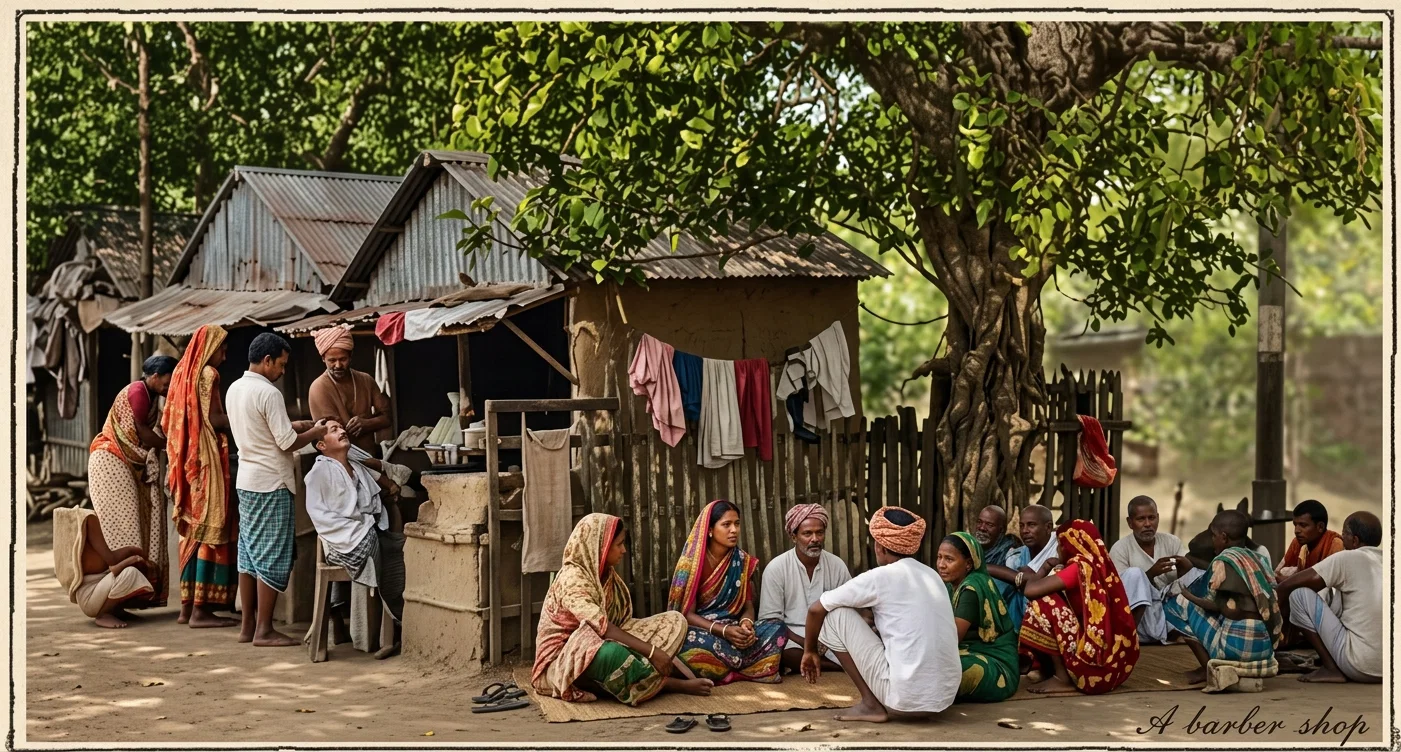
A BARBER SHOP IN INDIA
The chairman, Dr. Rouses, translator for the Baptist Mission Press, gave a few texts to prove, as he thought, that Sunday is the Sabbath, then spent the rest of his time abusing Seventh-day Adventists. One speaker accused Brother Mookerjee of offering land to the people as an inducement to join his mission. A man with long hair then shouted in English, “Shame! Papists!” The speaker then asked what should be done with such people. At once the reply came, “Beat them!” An expression was taken of the congregation to see how many condemned Seventh-day Adventists for these things, and nearly every one arose to his feet. The excitement began to get intense as the speaker thundered his abuses, until it looked as if the suggestion to beat them would be carried out at once.
But the next speaker, a man who seemed to have great influence over them, arose and spoke of Seventh-day Adventists in quite glowing terms. He said that when a new doctrine came into a community, it should not be hastily condemned, but tested in the light of the Bible. He confessed that he knew some Seventh-day Adventists who were very good people, and knew their Bibles better than many belonging to his own mission. This quieted the people for a time. But before he finished his talk, he tried to outdo all the other speakers in condemning us.
Mr. N. J. Bose, the leader of the Scotch mission in Gopalgunj, tried to give a history of Seventh-day Adventists, but he made such a complete failure that it was very evident to all that he was not acquainted with his subject. He declared that the Adventists had come to Gopalgunj because they dared not preach their doctrines to the educated Christians of Calcutta. If they should try to do so, he said, they would be beaten out of the churches. Since the doctrine of the seventh-day Sabbath had been rooted up, he said that the Adventists were going around with charts, on which were pictures of a lot of beasts, and trying to explain Daniel and the Revelation, books which no one could understand. He also said that while at first we taught that all Sunday-keepers would go to hell, now we declared that there is no hell. Whenever cutting remarks were made about us, many clapped their hands. In concluding, Mr. Bose advised them to have nothing to do with Adventists, not to give their daughters in marriage to them, nor eat, nor smoke the hooka (pipe) with them.
These speeches occupied about four hours. Then they abruptly closed the meeting, giving no one opportunity to say a word. The man who offered the closing prayer thanked the Lord that the Adventists were present, and took the remarks made about them so patiently. He also returned thanks for the wisdom used by the speakers, as undoubtedly their words would uproot all that the Seventh-day Adventists had done in East Bengal.
At the close of the meeting, one of the speakers asked me what I thought of the talks. I replied, “You made a great deal of noise and talked a long time, but none of you gave any proof that Sunday is the Sabbath.” He thought they had given plenty of evidence, but when pressed for a text, he replied that any day which a man might set apart to observe after working six days was all that God required. When asked if, according to his argument, the seventh day was not as much the Sabbath as the first day of the week, he said that he would talk with us further about it on the boat. But we did not see him again.
Two different tracts on the Sabbath question were distributed, one written by Dr. Rouse, who is at the head of the Baptist Mission Press, and the other by a Bengali minister. Both contained the same old arguments which we meet in the States.
The morning after the meeting, there was a slight earthquake, which they claimed was the outpouring of God’s Holy Spirit upon them, giving evidence that they had his approval.
We all had to go in small boats to the steamer. We were the first to arrive at the wharf, and when the rest came, they carried out the instruction they had received at the meeting, and took no notice of us. After we boarded the steamer, however, we were so close together that they could not easily avoid us, so we talked with some of them, and gave them to understand that what had been said about us was not the truth. They replied that if such were the case, they had been misinformed and would be glad to be set right in the matter. The man who shouted “Papists” tried to get out of it by saying that we misunderstood him.
Several remained to the celebration of the ordinances, which took place the day after we left; but some, who were close communists, would not remain lest they might be defiled. Thus we see how these churches are ready to unite to persecute Adventists, but they separate when it comes to the communion service.
We left many tracts with those who attended the meeting, among which was “The Law of God as Changed by the Papacy.” Two Hindus who could read Bengali went to the ministers and asked them to show them where they could find a text to prove Sunday to be the Sabbath. They wanted to show it to the Adventists, and get the money offered in the tract. They never came with the text.
While we were in Gopalgunj a Bengali convention was also held in Calcutta. Some Bengalese who believe our doctrines printed tracts and distributed them at the close of each meeting. One of the young men got his ears pulled, one was pushed out of the church, and another was told that the tract would be shown to the lord bishop, and they would hear what he had to say about them.
We have more to fear from the heathen who profess Christianity and are tutored by the churches than we have from the heathen who still worship their idols. All these things are signs of the times, and show that even in India steps are being taken toward the enforcement of Sunday observance.
Calcutta.