Openings in Mexico

7%

Seventh-day Adventist Publishing Association · Battle Creek, Mich. · Apr 21, 1903

FromReview and Herald, Vol. 80, No. 16.

Read the full edition

Openings in Mexico

A. G. BODWELL
HAVING received a large number of letters from our brethren and sisters in the States, inquiring about Mexico, I will give a brief sketch of a portion of the country through which I passed on my trip through the southern part of the republic.
Beginning at Oaxaca, in the State of Oaxaca, and traveling south to Tehuantepec, the country is quite mountainous until the town of Tequistlan is reached, which is about forty miles from Tehuantepec. But scattered all through the mountains are towns, the natives of which speak the Spanish and the Zapoteca (Indian) language. A great deal of mining is carried on in these mountains, and farming on the hillsides and along the banks of the creeks. But there are not any large tracts of tillable land. Stock is also raised.
Between Tequistlan and Tehuantepec the country is quite level, and in some places very sandy. For several miles before reaching the latter place the plantations are very beautiful, abounding in tropical fruits.
The town of Tequistlan would be a good place for some one to locate. Many of the people are liberal, and seem to be open to conviction. Tehuantepec would also be an excellent place. But I shall probably have something to say about it in another article.
Leaving Tehuantepec, and traveling south to Tonala, there is a beautiful strip of country between the Sierra Madre Mountains and the Pacific Ocean. I should judge that it is between twenty and thirty miles wide, in some places wider, in others narrower. At some points the land is covered with timber. At others there are large tracts of prairie, with timber on the creeks and rivers. The people in most of these towns speak the Spanish and the Zapoteca. As a rule they seem liberal, and the power of the Catholic Church is broken to a certain extent. This strip of country is well adapted to farming and stock-raising, and land can be bought for one dollar an acre, Mexican money.
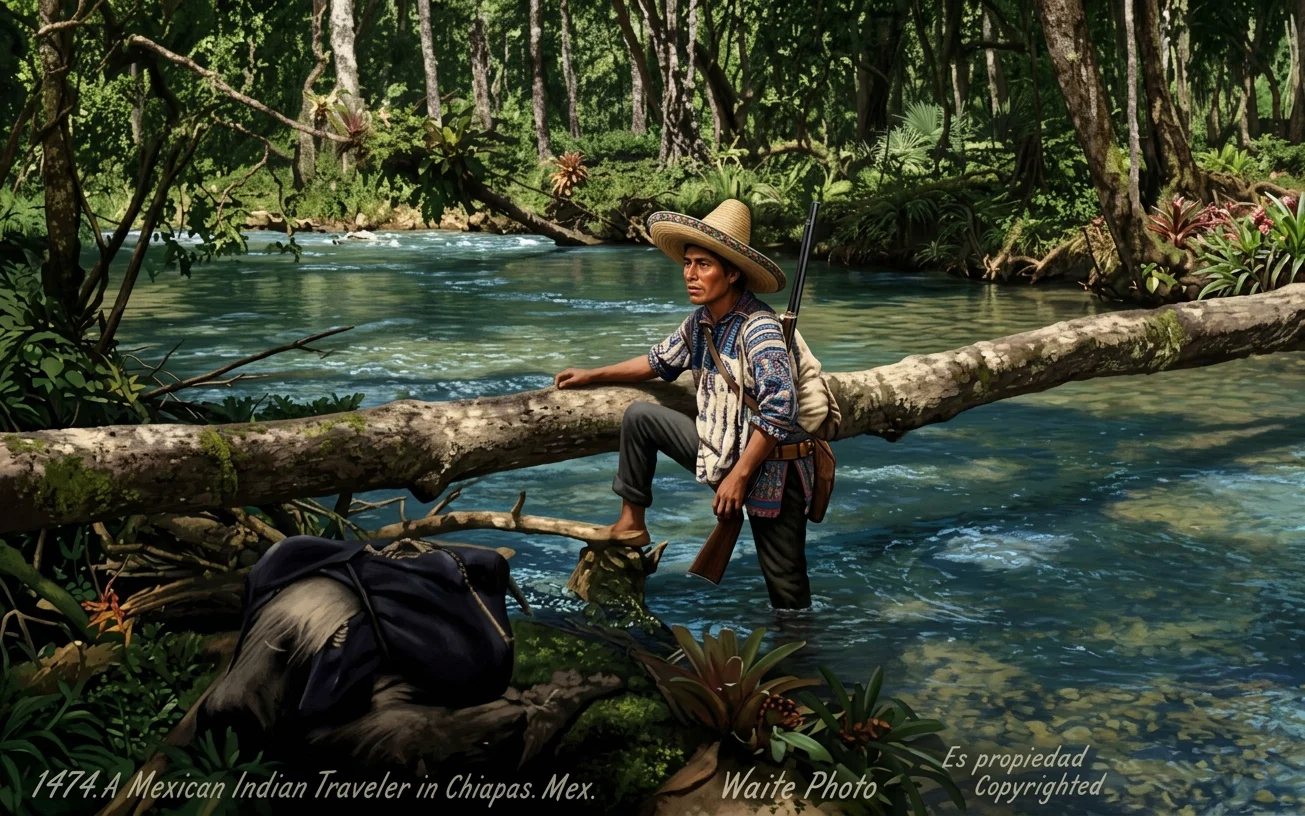
Between Tonala and Tapachula is a country that has wonderful resources, which as yet have not been developed. Passing through this section, one crosses rivers and creeks every few miles, which come rushing down from the mountains with sufficient force to run almost any kind of machinery. These usually have rock bottoms, and the water is clear and cold. The forests produce mahogany and cedar, and many other kinds of timber, the names of which I do not know.
1471. American Indian Trapper in Chiapas, Mex.
In some places I saw the largest trees I have ever seen, with the exception of the big trees of California.
The land is well adapted to stock-raising and farming. A German living near Mapastepec told me that he could raise three crops a year without irrigating. The tropical fruits also do well in this section. There are also some large forests of date-palms. There are many tigers, monkeys, parrots, large reptiles, and other animals of the tropics. Just before reaching Tapachula, I traveled through a somewhat level country. The land was black and sandy. There were good wagon roads, and barbed-wire fence.
A railroad is nearly finished to Tonala, and is to be extended to Tapachula. This will open up all the country, and raise the price of land. In this part of Mexico transportation is not difficult, the land being near the coast; and the new railroad will connect Mexico City with Guatemala. So there will be transportation both by water and by rail.
The district of Comitan, on the other side of the Sierra Mountains from Tapachula, is also a very desirable place for families to locate. While the opportunities for making money may not be so great as on the other side of the mountains, on account of transportation being more difficult, the climate is delightful, and the soil quite rich, being of a black, waxy nature. The country is thickly settled, and land can be bought very cheaply. In or near the towns of Comitan, Pinola, Tuxtla, Gutierrez, and San Cristobal would be excellent situations in which families could settle and do self-supporting missionary work. Through this section horses, cattle, and sheep are raised. Corn, cotton, oats, wheat, barley, vegetables, and fruits are also produced.
Any persons who are thinking of coming to Mexico ought first to know that this is the place where the Lord wants them. Then one or two of the company ought to come and select a place. They should then make an application to the government under the colonization act, giving the number expecting to come, their names, age, nationality, etc., also a list of the articles they wish to bring. If the application is approved by the government, it will notify the custom-house officials to let the party, with all of their freight, pass without having to pay duty. Under this act a person can bring furniture, wearing apparel, machinery, food, horses, cattle, mules, and almost anything needed, free of duty. He is also exempted from all taxes, except stamp and revenue, for ten years.