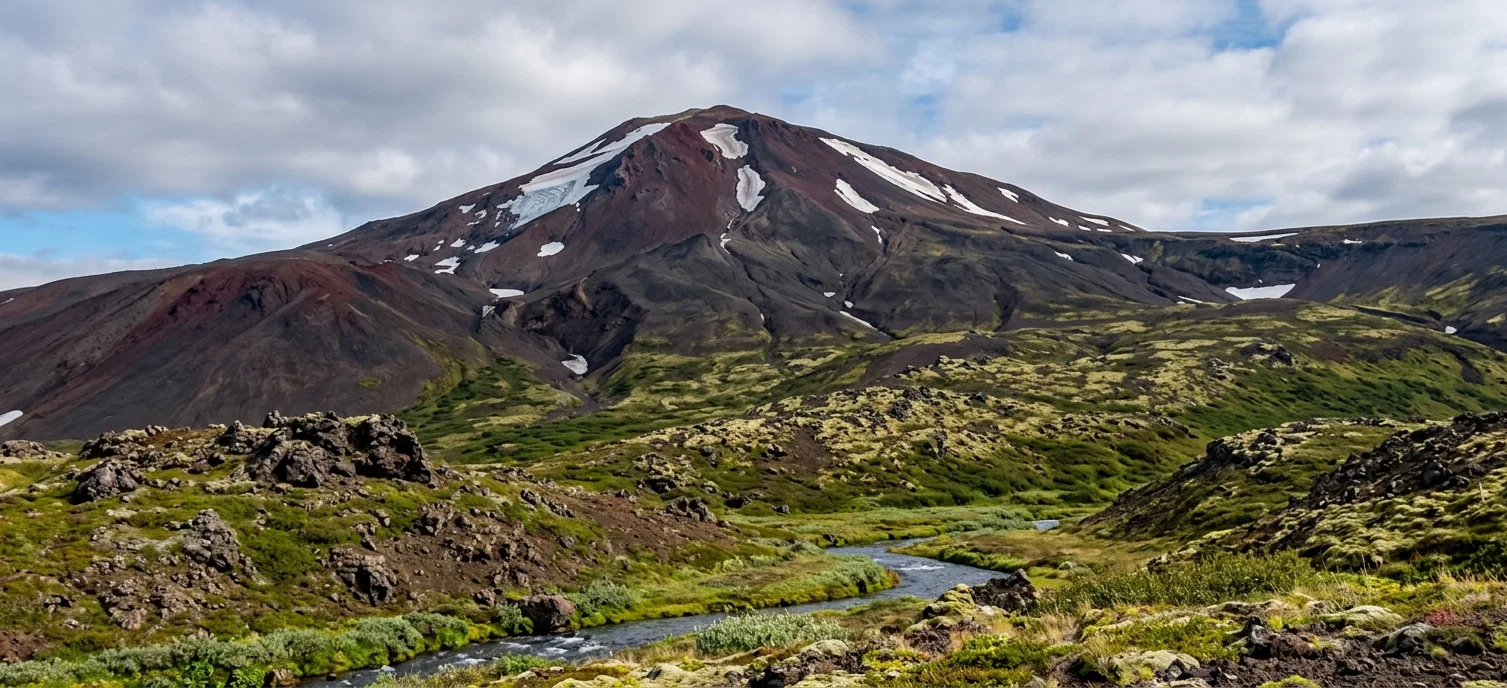
Mountains of Iceland

10%

Seventh-day Adventist Publishing Association · Battle Creek, Mich. · Jun 16, 1903

FromReview and Herald, Vol. 80, No. 24.

Read the full edition

Mountains of Iceland

DAVID OSTLUND
IN some parts of the country the mountains are fifty-seven hundred feet above the level of the sea. As the snow limit is about twenty-five hundred feet above the sea-level, it is believed that there must be large masses of eternal snow.
MOUNT HECLA, ICELAND
These great masses are called “jaclar.” They cover a great deal of the surface, by some estimated at about fifty thousand square miles. The largest of these is called Vatna Jökull, and is in the southeastern part of the island. It covers an area of nearly thirty thousand square miles, and is the largest field of snow in Europe. Its highest point is fifty-eight hundred feet. Out from this great snow field extend other smaller fields, down toward the lower part of the island.
From this some of our readers may think it must be very cold, and a very undesirable place in which to live. But this is a mistake. By scanning the map, it will be seen that Iceland is almost surrounded by the Gulf Stream. This makes the climate very much milder than a person would suppose it to be. The summer is not warm, but the winters are not much colder than in the northern part of America.
The mountainous part of Iceland contains many volcanoes, though only a few of them have been active for the last one thousand years; but that they were at some time active, many of the craters give abundant evidence; and by digging in the soil, there are found in many places layers of ashes several inches in thickness, which can not be explained in any other way than that they were thrown there by volcanic action. From the time that Iceland was first settled, there have been no less than eighty-six eruptions, and of these thirteen occurred in the nineteenth century.
The best known of these volcanoes is Hecla, about five thousand feet high, situated in the southern part. In the last thousand years there have been twenty-one eruptions from this volcano, the last two in the nineteenth century (1845 and 1878). Among other volcanoes, we might mention Katla, with twelve eruptions, the last two in 1823 and 1860; Eldeyjar, with ten eruptions, the last two in 1830 and 1879; Krafla, with four eruptions between the years 1725 and 1729; and Kverkfjöll, with three eruptions—one in 1717, one in 1867, and another in 1873.
The following from the Abbot Arngrimur Brandson (1361) describes graphically the volcanic eruptions on the island: “Some mountains in this land throw out terrible fire and great rocks, and the sound of the explosions can be heard over the whole land; and sometimes these eruptions are accompanied by such darkness that people in the summer time, in the middle of the day, can hardly see their own hands. In the ocean south of the land these eruptions have formed a great mountain, and another has disappeared which had been made in the same way.”
— Seydisfjördi.