THINKING that the readers of the REVIEW would like to know how to work and travel in this part of the world, I will give an account of our trip up the Belize River, from which we have just returned.
Our dory, a canoe dug out of a large log, was well filled with provisions, cooking utensils, our paltikee (a large basket with telescope cover, which, covered with painted canvas, is water tight) well filled with bedding, and clothing, and two large boxes of books. Over all was a large water-tight canvas, to keep everything dry; for this is the beginning of the rainy season. The Belize River, which in the dry season is a very slow and quiet stream, in the rainy season rises from six to ten feet, and becomes a great flood. But these floods, which are used to bring down the mahogany and logwood from the far interior, and from all the little creeks, are the harvest time of the wood cutters. The mahogany is floated down in rafts, but the logwood, which is too heavy to float, is brought down in dories.
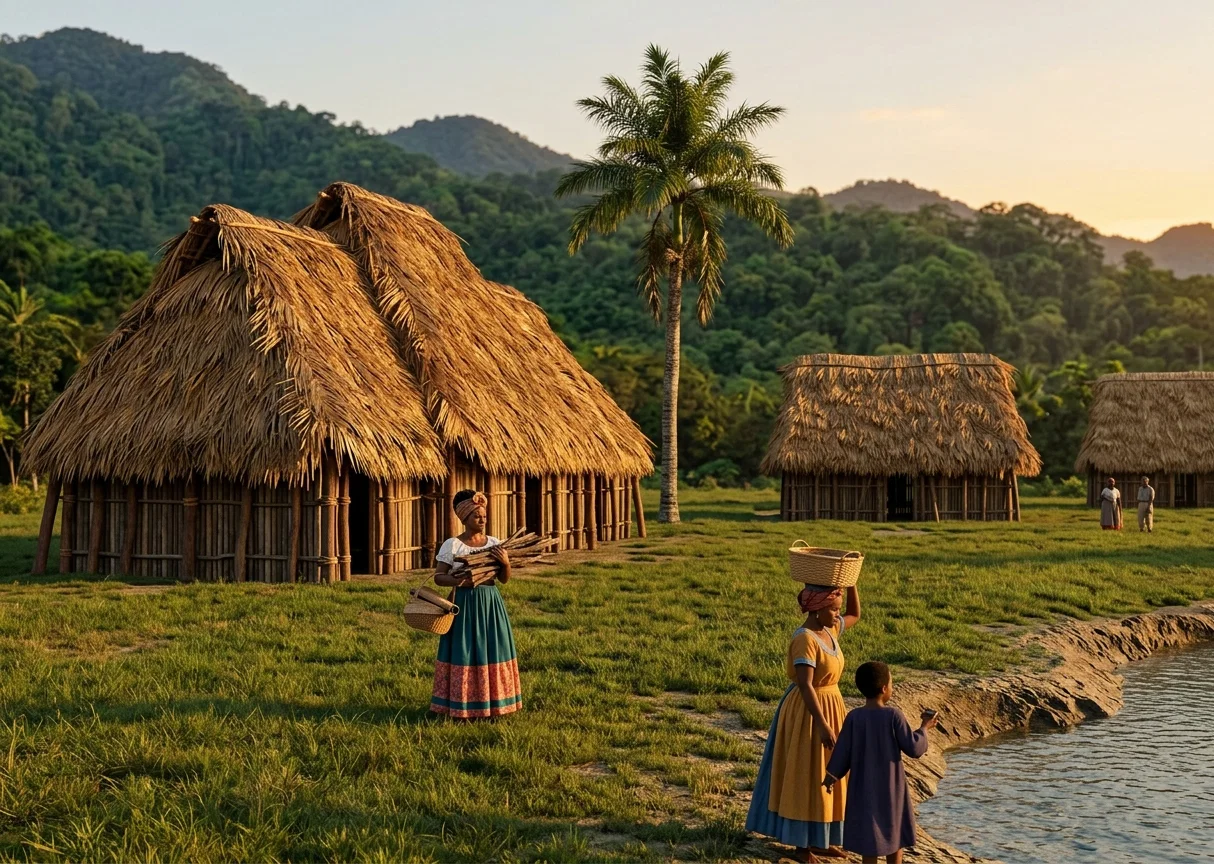
THATCHED HUTS
As there are but few roads in British Honduras, and these very poor, most of the people live along the rivers and the seacoast; and the only way to reach them is by water. There were three of us,—Brother Bennett, who had charge of the boat and the cooking; Brother Brauster, who is our pioneer canvasser and colporteur; and the writer. We left Belize at 3 P. M., June 15, and found no place to stop for the night till nine o'clock. As the house where we made our first stop was a good sample of a majority of those along the rivers and coast of this country, I will give you a description of it. Posts are set firmly in the ground; and to these are lashed with a strong, tough vine called tietie the framework of the walls and roof. The walls are usually composed of small poles fastened to the frame with the tietie vine. The roof is of thatch fastened in the same way, the doors and windows of boards with iron hinges, the floor of clay. The houses are usually divided into two rooms, a living room and a bedroom. At a little distance is the kitchen, built of the same material, but smaller, where the cooking is done over an open fire, sometimes on the clay floor, but more often on a raised platform covered with clay. The baking is done in a large, shallow kettle by building a fire on the heavy iron cover. The living room of this particular house was set apart for our use. So, quickly unloading cots and bedding, we put up our mosquito bars, covered our boat with the large water-proof canvas, and were soon sleeping soundly, not even a heavy rain being sufficient to awaken the writer.
At daylight we were astir. The dory was loaded, and we were soon paddling up the stream. At seven we stopped for breakfast. In this way we journeyed on, stopping at every house. At noon we came to the house of a man named Gordon, who years ago had purchased a copy of “Patriarchs and Prophets,” but having lost it, wanted another. He14was keeping the Sabbath, but did not seem to have any knowledge of our work, and I had never known of him. This man subscribed for the REVIEW, bought books to the amount of ten dollars, and seemed anxious to learn. We expect soon to see him walking in the light of the third angel's message.
That night we came to a good-sized village that used to be of some importance in the mahogany trade. We stayed here one day; and at night I spoke, by invitation, in the Wesleyan chapel and school, taught by Brother Green, whom I have mentioned before as interested in our work. The people earnestly asked us to stay a few days; to this we gladly consented, and stayed three days, holding a meeting each evening. This is a good opening for work, and ought to be improved without delay. I was sorry to leave this place; many heartily shook our hands, and asked us when we would come again, and why they had never heard these things before. Of this people only five or six adults could read, so they must depend more on hearing than reading. The next day at sunset we came to Lime Walk, after a hard day's work.
The river had risen about two feet, and most of the way the current was very strong, so we made slow progress with poles and paddles. At one place there is a rapids of eighty rods or more, where the river is filled with rocks. Here the brethren had to get out in the water, and draw the boat by hand along the bank, carefully avoiding the rocks. At Lime Walk we found Brother Hemsley. He has a daughter living in Belize, who accepted the Sabbath and was baptized soon after I went there. Her father spent a few weeks in town with his daughter, but declared he would go to none of her meetings, believing she was all wrong. But this prejudice was finally overcome. He came to meeting, and not long after began to observe the Sabbath; and the opposition of his neighbors and of his own family has not been able to move him. Some said that if we came there, we should not be allowed to land. It did not prove to be quite so bad as that, but we could hold no meetings with them, and sold only two books. However, we had some good Bible studies with Brother Hemsley and his family, which seemed to break down a great deal of prejudice, and we hope yet to see them all one in Christ.
The next day we came down the river to the mouth of Black Creek on our way to Crooked Tree, which is a good day's journey up this creek. We arrived just at night, very tired from the heat and the long pull up the stream. Brother Brauster went up into the village to find us a place to stay. He soon returned, saying that he was cordially received, and that a place was provided for us. As we were unloading our things, another man came down to the boat, and offered us a place in his house, which we accepted, as it was near by. At Crooked Tree is a strong Baptist society, with a nice church and schoolhouse combined in one building. Their mission worker, Mr. Cleghorn, also from Belize, was here to make them a visit. He met us very kindly, offering us a place to sleep in the schoolroom, which we accepted, as it had a board floor.
Friday was devoted to letter writing and helping Brother Brauster with his canvassing. Sabbath three of the Baptist brethren came in and asked why we kept the seventh day instead of the first day as the Sabbath. So we had a Bible study on the subject. They said it seemed very plain; but they wished to hear their own minister tell his side. Of course I told them that was right; and if he could produce any Scripture for Sunday sacredness, we would all keep it together. But much to their surprise, he refused to come. The next morning the same three men came the second time for another study on the same question. Sunday at 4 P. M. we had an open-air service, our subject being the Signs of Christ's Second Coming. This service was attended by the minister and all the people. We also attended the evening service. Monday evening we had a Bible study on Eden Restored; and as we had had some study on the Sabbath question, it was easy here to bring in that subject with great force. I asked them if in view of such precious promises, we could not give up all for Christ? and all answered in the affirmative. Three promised to give up their tobacco, and one man and his wife said they would keep the Sabbath. We sold a good quantity of books.
Tuesday we started on our way home, the water not being high enough for us to go farther. We reached Belize on Thursday, weary, but very thankful for a Father's care, and still more thankful that we could meet so many people who expressed a desire to know the truth. And they must know it. This trip has brought one thing forcibly to my mind; and that is that I can not stay in Belize. I told the little company here, while speaking from the words, “Go ye into all the world,” that they must no longer lean on the human arm for help, but take the work on their own shoulders, and carry the message to all this people; so that I might be free to go to those who had not yet heard the gospel. Yet the interest in Belize was never better; my correspondence is larger than ever before; the canvassing work must have more attention than hitherto; and yet the vision of those men and women saying, “Why have we never heard these things before?” comes up before me, and I must go. May God lay a burden on some hearts to come and work in the open fields of Central America.