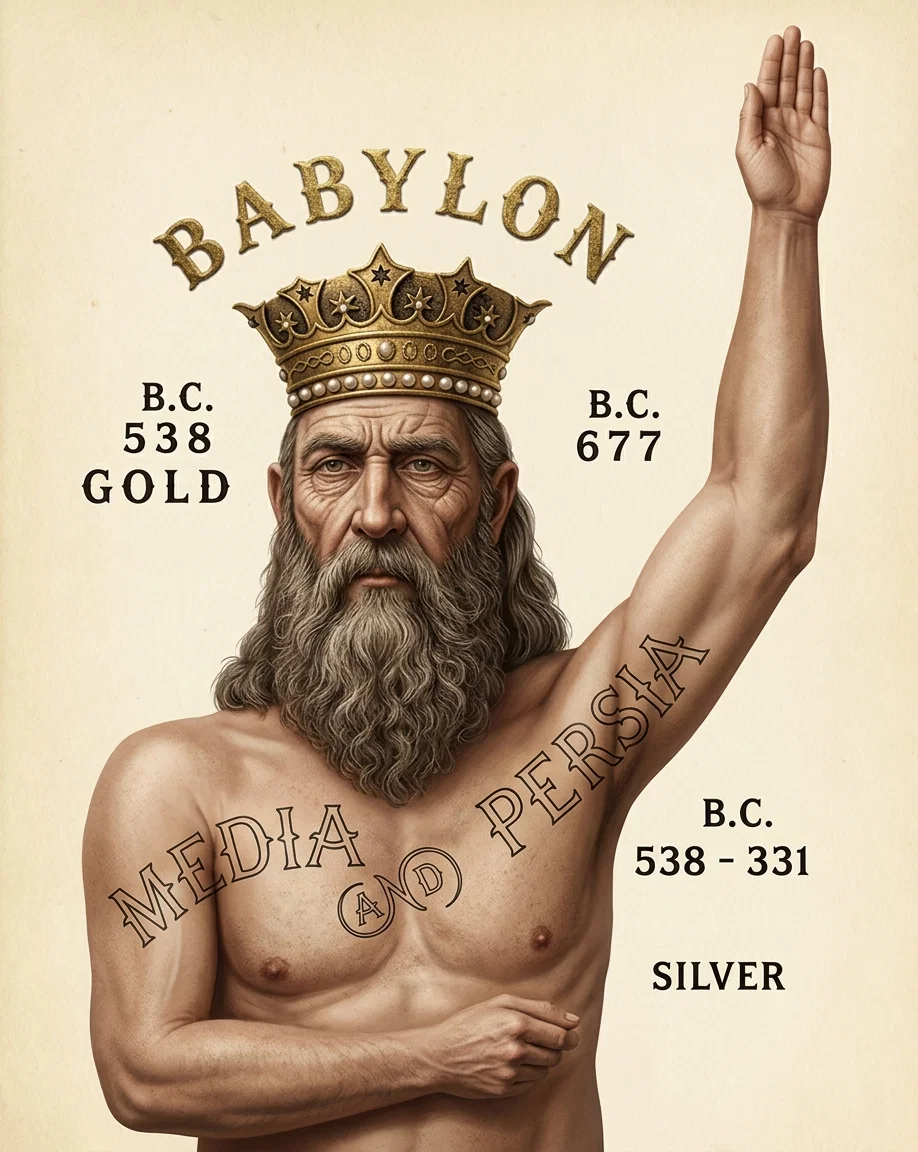
The year 599 B. C. is marked by the birth of Cyrus, the famous founder of the Persian monarchy. His mother was Mandana, daughter of Astyages, king of the Medes; and his father was Cambyses, king of Persia. A year before the birth of Cyrus, a son was added to the royal family of Media. This was Cyaxeres, called in the book of Daniel, "Darius the Median." He was brother to Mandana, the mother of Cyrus, and consequently bore the relation of uncle to Cyrus himself.
When Neriglissar came to the throne of Babylon, a violent war sprung up between him and the Medes, whereon Cyaxeres, who had just then ascended the throne of Media, called Cyrus out of Persia to his aid. In the first pitched battle the Assyrian army was routed and Neriglissar slain. He was succeeded in the kingdom of Babylon by Laborosoarchod, nine months, and then by Belshazzar, who was the last of the Babylonian, Assyrian, or Chaldean kings, as already noticed.
The war continued with uninterrupted success on the part of the Medes and Persians, under the command of Cyrus, who was generalissimo of both armies, until in the beginning of the sixteenth year of Belshazzar, Babylon was the only city that held out against him in all the East, and he sat down before that in a regular siege. To attempt the conquest of such a city was no ordinary undertaking. Babylon was sixty miles in circumference, perfectly square, the length of each side being fifteen miles. Its walls were impregnable, being eighty-seven feet thick, and three hundred and fifty feet high. The number of troops within for its defense was very great, and the city was stored with all sorts of provision for at least twenty years. Thus furnished the Babylonians scoffed at Cyrus from their lofty walls, and derided every effort he made against them. But he had been called by name and appointed to his work, by the Lord of hosts, over two hundred and sixty years before (Isa. 44), and therefore, as an instrument of Providence though he knew it not, he moved on in his great undertaking. The predictions concerning the taking of Babylon, the people who should accomplish it, and the particular circumstances that should attend it, may be found by those who take pleasure in noting the exact accomplishment of God's word, by a reference to the following passages: Isa. 13:17–22; 21:2; 47; Jer. 50:51.
Though an apparent digression, the reader will be interested to spend a moment considering by what means destruction came so suddenly upon them ere they were aware (Isa. 47:11; Jer. 1:24), while the king and the whole city were giving themselves to feasting, drunkenness and revelry, in the most apparent security. Dan. 5. The river Euphrates, upon the banks of which Babylon was situated, ran directly through the city. The banks being low, in order to secure the city from inundation (as the river overflowed every year when the snows melted upon the mountains of Armenia, as the Nile overflows Egypt), high walls of brick and bitumen, of the same thickness as the outer walls, were built on each side of it along its entire course through the city. While these were building (their foundations being laid as low as the bottom of the river), the whole river was turned from its channel into an artificial lake, forty miles square, prepared to the west of Babylon to receive it during this time. This being found convenient for the receiving of the surplus waters every year, to be from thence let out to water the country as needed, through the year, it was preserved till the time of Cyrus. In the walls above mentioned, against every street that crossed the river, on either side were gates of brass, and from them steps leading down to the water.
With these facts before us, we are prepared to understand the stratagem by which Cyrus, after a siege of nearly two years, made himself master of the place. He first dug a trench broad and deep around the city, and having ascertained that upon a certain day approaching, an annual festival was to be kept, in which the whole night was usually spent in revelry and dissipation, he resolved to take advantage of the disorder that would then prevail, and execute his scheme. He therefore stationed a body of men at the point where the river came out of the city on the lower side, and another at the upper side where it entered, with orders that when they should find the water of the river so reduced as to make it fordable, they should rush into its channel, and thus enter the city. He then sent up a body of men with orders at a given time to break down the embankment at the head of the canal leading to the lake above mentioned, and thus turn the river that way, while at the same time he opened the trench which he had dug around the city, and turned the water of the river also into that. Thus its channel through the city was rendered comparatively dry, and the soldiers entered in as ordered. But having secured this object, what was now to be done? for the walls on each side of the river were closed with huge gates of brass; and there was no earthly power then available that could scale those walls or force those brazen gates. But Providence had removed all difficulty here; for in the confusion of that night of impious feasting, these gates were all left open. It was doubtless in reference to this that the Lord had spoken by the prophet, I will "open before him (Cyrus) the two-leaved gates; and the gates shall not be shut. I will break in pieces the gates of brass, and cut in sunder the bars of iron." Isa. 45:1, 2. Thus the army of Cyrus found free entrance into the very heart of the proud city of their enemy.
From this scene turn to the palace of the king. "Belshazzar the king," says Daniel, who was there to witness it, "made a great feast to a thousand of his lords." Chap. 5. And when he had brought forth the vessels of gold and silver, which had been taken by his grandfather, Nebuchadnezzar, from the temple of the great God at Jerusalem, and was drinking wine from them with his princes, wives and concubines, and praising their gods of gold and silver, suddenly there flashed out upon the wall the appearance of a part of a man's hand, tracing mysterious characters, of fearful import. Then did the king's countenance change, the joints of his loins were loosed, and his knees smote together under the keener smitings of his conscience. The astrologers were called in haste to interpret the writing. Failing in this as they before had failed on the dream of Nebuchadnezzar, Daniel is called in to explain the mystery. Then the hand vanished; and the writing that was written had this interpretation: "MENE; God hath numbered thy kingdom and finished it. TEKEL; Thou art weighed in the balances, and art found wanting. PERES; Thy kingdom is divided and given to the Medes and Persians." And while the recording angel was writing out this sentence before the eyes of the guilty king, the legions of the Medes and Persians were pouring in through the two-leaved gates of the river walls, to its execution. They met at the palace as previously concerted, and upon the guard's opening the gates to ascertain the cause of the uproar without, they rushed in and slew the king. "That night was Belshazzar king of the Chaldeans slain," says the simple and comprehensive record of the Scripture, "and Darius the Median took the kingdom." We fear that not to Belshazzar alone is the sentence applicable, "Thou art weighed in the balances and art found wanting." How many of us, dear reader, should we be weighed in those scales by which God estimates the moral worth of mankind, would be found wanting?