Elders Conradi and Erzenberger left Hagen the evening of the tenth of January, as they were to spend the eleventh and twelfth in Basel, where the German-Swiss auditing was to be done. Elder H. F. Schuberth and the writer, taking a different route, met with our small church in Frankfort-on-the-Main, one of the great banking cities of the world, whose capital is largely invested in the Rhinelands, in Switzerland, and in the Netherlands. The city has 311,000 inhabitants. Here lived Goethe and the Rothschilds.
On our way to Heilbronn, the place of our South German Conference, we being passed through the “most beautiful town in all Germany,” Heidelberg, with its castle and famous university. This city, as well as Constance, where was held the council which condemned Huss and Jerome to the stake, is located in the Grand Duchy of Baden, a state whose 1,800,000 people are chiefly engaged in agriculture and forestry. In the Black Forest large quantities of wooden toys are made, and exported to various parts of Europe.
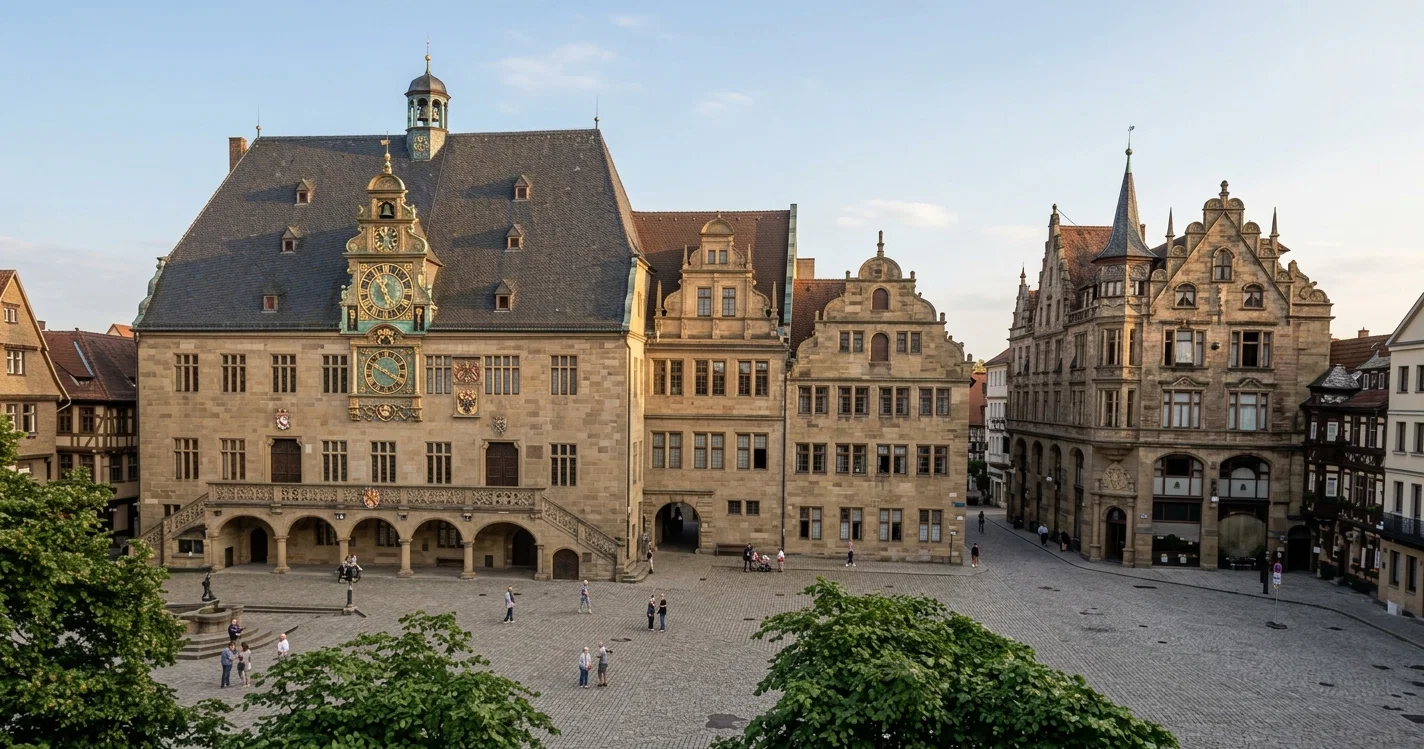
Heilbronn is a neat little city of 40,000 inhabitants. It is in the kingdom of Wurtemberg, which has a population of 2,100,000, the larger number of whom are kept busy in caring for their corn-fields, vineyards, and fruit-trees, although some find employment in mining and weaving. Indeed, in Heilbronn itself there is some manufacturing, soap, sugar, salt, machinery, soda, candles, and paper being produced, as well as silverware and wine. The Neckar River, with the canal, is navigable, and the Heilbronn harbor is commodious. The public buildings are substantial. The dwellings are large, and many of them are surrounded with beautiful gardens. Several ancient towers and the Gothic cathedral, and the antique city hall, with its characteristic clock, testify to the age of the place.
The meeting began the evening of the thirteenth, and lasted until the night of the seventeenth of January. The daily sessions were held in our local hall, while the public lectures were delivered to an audience of from three hundred to three hundred and fifty in one of the largest and best halls we could have secured. The subjects presented to the outside audiences were chiefly on the prophecies and the nearness of the second coming of Christ and our need of preparing to meet him. Elders Erzenberger, Conradi, and Schuberth had remarkable freedom in presenting the message to those who came to hear.
Of the nineteen churches and companies in the conference, sixteen were represented by forty-one delegates. About one hundred and twenty or one hundred and thirty of our brethren and sisters were able to attend. The church at Ulm, and the companies in Erlangen, Pforzheim, Langensteinbach, Baden-Baden, and Offenbach were received into the South German Conference.
The spirit present was strongly evangelical. The presentation of the East African Mission created a great interest. The people seemed anxious to do what they could to make the work in that field a success. In one place in the South German Conference, every member has been threatened with a fine of six dollars for attending the meetings; but God opens the way for them to come together, nevertheless. Many instances showing what a man may be called upon to endure, in these lands where the truth is young, and our people are little known, came to my attention; but the persecutions some are compelled to pass through do not keep them from feeling for the heathen in Africa, and their missionary spirit is not destroyed by their unfavorable surroundings any more than was the case in the early days of Christianity.
CITY HALL, HEILBRONN
Another thing that was noticeable at this meeting: former brethren, who had fallen away from the truth, were present to distribute their literature, and to attempt to draw away disciples after themselves; so remarkable were their untruthful statements, that it was thought best for Elder Conradi to spend an hour in examining their teachings, testing them by the law and the testimony. This exercise was very profitable to our brethren, as they saw the truthfulness of the third angel’s message more fully than ever. We feel sure that these outside movements will not harm the truth; for truth is eternal and remains, no matter who may disbelieve it—no matter who may turn away from it. If we only trust in God, we shall never be ashamed; but it is absolutely certain that we must come to that place where we shall trust him: if we do not come to such a time, and if we fail to have the experience of knowing him for ourselves, the trials that are ahead of us will certainly cause us to fall out by the way.
To strengthen the material fund for ‘Christ’s Object Lessons,’ and to constantly circulate that book; to increase our Sabbath-school offerings, all of which are used in the missionary work of the German Union; to devote our First-day offerings to the mission in German East Africa (and to increase these offerings); to pay a more strict tithe, two tenths of which will be hereafter16given by this South German Conference to the German Union, for missionary purposes; and to heartily thank God for the care he has had over the work the past year, were resolutions taken at this meeting, at the suggestion of the committee on recommendations.
To show their honesty of intention, a collection amounting to about twenty dollars, for German East Africa, was taken up on Sunday; fifty-eight dollars was raised for the Material Fund; twenty-one dollars was donated to the Conference Poor Fund at this meeting. On Sabbath afternoon, six were baptized, and the Lord’s supper was celebrated with those who had not been granted this privilege during the quarter; two church elders were also ordained on this holy day. The Sabbath services were very solemn, and we believe their results will be lasting.
The auditing work did not consume much time, and there was still a little left over in the conference treasury to begin the new year. In 1903 the tithe of this field was $4,102; Sabbath-school gifts, $284; First-day offerings, $87.85; week-of-prayer donations, $221.85. One hundred and three persons were baptized, eleven were received by vote, and the present membership is three hundred and thirty.
Besides the States mentioned in the second and third paragraphs above, there are in the territory of the South German Conference, the agricultural, manufacturing, mining kingdom of Bavaria (population, 6,176,000), where are located Spires and Augsburg, two cities so famous in the Reformation; the imperial province of Alsace-Lorraine, with 1,719,500 inhabitants; that part of the Grand Duchy of Hesse-Darmstadt south of the Main, with about 750,000 people; the Grand Duchy of Luxemburg, with 211,000 inhabitants; and the Duchy of Hohenzollern, with 66,000 inhabitants. The entire population of the South German field is about 13,000,000, and for these millions, we have three ordained ministers, three licentiates, and five Bible workers. Elder C. W. Weber, again chosen president of this conference, finds that here, as is the case elsewhere, the work is great, hedged up by difficulties, and yet that the laborers are few. We should therefore pray that the Lord of the vineyard may send forth laborers into his harvest.