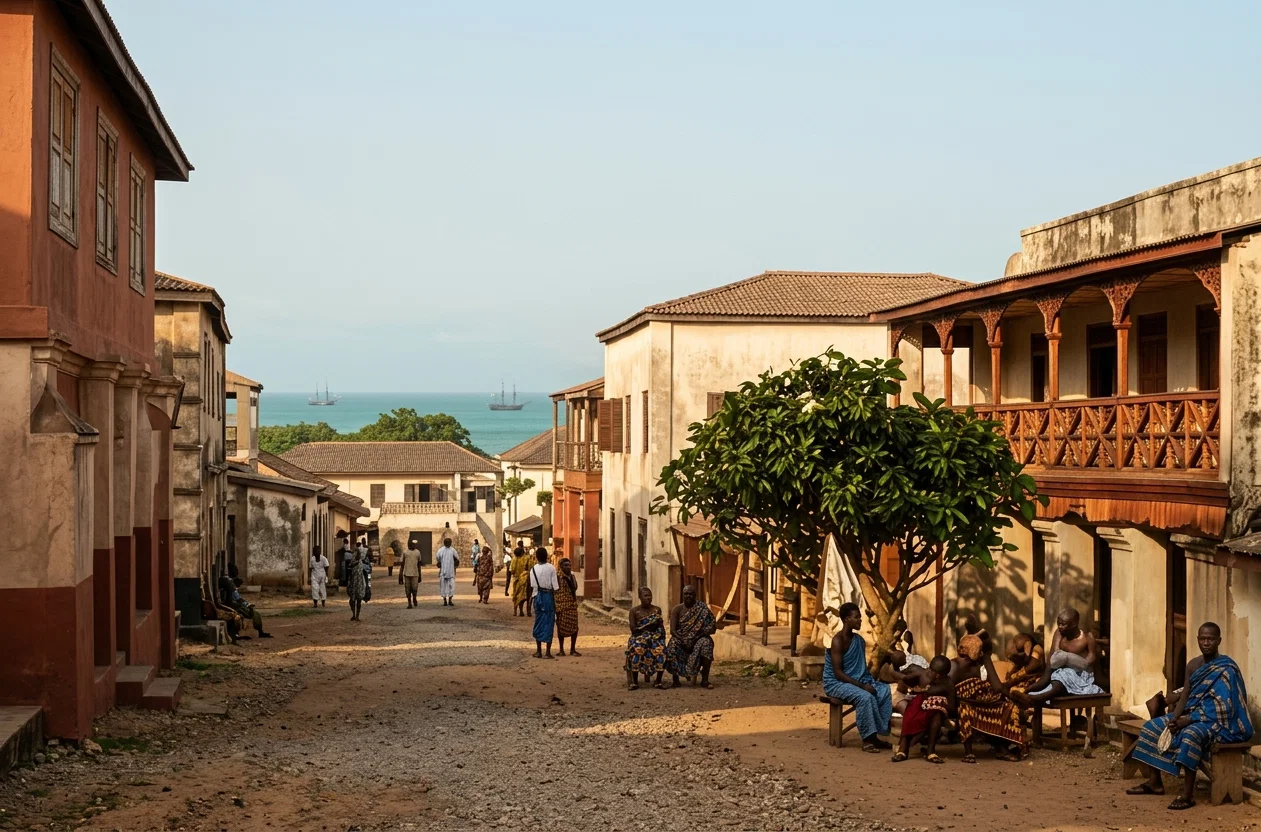
MISSION work on the Gold Coast, especially Cape Coast, dates from 1751. This first effort was made by the Church of England, who sent out the Rev. Thomas Thompson. He stayed four years at Cape Coast before returning, and taking some young men to England to train. In 1828 the Basel German Mission opened a station farther down the coast, at Accra.
STREET SCENE, CAPE COAST CASTLE, WEST AFRICA
It seems that from the very first, Cape Coast has been recognized as the strategic point of missionary work on the Gold Coast. It was in 1831 that a few young natives attending the government school formed a society for Bible study. One of their number applied to the captain of a merchant vessel for some copies of the New Testament. The captain was surprised to receive such a request from the native youth, and asked if he and his friends would not like the instruction of a missionary. Upon his return to England, he brought the matter before the Wesleyan Missionary Society, offering to carry out and bring back the missionary free of all cost.
In due time the missionary came. From this nucleus the Wesleyan church of the Gold Coast has grown to 111 churches, with 573 preaching places. There are said to be 6,350 day scholars and 7,677 full members, with a total congregation on Sunday of 32,371. The Basel German Mission claims a membership of 7,266, with 5,000 day scholars. The Roman Catholics claim a membership of 4,405, with 1,200 day scholars. Of this number 1,100 are said to belong to the Cape Coast church. This is their headquarters. All these societies have suffered the loss of many missionaries.
It can readily be seen that the Lord has prepared the way for a quick work to be done in giving the message to the two and three-quarter millions of the Gold Coast. There are thousands of scholars scattered in different parts of the country. Who knows but many of these will be used in giving the message when the earth is lightened with His glory?
Next to the need of the Bible is the need of knowing how to till the soil. This knowledge is greatly lacking. Many things would grow here, as the soil is very rich. A committee appointed by the government to look after agriculture said that not more than five per cent of the soil is under cultivation. The Basel Mission is the only society that has made an effort to teach the people to cultivate the soil. This effort seems to be confined mostly to their headquarters and surrounding country. I learn that the people are very industrious in this vicinity, raising cotton, cocoa, coffee, rubber-trees, and all kinds of garden produce. It is said that cocoa yields a large financial return for the labor put forth; hence much of it is raised. A strong effort is being made by the government to get cotton-growing well established.
Aburi, situated in the mountains, about twenty-five miles from Accra, is called the “Madeira of the West Coast.” This is the health resort of the foreigners operating on the coast. Here the Wesleyans have a house built especially to accommodate workers who come from the coast to recuperate their health. In connection with this is a girl's training-school. We should by all means have a building in these mountains, possibly in this village, that workers may go there when run down in health. In fact, these mountains would be an excellent place for our mission farm and training station, if the way should open for us. Many of the Europeans go to Aburi to rest, in preference to going to England. It is said to be a very healthful place. Here the government botanical garden is situated.
Our work is moving on fairly well. Our enemies are not asleep. The other churches have practically combined against us. While they do not agree among themselves, they can unite in fighting us. At present, our attendance is greatly affected; but I think it will be better after a while. We labor under great disadvantage because our work is not well established. The others encourage the belief among the people that we are not going to stay here long. There is nothing that the native fears so much as being laughed at because his mission is broken. Hence, this has much weight with some. They point to the lone missionary for the whole West Coast, and then compare him and his mission with the many churches and ministers of the other missions. When we once get established in one place, it will have a good effect on the whole coast. I am waiting to hear if any workers are coming soon. If they are not, I expect to start a school of some kind.
In visiting the better class of natives, I find that our papers are exerting a power for good. They talk long and earnestly about the matter. The foundation is being laid for a good work when we can get more help. Some young men, now clerks, have spoken to me about giving up their work and entering our training-school if we start one. They know that there will be little or no money in it, yet they say that they would rather do this. These have finished the schools here. The training that they most need is Bible study and manual labor.
The report of our work has been carried for miles up and down the coast—that is, about the “Saturday mission.” I have had several letters from those to whom I have sent papers. I learn that some have been keeping the Sabbath for years. The young man who went from here to the mine writes that he has given the papers to those who could read, and that some of the European miners were trying to keep the Sabbath. I send him a bundle of papers each week. He is waiting until the mission station is opened up, hoping to connect with it.
I notice that the general public is honoring Sunday more now than they did a few months ago. When the mail boat comes on that day, it comes as quietly as possible, while the steamer was formerly signaled three ports up coast. One of our young men has been flogged because he refused to work at the carpenter's trade on the Sabbath.
The other night I was out giving away copies of the REVIEW and other papers. The next day I met a man whose house I had passed, and he said that he stayed up the greater part of the night, reading the paper that I left with him. I see from this that there are many who have13not had the chance yet of hearing the truth. We see no reason to be discouraged. We firmly believe the statement made by Sister White, that nothing can stop this message, and we are sure that the time is not far distant when God will do a mighty work for this dark country. It is certainly true that we can hear the sound of a 'going' in the top of the mulberry trees.