Report from Brazil

7%

Review and Herald Publishing Association · Washington, D.C. · Jun 23, 1904

FromReview and Herald, Vol. 81, No. 25.

Read the full edition

Report from Brazil

F. W. SPIES
In my last, I reported our work up to the baptism at the Salto do Riberao Grande, which occurred on Sabbath, October 31. We intended to leave the Salto the following Monday, but a heavy rain and hail-storm on Sunday caused the Riberao (small river), which is not a very small river after all, and which we were obliged to ford seven times, to be so high that we could not cross it till Tuesday.
Returning to the villa of Ribeira, we had another baptism, on November 3; this time five souls were buried with their Lord in baptism. At this place we also had the Lord's supper. From Ribeira we went to Apiahy. Apiahy is a place where more than a century ago considerable gold was mined. At this time we found quite an excitement in this section, owing to a re-opening of the mines. As is always the case under such circumstances, the true and enduring gold, the heavenly riches, was not in general demand. We, however, found a few souls, even in Apiahy, who were interested in the gospel, and with these we spent a few days, rendering them such assistance as we could, and then came to Itarare.
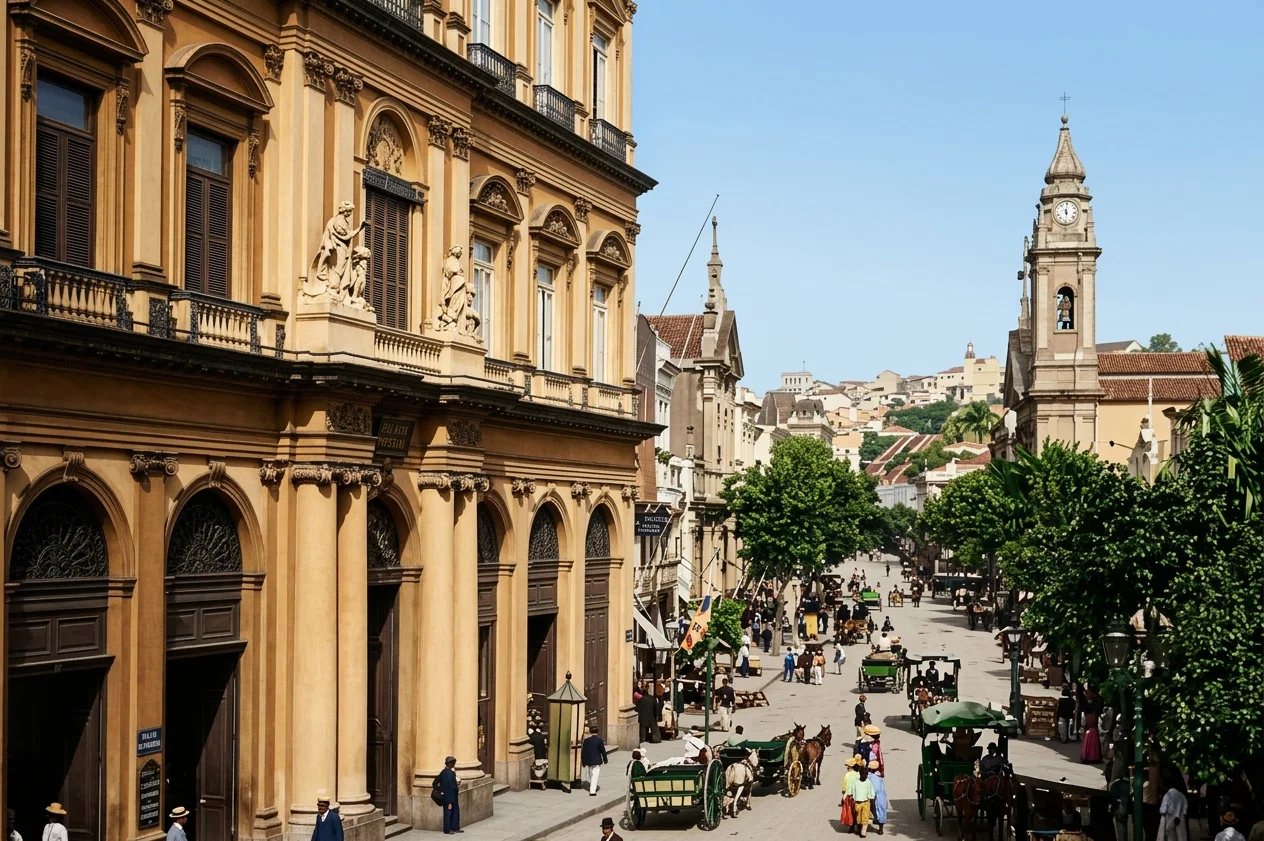
A STREET SCENE IN RIO DE JANEIRO
As will doubtless be remembered from previous reports, a state meeting had been held in Itarare in June, and Brother Emil Holzle remained for a month to follow up the interest. As a result of his labors the interest had deepened, and some had taken their stand for the truth.
It was to further develop this interest that we have now labored together here another five weeks, and the Lord has blessed our work. Last Sabbath, December 5, we buried ten dear souls with their Lord in baptism, while as many more are looking forward to the next baptism as the time when they can be thus buried with their Lord, and at least ten others are keeping the Sabbath.
As a rule, these people are all addicted to the use of tobacco and whisky, and some of them have their hardest battles to conquer these evils. But thanks be to the Lord, there is victory for all who seek it in faith in the Source of all power.
There are many interested yet in this section. We have organized a tract society, and set the brethren to work for those in their immediate reach, but to the other places we can not now go, as the time would not permit us to finish the work if we began it ere the next conference. And aside from this, we must visit in the adjoining State (Parana) a scattered company that has not been visited by a minister for about two years, and also some Sabbath-keepers who have never seen a minister as yet. Then we are also desirous of getting better acquainted with the needs of the State of Parana, so that we may be better able to report them at the next conference.
This brief statement gives an idea of the scarcity of workers in this vast field. It is now almost three months since I left my home on this trip, and I expect that six weeks more will pass before I return. Of the fifty-two weeks of the year, I have spent only five in work near my home, although there is work in abundance there. The time has been spent in attending the various State meetings held and in laboring far from my home in various provinces, in order to do something to meet the demands made upon us. O that we had more laborers to enter these ripe fields!
In closing, I would relate an incident to show how Satan works to hinder the Lord's work. On Sabbath, November 28, the constable came into the place where we were holding our services, and at the close of the meeting informed us that the delegado of the police commanded us to leave the place in twenty-four hours. We asked to see the document that authorized him to bring such a message to us; for up to that time this man had been very friendly to us, and also somewhat interested in the truth. Upon reading the document we found that the constable, because he could read only very poorly, and because of the way in which the document was worded, had become confused in its instruction, and instead of sending in a report to the police delegado which would have resulted in our being expelled in twenty-four hours, he understood it to be his duty to tell us to leave in twenty-four hours. Of course we went to the authorities, and, in fact, to all the leading men concerned in this question, and the sum of the whole thing can be given as follows:—
The close friends of the Catholic priest, and no doubt the priest himself, had become alarmed at the interest which the preaching of the gospel was causing to spring up among the people in the vicinity, and they decided that this must be stopped. But how? As the constitution of Brazil guarantees religious liberty, they could not make religion, even though the religion of the Bible is ever so distasteful to them, the ground of procedure.
They knew of our health principles, and here they thought to get a hold on us. Recently a brother had given up a very profitable business, that of making rum from sugar-cane. Thus they had tangible evidence that we were not favorable to whisky. They knew also that we taught that tobacco is a poison, and its use injurious, and that pork is an unfit article for food. Here they thought they could get a reason against us. And so a certain major, the political chief in the city and most intimate friend of the priest, went to the police delegado and asked him to expel us from his limits within twenty-four hours, because we taught the people not to plant tobacco nor sugar-cane, and not to fatten pork. He also said that these things were utterly absurd, and threatened to ruin the commerce and business of the commonwealth, and that along with the foregoing we had taught that people should work only four days a week, and, in fact, we were already having meetings every day, and that the people were neglecting their planting, etc.
Thus the issue was shorn of its religious character, and placed in the light of an 'absurd fanaticism' that would prove injurious to the community, would cause the people to cease from lucrative business, and result in loss to the community.
In our private conversation with these leading men we proved to them that the planting and using of tobacco and the making and drinking of whisky were nobenefit to any community, that on the contrary these articles could only be a detriment. And while the old major referred to above at first had great difficulty to control his anger, in the course of our conversation he became calm, and apparently consented to the truths presented. These men, seeing that we understood the situation quite well, made no further effort to molest us, and we finished our work for the present. May the Lord ever give his cause the victory is our prayer.