In Egypt and Syria

4%

Review and Herald Publishing Association · Washington, D.C. · Jul 28, 1904

FromReview and Herald, Vol. 81, No. 30.

Read the full edition

In Egypt and Syria

(Concluded)
L. R. CONRADI
HAIFA is a growing city of about fourteen thousand inhabitants. It is probably one of the cleanest cities in all Turkey. It surely seems to have a promising future; for its harbor is much better than that of Jaffa, and there is now in process of construction a railroad from here to Mȗzerib, where it will connect with the line to Damascus, and will thus be a natural highway to Damascus, to Jerusalem, and to the Jordan Valley.
Leaving Haifa in the afternoon of Tuesday, we followed this railway quite a distance, going up the valley of the Kishon. See 1 Kings 18:40. We at length crossed the stream, and entered the hills of Galilee. As there is quite a good wagon road, we made the twenty-four miles from Haifa to Nazareth in about five hours, reaching the latter place at nine in the evening.
Nazareth lies in the midst of hills. It is not mentioned in the Old Testament, and in the time of Christ it was an insignificant place. To-day there are many missions here, and the city is rapidly growing. It has about twelve thousand inhabitants.
After midnight we left Nazareth, pressing on toward Tiberias. We soon passed through Cana, where the marriage supper was, and at about eight o’clock in the morning we were able to look down upon the surface of the beautiful Sea of Gennesaret, which lies about twenty miles from Nazareth. My small instrument which measures altitudes, showed that we were nine hundred feet above the level of the Mediterranean. However, we rapidly descended until we were six hundred and fifty feet below the sea-level, and had reached Tiberias, which lies upon the shore of the Sea of Galilee. This town to-day has about four thousand inhabitants, two thirds of whom are Jews. It is still surrounded by walls. There are many ruins around the city, testifying of its ancient greatness. As to the lake, its greatest depth is one hundred and fifty feet. It has the shape of an irregular oval. In its widest part it is six miles across, while its greatest length is fourteen miles. In the afternoon we took a bath in the hot springs one mile south of the city. The water here gushes out of the mountain so hot that one can not bear his hand in it. In the evening we took a boat ride on the lake. As we came down to the city in the morning, we passed by a place on the mountainside that seemed admirably adapted to accommodate the hundreds who were present at the time the sermon on the mount was spoken. The lake, the city,
and the surrounding villages were in plain sight. Away in the distance, up on the mountain, we could see Safed. In this rare atmosphere, a good, strong voice could be heard by thousands of people, without difficulty.
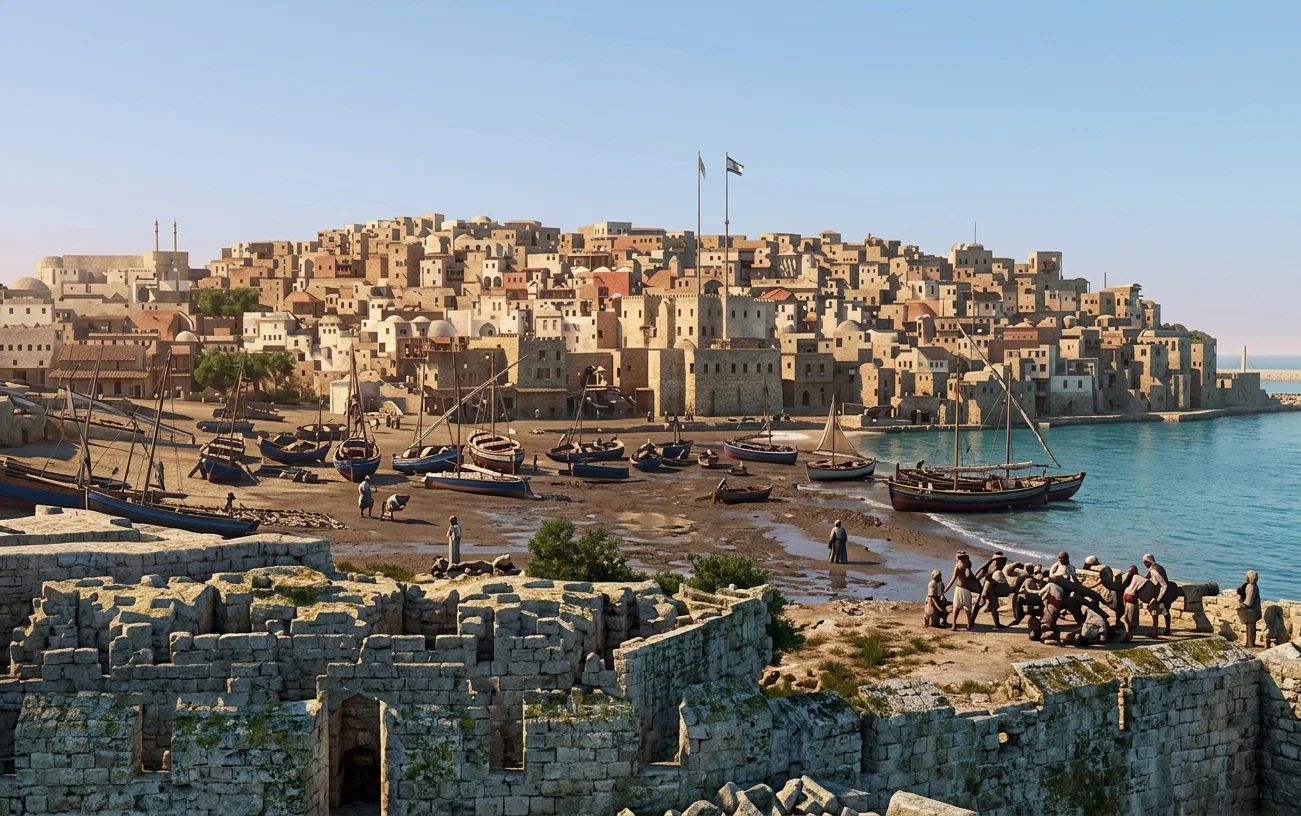
JAFFA
JAFFA
Here we had to change our method of travel, as there is no good wagon road to the south. Brethren Krum and Zarub decided to go north via Safed, to visit some interested persons, and thus they would return to Beirut through the mountains; while the other five of us bargained with three mule drivers for our transportation to Jerusalem. As these men had a cargo of fish, we secured quite reasonable figures from them. To mount the broad Arabic stirrup saddle, was a new experience to us, as well as was also the attempt to direct a mule without a bridle. Thus far we had been favored with wonderfully dry roads for this season of the year. Had it not been for this, we certainly could not have carried so many in the wagon.
During the night it had rained, and it was still threatening weather as we started out in the morning, about five o’clock. We ascended the mountains again, but soon turned toward the south, past Mount Tabor. This mountain has a round top. In Ps. 89:12 it is mentioned in connection with Mount Hermon, while tradition calls it the mount of the transfiguration. We passed near the village of Endor, and then crossed a mountain range, and descended to the Plain of Esdraelon, going to Jennin, leaving the mountains of Gilboa to our left. We were in the saddle thirteen hours, breaking our journey for only a few minutes. Our mules were sure-footed creatures, and did well ascending and descending the steeps and the rocky mountainsides. While we were on the mountain range, suddenly we found ourselves in the midst of a great storm, with lightning and thunder and wind and hail and rain. In a few minutes the ground was white with large hailstones. Our mules refused to face the storm. Two of them turned their backs toward the stones of ice, and ran away. The fury of the storm reminded us of Job’s reference to the commotion of the heavens, in the thirty-eighth chapter, beginning with the twenty-second verse.
Between Tiberias and Jennin there were very few villages or towns. The latter place is a small Arabic settlement, with only eighteen hundred inhabitants. It is over thirty-five miles from Tiberias. It has only one hotel, a truly Arabic building, and no family lives there. It is supposed that the traveler will furnish his own bed, as well as everything else. It offers shelter only. It is without stoves or the comforts of hotels as found in European cities. But wet as we were, and tired and cold and hungry, we were only too thankful to reach shelter and a place of rest. We let the supplied blankets serve us as fire to warm us during the night.
Next morning at eight we continued our journey over the mountains of Samaria. I noticed that at the least, three times we crossed mountain passes as high as two thousand or two thousand five hundred feet, and one does not wonder why the Turks have not thus far completed a wagon road through this part of the land. It is sparsely settled, and the country is very rough. In the forenoon we passed the village of Taluza. This is said to be the site of ancient Tirzah. See 1 Kings 16:8. It was for a time the capital of the northern kingdom. Not far from there we could see the tops of Ebal and Gerizim, and finally, Nablus, the old Shechem. We reached this city about four o’clock Friday afternoon. It is a growing place, and has about twenty-four thousand inhabitants. Its people are still noted for their quarrelsomeness. There are a number of mosques in the town. The streets inside are narrow, as are the streets in Jerusalem. As large as the city is, there is no hotel. The Catholic
monks keep a sort of lodging-house. We went to them, but they asked one dollar for each of us, should we lodge with them and take breakfast, and then they demanded that we leave Sabbath morning, as they were expecting a party of twenty that had been announced to arrive at that time. As we had passed by the Church of England hospital on entering the town, and the doctor in charge had kindly greeted us, we determined to see if we might not stay with them over Sabbath. Upon learning that we were American missionaries, they made room for Brethren Dail, Jespersson, and Hoerner in one of the hospital buildings, and the doctor himself opened his house to Elder Wakeham and me.
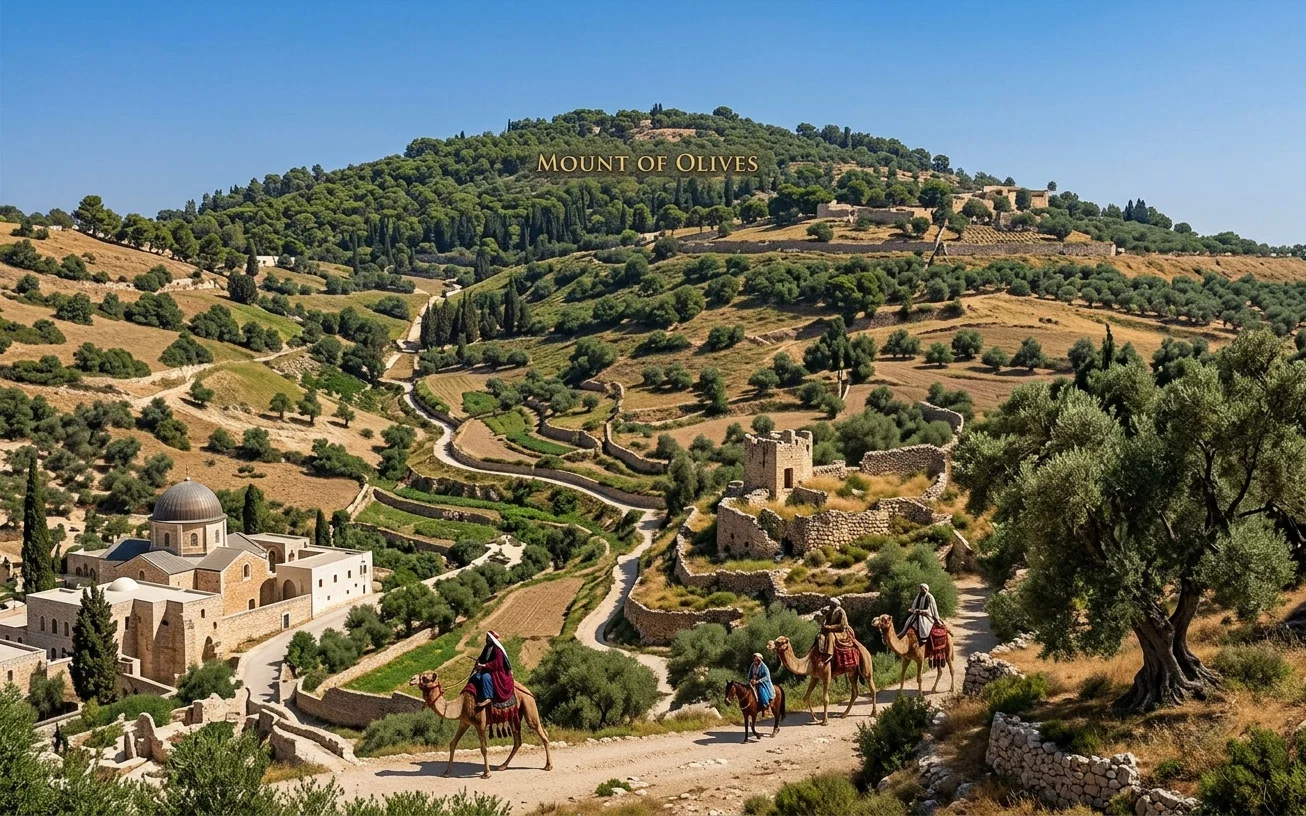
MOUNT OF OLIVES
MOUNT OF OLIVES
The doctor had been a missionary in Persia for several years, and he was pleased to meet those who had been acquainted with his home language and country, and were interested in missionary work. We much enjoyed our stay, and above all, the kind hospitality of these friends. Sabbath morning we visited their hospital, and found it contains about forty patients. They are certainly doing a good work for humanity. The hospital is quite new. They also have a church building here. They would receive no compensation for their kindness.
We were now ready to ascend Mount Gerizim, where we saw the ruins of the old Samaritan temple, and could look down upon Jacob’s well and Joseph’s tomb, and see the village of Sichar. We had a splendid view of the mountains of Samaria, and could see snow-covered Lebanon far to the north. Ebal is somewhat higher than Gerizim, but by the time we had visited the well which Jacob dug, and the tomb where lay the bones of Joseph, and the village of Sichar, the day was far spent. Jacob’s well now belongs to the Greeks, and it is surrounded by a modern wall. It is about seventy feet deep, and has a diameter of eight feet, and is walled almost to the top. But there is no water in it. This seemed to us the more remarkable because Nablus is well provided with streams from the mountainside, and
right near this well there is a superabundance of this water running through a small aqueduct. We were asked to write our names in the register, and we felt free to write these words: “While Jacob’s well is dry, the fountain of God is full of water.” Half a mile distant is Joseph’s tomb (Joshua 24:32); the building here is modern. Sichar is now called Askar, and it is probably a mile distant from Jacob’s well, at the foot of Mount Ebal.
On Sabbath Brother Jespersson had an attack of fever. We were glad he had such good quarters at the hospital, and yet we were very anxious to press on to Jerusalem. However, our drivers said they did not consider the road safe enough to start out that night, but would wait until about three o’clock in the morning.
From Nablus south there is a good wagon road for about ten miles, and the next five miles are unfinished, over the worst and steepest mountain passes, and then on to Jerusalem, about twenty-three miles further, is also a good road. When this road is completed, it will make the journey from Samaria to Jerusalem comparatively easy; then it must not be forgotten that there is now a good wagon road from Nablus to Jaffa and Haifa, and that the railroad is in process of construction from Haifa to the Jordan Valley. From Nablus to Jerusalem we crossed still higher hills, reaching an elevation of two thousand seven hundred feet. We had a very good view of Shiloh from our mountain pass; there remain but ruins of that ancient place. As we come into the territory of Ephraim, we find it truly a lovely country, as the mountainsides are covered with large olive groves; but when we pass Bethel and go into Judea, the mountain slopes become very stony. When we reached Er-Ram, or ancient Ramah, as our mules were very tired, we were glad to abandon them for a cheap ride by wagon to Jerusalem, whose towers were already in sight. And when we reached the health home in Jerusalem, Sunday evening about six o’clock, we were very glad for a place of rest.
We could notice a difference in the temperature of the highlands of Judea and the lowlands of the country of the Philistines and Jaffa. The air was chilly, especially in the evening. This last winter they had such a heavy snowfall in Jerusalem that quite a number of the olive branches were broken.
We spent several days in the holy city, counseling with reference to the health home there, and also visiting the temple site. Quite a number of buildings have been erected in Jerusalem since my first visit, in 1901. In order to visit the temple site, one goes to the consul of his country, and secures the kawass, or the official guard of the embassy. He in turn engages the services of a Turkish soldier, and with this protection, one is free to visit the ancient temple site, and the Mohammedan mosques erected there. I was surprised at the great space in the temple place, and still more was I impressed with the Mosque of Omar. While the Catholics and the Greeks and the Protestants vie with one another in having the finest churches and monasteries, the Mohammedans are surely still in the lead. They consider the Mosque of Omar second only to that found in Mecca. The mosque stands on an irregular platform about ten feet high, to which steps lead up from all four sides of the compass. The vast temple court is planted with quite a number of cypress and olive trees. The mosque is a large octagon. The lower part is of the finest marble, and the upper part is decorated with porcelain tiles, every one of which was specially and separately made, and many of them contain inscriptions from the Koran. The center of the structure is occupied by the large rock upon which Abraham offered up Isaac. As old Jerusalem is covered by a threefold layer of ruins and debris, this rock and the rock in the Church of the Holy Sepulcher are the only places where one can see the real stones of the actual surface of ancient Jerusalem. Of course the Mohammedans can show you in this temple and upon this rock the places where David and Solomon and Mohammed and Abraham anciently prayed. They believe that the judgment will be held here in the last days, and that God will place his throne here on this rock, and therefore Mohammed says that a prayer offered on this rock is better than a thousand prayers offered elsewhere. He himself had prayed in the cave below the rock, and then his body made a round hole in the ceiling of the cavern, which is shown to-day; as the rock wanted to cling to Mohammed, as he ascended to heaven, it was necessary for the angel Gabriel to seize hold of it with his hands, and keep the massive rock in its place: the imprints of Gabriel’s hands are still to be seen! Ere we left the mosque, we were shown a jasper stone, in which Mohammed had placed nineteen spikes of a peculiar make—there are no other such nails in existence. They are miraculously taken out from time to time; and when they are all pulled, then the end of the
world will come. Of the nineteen, only three and one half now remain, so the dervish told us, and therefore the end of the world is near, according to their belief.
Farther to the south is the Mosque of L-Aksa. It is two hundred and seventy feet long, and one hundred and seventy feet wide. Below there is really another mosque, and away in the south-eastern corner, they even show you the stone cradle of Christ, and a little farther on, to the right, are Solomon’s stables. Underneath the pavement of the temple place, there are many cisterns. Off to the eastern side, is the Golden Gate, which has been closed from ancient times. The Arabs walled this up, and there is a tradition of the Moslems that some Friday a Christian conqueror will enter this gate, and then the Mohammedan power in Jerusalem will fall.
To the north of the temple is the Pool of Bethesda. This is in the hands of the Roman Catholics. They have excavated the largest part of it, and have also erected a seminary here for the Greek Catholics. The monk in charge of the pool showed us their small, but very valuable museum. Here they have many things that were dug up while they were making their excavations. Among them is a genuine talent-weight. It is a stone that weighs 42 kilo or 84 pounds.
Wednesday morning we left Jerusalem by train for Jaffa, passing the cave where Samson probably lived, and from which he came forth to trouble the Philistines.
We had a few more meetings in Jaffa. We were glad when we learned that on Friday we could get a Russian steamer from Jaffa to Port Said. We hoped the sea would be calm enough to allow our embarking, and sure enough, we were so favored that we were able to make the journey during the night. We are very much pleased that the truth has gained a foothold in Palestine, and while as yet no great things have been accomplished there, yet we are happy that God has set his seal to our efforts, and we are more and more hopeful for the future. While the whole world is seeking to gain a foothold in the holy land, we surely ought to do our best, not only to warn those who sit in darkness in this dark land, but also to help the many pilgrims who come here from all parts of the earth.