Men, with their finite wisdom, write of events after they have taken place, and are not able to get even that correct. God, with his infinite wisdom, writes of events before they have taken place; and the pen of verified history confirms the writing.
Through many lines of prophecy Jehovah has made it possible for his people to know beforehand the mighty events that transpire through the great epochs of history up to the very close of time and the ushering in of his everlasting kingdom. One of the most remarkable, most clear, and most unmistakable of these divine foreviews of the world's history is that found in the seventh chapter of Daniel. The eye of the Infinite, in this prophetic delineation of events yet to be, traces the course of earth's peoples from 625 B. C. down to the end of time. It is such an epitome of history as no man could write, and one which no man can dispute. It begins with literal Babylon, the beginning of universal kingdoms, the lion among the nations; and it closes with the record of spiritual Babylon, a merciless spiritual tyrant over the consciences of men, a universal spiritual ruler, summoned to the bar of the eternal Judge, sentenced to pay a fearful penalty for its iniquitous course; and when it is executed, the victims of its wrath enter into possession of the everlasting inheritance.
Daniel's Dream
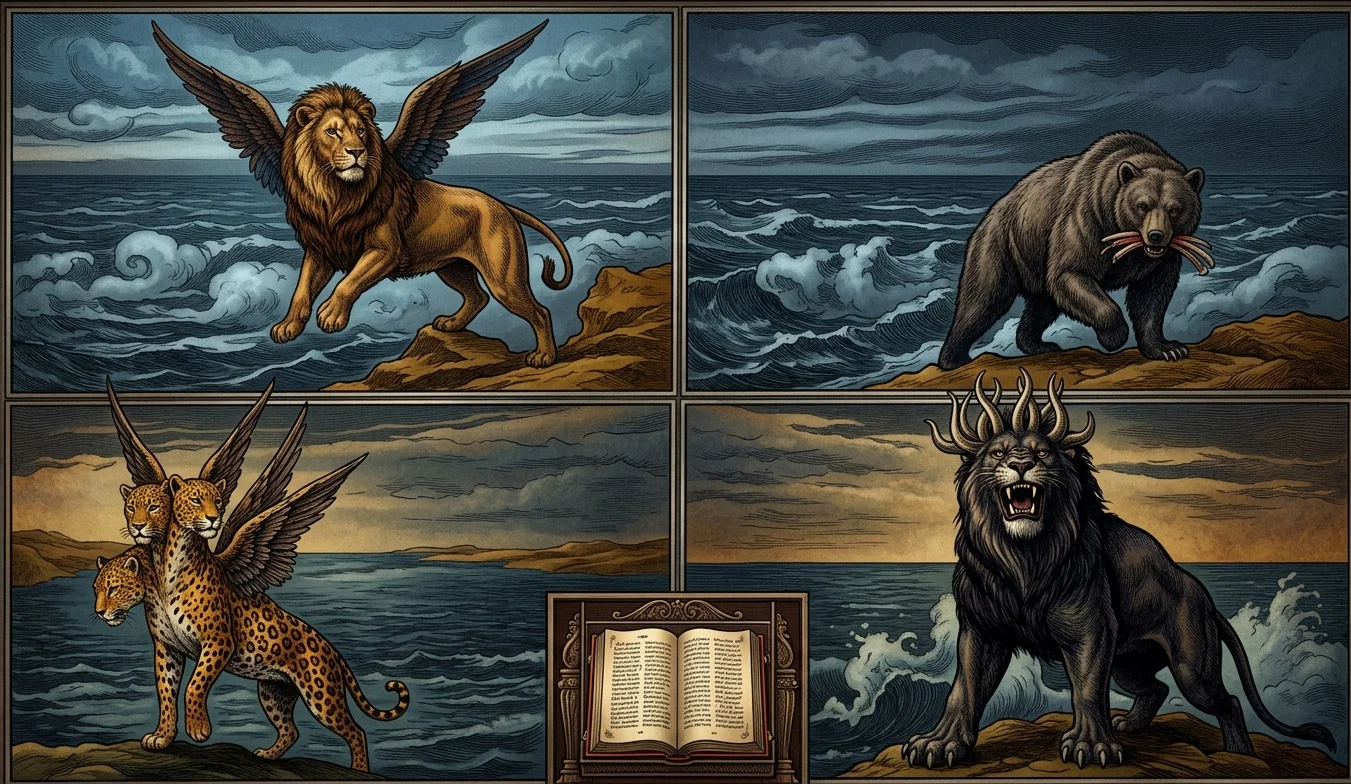
The prophet tells us that “in the first year of Belshazzar king of Babylon Daniel had a dream and visions of his head upon his bed.” Dan. 7: 1. He saw the four winds of heaven striving upon the great sea, and four beasts come up, one following the other, and differing each from the others. The first was like a lion, and was provided with eagle's wings. The second was like a bear. There was something peculiar about its appearance. The prophet expresses that peculiarity by saying that it raised itself up on one side and had three ribs in its mouth. Some one gave it command or permission to devour much flesh. The third beast resembled a leopard, but it had four heads, and on the back of it four wings. Then came a fourth beast (verse 7), whose fearsome aspect seemed to strike terror into the soul of the prophet himself. It was terrible and powerful and strong exceedingly, with teeth of iron and nails of brass. It devoured and broke in pieces and stamped the residue with its feet. That beast was different from all the others, says the inspired writer, “and it had ten horns.”
While the prophet's gaze was fixed upon the horns, he saw coming up among them another, a little horn, growing more stout than the others, and uprooting three of the others to make place for itself. That particular horn began to develop striking features. There appeared in it “eyes like the eyes of a man, and a mouth speaking great things.”
While Daniel was considering these things, he saw the Almighty entering upon the work of judgment, and the Son of man entering in before him to receive at the Father's hands the title to the eternal inheritance. The fulfillment of that prophetic forecast will close the history of sin and usher in the fruition of the Christian's hope—the culmination of the gospel.
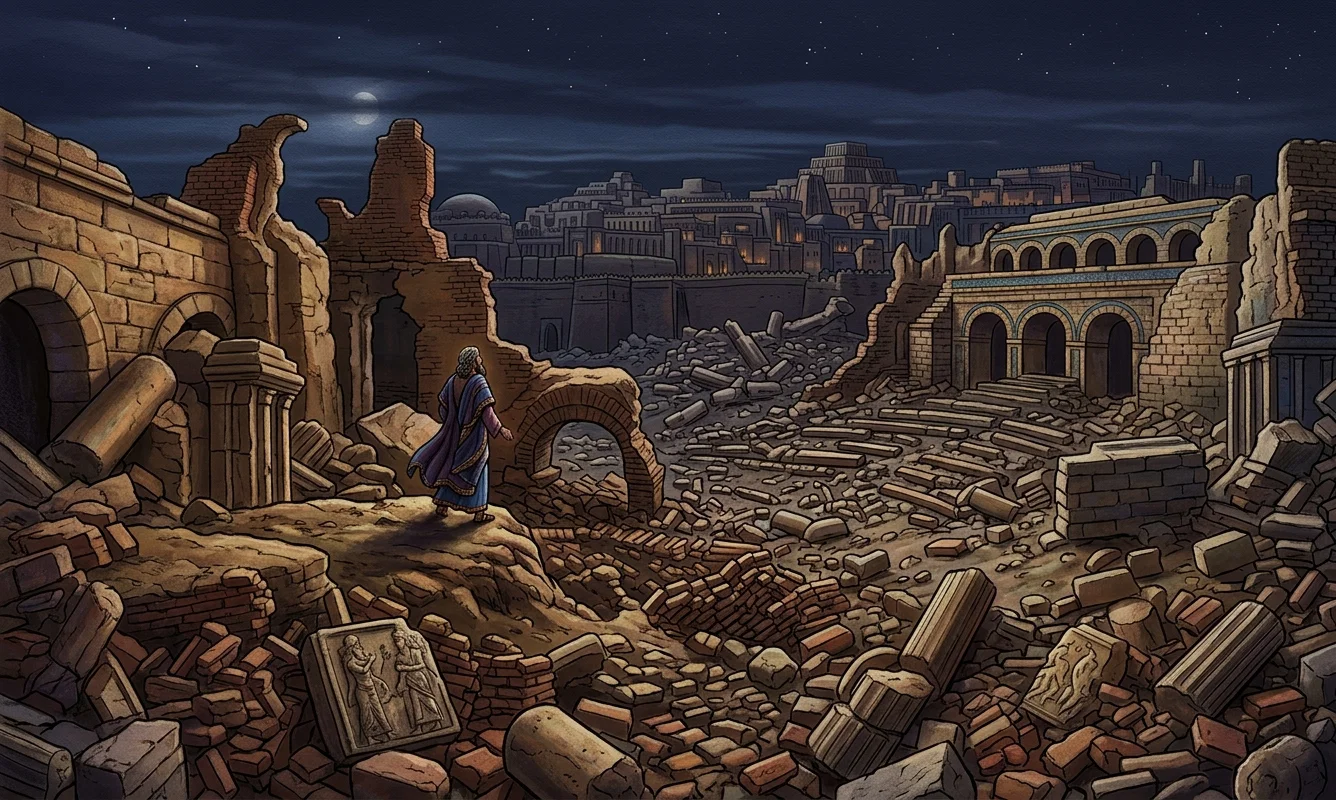
ISAIAH'S VISION OF THE RUINS OF BABYLON
A Divine Interpretation
What mean those beast symbols? Daniel himself wanted to know. So he says: “I came near unto one of them that stood by, and asked him the truth concerning all this. So he told me, and made me know the interpretation of the things.” Verse 16. “The four beasts are four kings [or kingdoms], that shall arise out of the earth,” and that “the saints of the Most High shall receive the kingdom, and possess the kingdom forever, even forever and ever.”
But something was still troubling Daniel. He wanted to know about that beast whose aspect was so fearful, and whose work was so destructive, and about the ten horns upon its head, and especially about the “little horn” with the eyes of a man and a mouth that uttered great, swelling words and words of blasphemy, which was to make war upon the saints and prevail against them until the day of judgment. What was the interpretation of the symbols? To Daniel's anxious inquiry the heavenly interpreter replies:—
“The fourth beast shall be a fourth kingdom upon earth, which shall be diverse from all the kingdoms, and shall devour the whole earth, and shall tread it down, and break it in pieces. And as for the ten horns, out of
this kingdom shall ten kings arise: and another shall arise after them; and he shall be diverse from the former, and he shall put down three kings. And he shall speak words against the Most High, and shall wear out the saints of the Most High; and he shall think to change the times and the law; and they shall be given into his hand until a time and times and half a time. But the judgment shall be set, and they shall take away his dominion, to consume and to destroy it unto the end.” Verses 23-26.
That first beast stood for Babylon, as did also the golden head of the great image which God showed to Nebuchadnezzar, the king of Babylon, in a dream,—a dream which this same prophet Daniel interpreted for that king. To show that these beasts symbolized kingdoms, the heavenly interpreter assured Daniel that “the fourth beast shall be a fourth kingdom upon earth.” Verse 23. Why were there only four beasts presented? The answer is obvious. These beasts represented universal kingdoms; and there were only four such kingdoms this side Daniel's day. It is generally agreed that the wings upon the back of the lion indicated the rapidity of the conquests of that kingdom.
Babylon finally succumbed (b. c. 538) to the onslaughts of the Medes and Persians, who spread themselves over Babylon's territory and flowed beyond her borders. It “raised up itself on one side.” This nation was composed of two peoples, the Persian division coming into prominence last, but overshadowing the other. This same power is represented in another vision (Dan. 8: 3) by a ram with two horns, “but one was higher than the other, and the higher came up last.”
In the year 331 B. C., the mighty Median-Persian Kingdom ceased to be, and the kingdom of Grecia ruled the world. The rapidity of the movements of Alexander's conquering hosts exceeded anything the world had ever known. That swiftness of movement is fittingly indicated by the fleet-footed leopard (the third beast), with four wings to increase the speed of its operations. Alexander's control spread over all that Medo-Persia had ruled, and swept beyond. As that beast had four heads, so we find the four leading generals of Alexander's army after his death
The Fourth Beast, or Kingdom
Then arose that more mighty beast, dreadful and terrible and strong exceedingly, which wrought its purpose exceedingly unhindered in the world, broke in pieces all opposition, and stamped the residue with its brass-clawed feet. All the other beasts are named,—the first is a lion, the second a bear, and the third a leopard,—but Inspiration gives no name to that beast. There was nothing like it in the world. “It was diverse from all the beasts that were before it.” But it was to represent the fourth great kingdom or nation, which was unlike all others—that was Rome. She was established in 168 B. C., was not like any, and she conquered and ruled with a merciless despotism. The interpreter continues, “As for the ten horns, out of this kingdom shall ten kings arise.” The great Roman Kingdom was made up of a diversity of distinct peoples; and in the year 476, when the Roman nation was finally overwhelmed, these peoples became ten nations,—the ten divisions of the Roman nation, which no schemes of human ambition has been able to weld together again. Concerning the fourth beast the interpreter declared that it would “devour the whole earth,” “tread it down, and break it in pieces.” Verse 23. No other nation ever had the civilized portion of this world so completely in its grip, so thoroughly under its control and at its disposition, as did Rome.
The Little Horn — Papal Rome
But when Rome was divided, in 476, ten nations—“ten kings”—stood up in the place of the old empire of Western Rome. The prophecy continues: “Another [horn, or power] shall arise after them; and he shall be diverse from the former, and he shall put down three kings.” Verse 24. The “three kings” referred to are, without question, three of those ten kings, or kingdoms, into which Western Rome was divided. What power can fulfill those specifications—rising after the ten kings, differing essentially from all of them, destroying three to make way for its own extension and ambition, speaking words against the Most High,” (verse 25), persecuting, or wearing out, “the saints of the Most High,” and thinking even “to change the times and the law”? There is only one power on earth that can fulfill those specifications, and that is the power known as papal Rome.
Three Kings Fell Before the Papacy
Three kings, or nations, were uprooted to make way for that power. The two most important of these, which stood most in the way of the Papacy's development and operation, were the Vandals and the Ostrogoths. They were Arians. In Myers's “General History” we read of the Vandals:
“The Vandals persecuted with furious zeal the orthodox party, the followers of Athanasius. Moved by the entreaties of the African Catholics, the emperor Justinian sent his general Belisarius to drive the barbarians from Africa, and to restore the province to the bosom of the true Catholic Church. The expedition was successful. . . . The Vandals remaining in the country were gradually absorbed by the old Roman population; and after a few generations no certain trace of the barbarians invaders could be detected in the physical appearance, the language, or the customs of the inhabitants of2
the African coast. The Vandal nation had disappeared; the name alone remained.”
*Pages 372, 373.
The nation was plucked up. And note that it was done at the request of the Roman Catholics, and to make way for the Papacy.
The Ostrogothic nation was forced out of the way of the Papacy in 538 and plucked up completely in 554, and this also on solicitation of the Pope, that the purposes of the Papacy might go on unhindered. Concerning that event Ridpath, in his “History of the World,” speaks as follows:—
“Thus, in the year 554, after a period of sixty years' duration, was subverted the Ostrogothic throne of Italy. . . . As for the Goths, they either retired to their native seats beyond the mountains, or were absorbed by the Italians. The Franks also receded beyond the limits of Italy, and the emperor and the Pope, using Narses as the right arm of their power, proceeded to restore a certain degree of order to the distracted peninsula.”—Vol. IV, page 417.
The emperor who brought this about was Justinian, the embodiment of the papal idea, and it was accomplished to further the interests of the Papacy; for the Ostrogothic nation also was Arian in its origin, in its sympathies, and was opposed to the papal principles of intolerance in religion. Of the centuries in which these things were taking place the historian says:
“This epoch in history should not be passed over without reference to the rapid growth of the papal church.”—“History of the World,” Ridpath, Vol. IV, page 418.
Thus did this growing and expanding power fulfill the divine prediction by uprooting three powers that stood in the way of its complete spiritual dominance over the civilized world; and in the nature of its dominance fulfilled the prediction again, being diverse from all the others in that particular.
“Great Words Against the Most High”
Another specification we must not overlook. That power was to “speak great words against the Most High.” Verse 25. Paul, speaking of that same power, says:—
“Who opposeth and exalteth himself above all that is called God, or that is worshiped; so that he as God sitteth in the temple of God, showing himself that he is God.” 2 Thess. 2: 4.
Cardinal Bellarmine, in a work entitled “On the Authority of Councils,” says this of the Pope: “All the names which are attributed to Christ in Scripture, implying his supremacy over the church, are also attributed to the Pope.”—Book 2, chap. 17. Christopher Marcellus, in an oration before the fourth session of the Fifth Lateran Council, addressed the Pope in these words: “Thou art the shepherd, thou art the physician, thou art the director, thou art the husbandman; finally, thou art another God on earth.”—Labbe and Cossart's “History of Councils” (1672), Vol. XIV, col. 109. He is also called “King of kings and Lord of lords.” See “Vatican Council,” by Bacon, page 220. Again it is said of him: “Christ intrusted his office to the chief Pontiff; . . . but all power in heaven and earth has been given to Christ; . . . therefore the chief Pontiff, who is his vicar, will have this power.”—Canon Law (1566), Vol. III, “Extravagantes Communes,” col. 29. Again: “Hence the Pope is crowned with a triple crown, as king of heaven, and earth, and purgatory (infernum).”—“Prompta Bibliotheca,” Ferraris, Vol. IV, page 26, article “Papa” (the Pope).
“We hold upon this earth the place of God Almighty.”—Pope Leo XIII, in “The Great Encyclical Letters of Pope Leo XIII,” page 304.
The Papacy meets the specifications of the prophecy in this particular also.
Persecution of the Saints
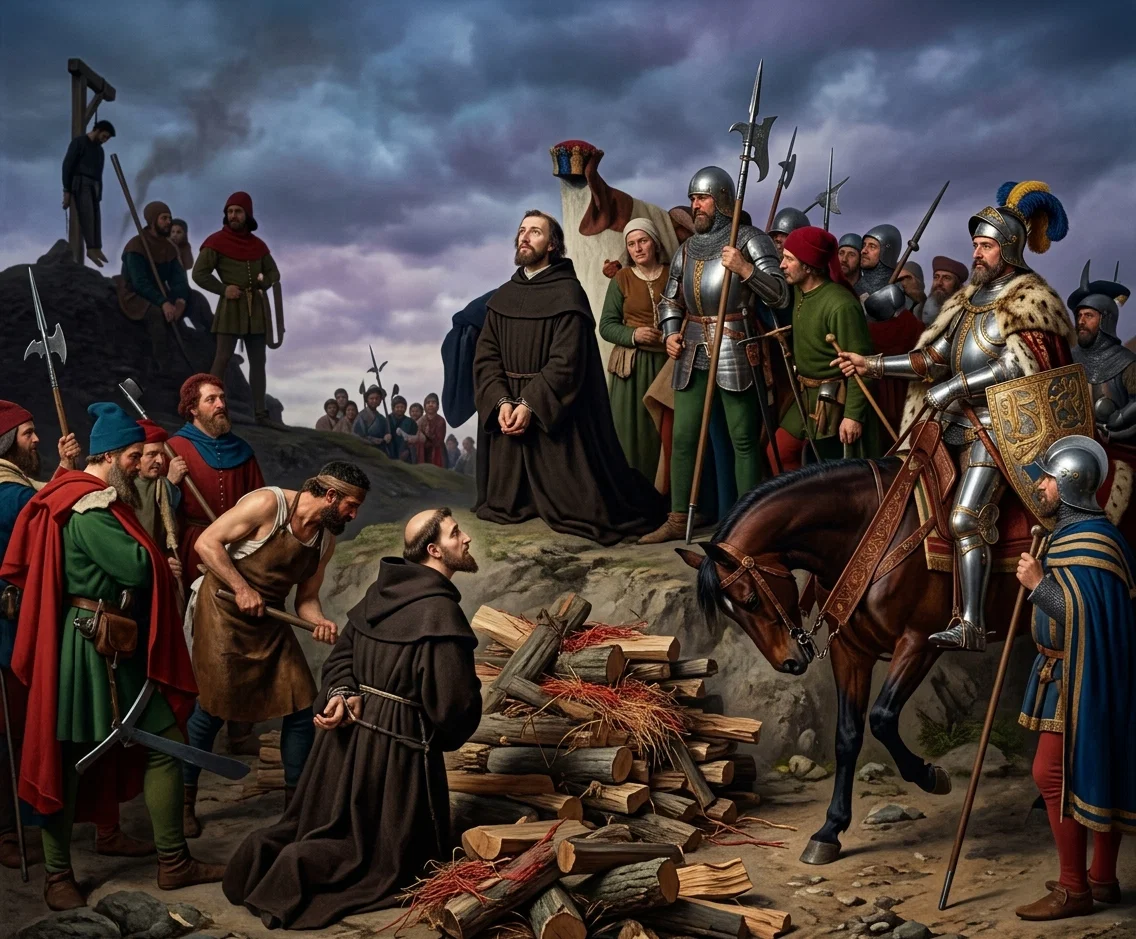
That power was to “wear out the saints of the Most High.” Through the dreary, blood-stained centuries following its rise, the papal power fulfilled that specification of the prophecy also to the letter. She carried on that cruel work against individuals and against whole peoples till millions had perished by fire and sword, by water, rack, and dungeon. The unabated continuance of that work through the centuries makes particularly appropriate the use of the words “wear out,” as applied to the effect of the Papacy's work upon those opposed to her doctrines. The Albigenses were ground out of existence by that power. The Waldensians well-nigh perished from the earth. The Paulicians were completely extinguished. The Anabaptists were crushed, partly by that power and partly by the state churches of northern Europe. Evangelical Christianity was completely extinguished in Spain by the various instrumentalities of that persecuting power; and through all these countries the steady grind of that merciless mill of oppression went on through the long and dreary centuries.
The Order to Exterminate the Hussites
This work was not done spasmodically or during the administration of a few of the popes. It was the settled policy of the system; and Pope Martin V was in perfect harmony with the system when he sent the following order to the king of Poland: “Know that the interests of the Holy See, and those of your crown, make it a duty to exterminate the Hussites. . . . While there is still time, then, turn your forces against Bohemia; burn, massacre, make desert everywhere, for nothing could be more agreeable to God, or more useful to the cause of kings, than the extermination of the Hussites.”—Commentin, Vol. II, pages 116, 117.
“Temporal princes shall . . . publicly make oath that they will endeavor, bona fide, with all their might to extirpate from their territories all heretics marked by the Church; so that when any one is about to assume any authority, whether spiritual or temporal, he shall be held bound to confirm by title by this oath. And if a temporary prince, being required and admonished by the Church, shall neglect to purge his kingdom from this heretical pravity, the metropolitan and provincial bishops shall bind him in fetters of excommunication.”—“The Decretals of Gregory IX,” book 6, title 7, chap. 13, par. 3.
The Papacy has worn out “the saints of the Most High.” She has fulfilled that specification of the prophecy, and no other power on earth has done so.
THE FOUR BEASTS OF DANIEL 7
An Attempt to Change the Law of God
One more specification, and the vision of the “little horn” is complete, so far as its identification is concerned. That power would “think to change the times and the law.” Earthly governments are continually changing their own laws; therefore this cannot refer to anything of that nature. It cannot refer to nations always change the laws of the nations they conquer. The change cannot refer to anything of that kind. The only other law that any power could “think to change” is the law of God; and as this power claimed all authority in religious things, it is essential to look for the fulfillment of that specification in that power. And we do not look in vain. The prophecy says he should “think to change” the law, but does not indicate that he would be able to do it. If it were a human law, he could accomplish his purpose. But if it be God's law, he can do no more than think to do it, or attempt to do it, or seek to make it appear that he has done it. The law of God is eternally unalterable.
The Papacy has, in its general catechisms, expunged the second commandment from the decalogue, and thus has made way for its adoration of images. The division of the tenth commandment into two preserves the number ten. “And, more audacious than all! it has taken hold of the fourth commandment, torn from its place the Sabbath of Jehovah, the only memorial of the God that he would be able to do it. If it were a human law, he could accomplish his purpose. But if it be God's law, he can do no more than think to do it, or attempt to do it, or seek to make it appear that he has done it. The law of God is eternally unalterable.
The Duration of Papal Supremacy
The prophecy continues: “They shall be given into his hand until a time and times and half a time.” Great Bible commentators agree that this means a year, two years, and a half year—three years and a half, or 1260 days. As we are dealing with symbolic prophecy, we are dealing with symbolic time also. In such prophecy a day represents a year (see Num. 14: 34 and Eze. 4: 6), so the 1260 days represent 1260 years. Did the Papacy fulfill the prophecy as to the time of its continuance as a persecuting power?—She did.
In the year 533, through the decree of the emperor Justinian, the Pope was recognized as the head of all the churches and in a letter to the Pope Justinian designates him as corrector of heretics; but the Pope could not enter with any degree of freedom into the work which that position implied until the Ostrogothic kingdom was out of his way. In 538 this was practically accomplished. With the period 533 to 538, then, commences the 1260 years of this prophecy, which would extend to the period 1793-98. The year 1793 was the year when the Roman Catholic religion was set aside in France. As a result of the revolt against papal authority the French army under Berthier, in 1798, entered Rome and took the Pope prisoner. Thus what the specification also fulfilled, and fulfilled to the letter.
The next incident in that prophecy is the judgment of that power and the giving of that kingdom and dominion to “the people of the saints of the Most High.” That power, which had annihilated individuals, peoples, and nations, is to be itself annihilated by the Most High, whose titles and prerogatives it has usurped, whose law it has mutilated and defied, and whose peoples it has oppressed and exterminated.
As every other detail of the prophecy has been fulfilled, this will be also. It is the next step in the completion of that wonderful historical production, written so many hundreds of years in advance of its occurrence.
That act, when it comes, will be one of the last two acts in the tragedy of sin. Other prophecies indicate that this act is soon to take place. Then comes the mighty triumph of the Son of Righteousness and the giving of the everlasting kingdom into the possession of the saints of the Most High. Toward that glorious event the servants of God look with longing eyes and glad anticipation. The trials and persecutions of this world finished, the earth renewed, the kingdom restored, and the redeemed gathered into their eternal inheritance,—all these wait on the fulfillment of this last specification of this wonderful prophecy. It is all in the past but that, and that is not long to wait.