“In the first year of Belshazzar king of Babylon Daniel had a dream and visions of his head upon his bed: then he wrote the dream, and told the sum of the matters.” Dan. 7: 1.
NOTE.— That is, in the first year of Belshazzar’s reign—of the associate king with his father Nabonidus, or 540 B. C.
2. What effect did this dream have upon Daniel?
“I Daniel was grieved in my spirit in the midst of my body, and the visions of my head troubled me.” Verse 15.
NOTE.— The effect of Daniel’s dream upon him, it will be noticed, was similar to the effect of Nebuchadnezzar’s dreams upon him; it troubled him. See Dan. 2: 1.
3. What did Daniel ask of one of the heavenly attendants who stood by him in his dream?
“I came near unto one of them that stood by, and asked him the truth of all this. So he told me, and made me know the interpretation of the things.” Dan. 7: 16.
4. What did the prophet see in this vision?
“Daniel spake and said, I saw in my vision by night, and, behold, the four winds of the heaven strove upon the great sea.” Verse 2.
5. What was the result of this strife?
“And four great beasts came up from the sea, diverse one from another.” Verse 3.
The Scriptural Interpretation of These Symbols
6. What did these four beasts represent?
“These great beasts, which are four, are four kings, which shall arise out of the earth.” Verse 17.
NOTE.— The word kings here, as in Dan. 2: 44, denotes kingdoms, as explained in verses 23 and 24 of the seventh chapter, the two words being used interchangeably in this prophecy.
7. In symbolic language, what is represented by winds?
NOTE.— That winds denote strife and war is evident from the vision itself. As a result of the striving of the winds, kingdoms rise and fall.
8. What, in prophecy, is symbolized by waters?
“And he saith unto me, The waters which thou sawest . . . are peoples, and multitudes, and nations, and tongues.” Rev. 17: 15.
NOTE.— In the second chapter of Daniel, under the figure of an image, the mere political outline of the rise and fall of earthly kingdoms is given, preceding the setting up of God’s everlasting kingdom. In the seventh chapter, earthly governments are represented as viewed in the light of heaven,—under the symbols of wild and ferocious beasts,—the last one, in particular, oppressing and persecuting the saints of the Most High. Hence the change in the symbols used to represent these kingdoms.
Four Universal Empires
9. What was the first beast like?
“The first was like a lion, and had eagle’s wings: I beheld till the wings thereof were plucked, and it was lifted up from the earth, and made stand upon the feet as a man, and a man’s heart was given it.” Dan. 7: 4.
NOTE.— As the fourth beast represents the fourth kingdom (verse 23), the lion, the first of these four great beasts, like the golden head of Nebuchadnezzar’s dream, represents the Babylonian monarchy—the lion, the king of beasts, standing at the head of his kind, as gold does of metals. The eagle’s wings doubtless denote the rapidity with which Babylon extended its conquests under Nebuchadnezzar, who reigned from 604 B. C. to 561 B. C. This kingdom was overtaken by the Medes and Persians in 538 B. C.
10. By what was the second kingdom symbolized?
“And behold another beast, a second, like to a bear, and it raised up itself on one side, and3it had three ribs in the mouth of it between the teeth of it: and they said thus unto it, Arise, devour much flesh.” Verse 5.
NOTE.— “This was the Medo-Persian Empire, the successor of Babylon, represented here under the symbol of a bear. . . . The Medes and Persians are compared to a bear on account of their cruelty and thirst after blood, a bear being a most voracious and cruel animal.”—Adam Clarke, on Dan. 7: 5.
11. By what was the third universal empire symbolized?
“After this I beheld, and lo another, like a leopard, which had upon the back of it four wings of a fowl: the beast had also four heads; and dominion was given to it.” Verse 6.
NOTES.— If the wings of an eagle on the back of a lion denoted rapidity of movement in the Babylonian, or Assyrian, Empire (see Hab. 1: 6–8), four wings on the leopard must denote equal celerity of movement in the Grecian Empire, which followed the Medo-Persian Kingdom. This we find to be historically true.
“The rapidity of Alexander’s conquests in Asia was marvelous; he burst like a torrent on the expiring Persian Empire, and all opposition was useless. The gigantic armies collected to oppose him melted like snow in the sunshine. The battles of Granicus, 334 B. C., Issus in the following year, and Arbela in 331 B. C., settled the fate of the Persian Empire, and established the wide dominion of the Greeks.”—The Divine Proworld’s History, by H. Grattan Guinness, page 318.
“The beast also had four heads.” The Grecian Empire maintained its unity but a short time after the death of Alexander, which occurred in 323 B. C. Within twenty-two years after the close of his brilliant career, or by 301 B. C., the empire was divided among his four leading generals. Cassander took Macedonia and Greece in the west; Lysimachus had Thrace and the parts of Asia on the Hellespont and Bosporus in the north; Ptolemy received Egypt, Lydia, Arabia, Palestine, and Coele-Syria in the south; and Seleucus had all the rest of Alexander’s dominions in the east.
12. How was the fourth kingdom represented?
“After this I saw in the night visions, and behold a fourth beast, dreadful and terrible, and strong exceedingly; and it had great iron teeth: it devoured and brake in pieces, and stamped the residue with the feet of it: and it was diverse from all the beasts that were before it; and it had ten horns.” Verse 7.
13. What was the fourth beast declared to be?
“Thus he said, The fourth beast shall be the fourth kingdom upon earth, which shall be diverse from all kingdoms, and shall devour the whole earth, and shall tread it down, and break it in pieces.” Verse 23.
NOTES.— This is allowed on all hands to be the Roman Empire. It was dreadful, terrible, and exceeding strong.
“. . . and became, in effect, what the Roman writers delight to call it, ‘the empire of the whole world.’”—Adam Clarke, on Dan. 7: 7.
The final overthrow of the Greeks, by the Romans, was at the battle of Pydna, in 168 B. C.
The Ten Horns
14. What was denoted by the ten horns on the head of the fourth beast?
“And the ten horns out of this kingdom are ten kings that shall arise.” Verse 24.
NOTES.— The Roman Empire was broken up into ten kingdoms between the years A. D. 351 and 476.
“The historian Machiavelli, without the slightest reference to this prophecy, gives the following list of the nations which occupied the territory of the Western Empire at the time of the fall of Romulus Augustus (A. D. 476), the last emperor of Rome: the Lombards, the Franks, the Burgundians, the Ostrogoths, the Visigoths, the Vandals, the Heruli, the Suevi, the Huns, and the Saxons; ten in all.”
“Amidst unceasing and almost countless fluctuations, the kingdoms of modern Europe have from their birth to the present day averaged ten in number. They have never since the breakup of old Rome been united into one single empire; they have never formed one whole even like the United States. No scheme of proud ambition seeking to reunite the broken fragments has ever succeeded; when such have arisen, they have been invariably dashed to pieces. . . .”
“And the division is as apparent now as ever. Plainly and palpably inscribed on the map of Europe this day, it confronts the skeptic with its silent but conclusive testimony to the fulfillment of this great prophecy. Who can alter or add to this tenfold list of the kingdoms now occupying the sphere of old Rome? Italy, Austria, Switzerland, France, Germany, England, Holland, Belgium, Spain, and Portugal,—ten, and no more; ten, and no less.”—The Divine Program of the World’s History, by H. Grattan Guinness, pages 318–321.
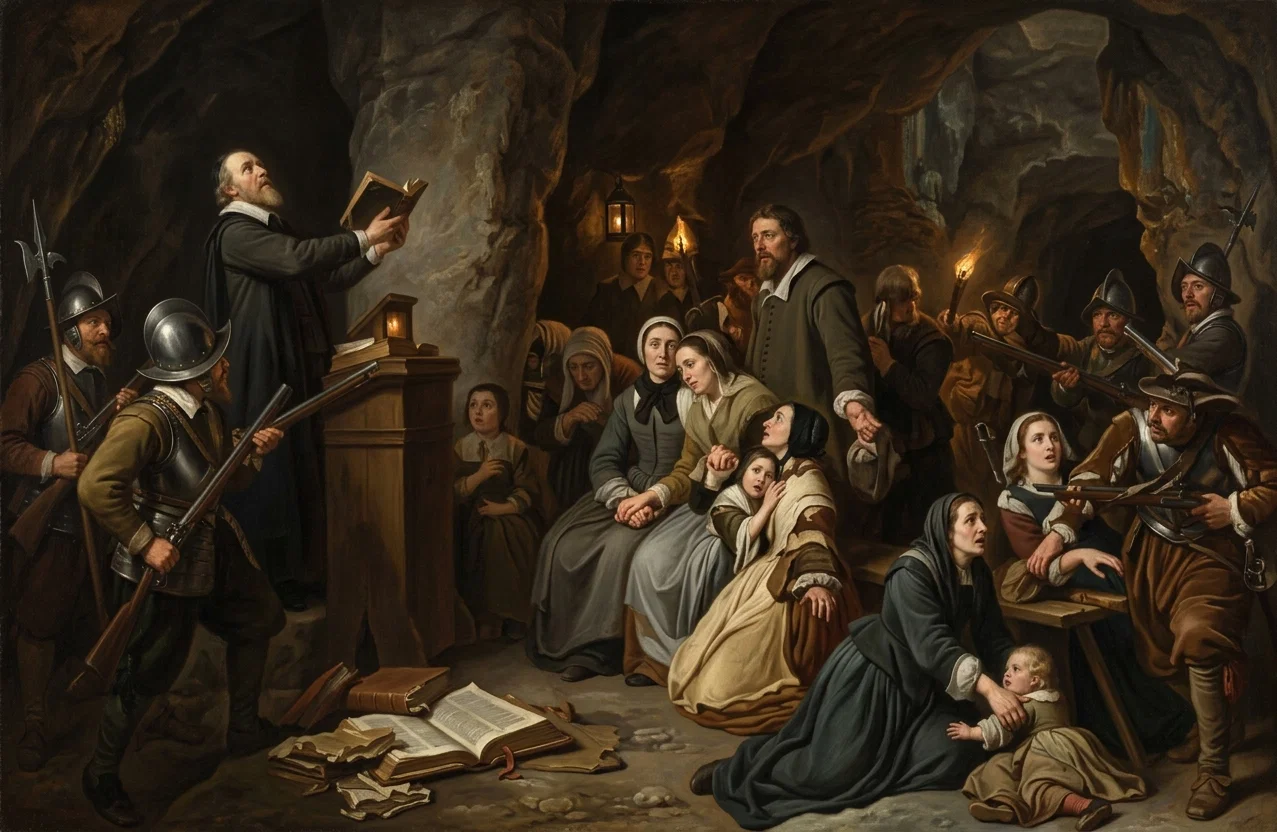
CHRISTIANS SURPRISED BY TROOPS WHILE WORSHIPPING IN A CAVERN
The Little Horn
15. What change did Daniel see take place in these horns?
“I considered the horns, and, behold, there came up among them another little horn, before whom there were three of the first horns plucked up by the roots: and, behold, in this horn were eyes like the eyes of a man, and a mouth speaking great things.” Verse 8.
16. What inquiry on the part of Daniel shows that the fourth beast, and especially the little horn part of it, constitutes the leading feature of this vision?
“Then I would know the truth of the fourth beast, which was diverse from all the others, exceeding dreadful, whose teeth were of iron, and his nails of brass; which devoured, brake in pieces, and stamped the residue with his feet; and of the ten horns that were in his head, and of the other which came up, and before whom three fell; even of that horn that had eyes, and a mouth that spake very great things, whose look was more stout than his fellows.” Verses 19, 20.
17. When was the little horn to arise?
“And another shall rise after them.” Verse 24.
NOTE.— The ten horns, as already shown, arose when Rome, the fourth kingdom, was divided into ten kingdoms. This division was completed in A. D. 476. The little horn power was to arise after them.
18. What was to be the character of the little horn?
“And he shall be diverse from the first, and he shall subdue three kings.” Same verse last part.
NOTES.— That power which arose in the Roman Empire after the fall of Rome, in A. D. 476, which was entirely different from all the ten kingdoms into which Rome was divided (for it demanded and exercised spiritual power over the other kingdoms), and before whom three of the other kings fell, was the Papacy.
The Papacy, which arose on the ruins of the Roman Empire, differed from all previous forms of Roman power, in that it was an ecclesiastical despotism, claiming universal dominion over both spiritual and temporal affairs, especially the former. It was a union of church and state, with the church actually in power to such a degree that the state was the agent to execute the wishes of the church.
The Papacy, or Antichrist
19. What attitude of rivalry was the Papacy, represented by the little horn, to assume toward the Most High?
“And he shall speak great words against the Most High.” Verse 25, first clause.
20. How does Paul, speaking of the man of sin, describe this same power?
“Who opposeth and exalteth himself above all that is called God, or that is worshipped; so that he as God sitteth in the temple of God, shewing himself that he is God.” 2 Thess. 2: 4.
NOTES.— The following extracts from authoritative works, most of them by Roman Catholic writers, will indicate to what extreme the Papacy has done this:
“All the names which are attributed to Christ in Scripture, implying his supremacy over the church, are also attributed to the Pope.”—Bellarmine, “On the Authority of Councils,” book 2, chap. 17.
“For thou art the shepherd, thou art the physician, thou art the director, thou art the husbandman; finally thou art another God on earth.”—From “Oration of Christopher Marcellus” in fourth session of Fifth Lateran Council, Labbe and Cossart’s “History of Councils,” published in 1672, Vol. XIV, col. 109.
“The Pope is the supreme judge of law of the land. He is the vicegerent of Christ, who is not only a priest forever, but also King of kings and Lord of lords.”—From the Civiltà Cattolica, March 18, 1871, quoted in “Vatican Council,” by Leonard Woolsey Bacon, American Tract Society edition, page 220.
“Christ intrusted his office to the chief Pontiff; but all power in heaven and earth has been given to Christ; therefore the chief Pontiff, who is his vicar, must have this power.”—Glossa on “Extravagantes Communes,” book 1, tit. 1, “On Authority and Obedience,” chap. 1, on words Porro Subesse, Romano Pontiff. Canon law, published in 1556, Vol. III, “Extravagantes Communes,” book 1, col. 29.
“Hence the Pope is crowned with a triple crown, as king of heaven, and earth, and in purgatory (Inferno).”—“Prompta Bibliotheca,” Ferraris, Vol. VI, page 26, article “Papa” (the Pope).
21. How was the little horn to treat God’s people?
“And shall wear out the saints of the Most High.” Dan. 7: 25.
NOTE.— Under these bloody maxims (previously mentioned), those persecutions were carried on, from the eleventh and twelfth centuries almost to the present day, which stand out on the page of history. After the signal of open martyrdom had been given in the canons of Orleans, there followed the extirpation of the Albigenses under the form of a crusade, the establishment of the Inquisition, the cruel attempts to extinguish the Waldenses, the martyrdoms of the Lollards, the cruel wars to exterminate the Bohemians, the burning of Huss and Jerome and multitudes of other confessors, before the Reformation; and afterwards, the ferocious cruelties practiced in the Netherlands, the martyrdoms of Queen Mary’s reign, the extinction by fire and sword of the Reformation in Spain and Italy, by far and open persecution in Poland, the Massacre of Bartholomew, the persecution of the Huguenots by the league, the extirpation of the Vaudois, and all the cruelties and prejudices connected with the revocation of the Edict of Nantes. These are the more open and conspicuous facts which explain the prophecy, besides the slow and secret murders of the holy tribunal of the Inquisition.”—“The First Two Visions of Daniel,” Rev. T. R. Birks, M. A., London, 1845, pages 248, 249.
22. What else does the prophecy say the little horn would do?
“And he shall think to change the times and the law.” Dan. 7: 25, third clause, R. V.
NOTES.— Although the ten commandments, the law of God, are found in the Roman Catholic versions of the Scriptures, as they were originally given, yet the faithful are instructed from the catechisms of the church, and not directly from the Bible. As it appears in the catechisms in general use, the law of God has been changed and virtually reenacted by the Papacy. Furthermore, communicants not only receive the law from the church, but they deal with the church concerning any alleged infractions of that law; and when they have satisfied the ecclesiastical authorities, the whole matter is settled.
The second commandment, which forbids the making of, and bowing down to, images, is omitted in the Catholic catechisms in general use, and the tenth, which forbids coveting, is divided into two.
As evidence of the change which has been made in the law of God by the papal power, and that it acknowledges the change and claims the authority to make it, note the following from Roman Catholic publications:
“Question.—Have you any other way of proving that the church has power to institute festivals of precept?”
“Answer.—Had she not such power, she could not have done that in which all modern religionists agree with her,—she could not have substituted the observance of Sunday, the first day of the week, for the observance of Saturday, the seventh day, a change for which there is no Scriptural authority.”—“A Doctrinal Catechism,” Rev. Stephen Keenan, page 174. Imprimatur, John Cardinal McCloskey, Archbishop of New York.
“Ques.—How prove you that the church hath power to command feasts and holy days?”
“Ans.—By the very act of changing the Sabbath into Sunday, which Protestants allow of; and therefore they fondly contradict themselves by keeping Sunday strictly, and breaking most other feasts commanded by the same church.”
“Ques.—How prove you that?”
“Ans.—Because by keeping Sunday they acknowledge the church’s power to ordain feasts, and to command them under sin; and by not keeping the rest by her commanded, they deny again in fact, the same power.”—“An Abridgment of the Christian Doctrine,” composed in 1649, by Rev. Henry Tuberville, D. D., of the English College of Douay, New York, John Doyle, 1883, page 58.
“Is not every Christian obliged to sanctify Sunday, to abstain on that day from unnecessary servile work? Is not the observance of this law among the most prominent of our sacred duties? But you may read the Bible from Genesis to Revelation, and you will not find a single line authorizing the sanctification of Sunday. The Scriptures enforce the religious observance of Saturday, a day which we never sanctify.”—“The Faith of Our Fathers,” by James Cardinal Gibbons, Baltimore, John Murphy & Co., 1893, page 111.
All Roman Catholic writers agree in this teaching.
The 1260 Years of Papal Supremacy
**23. Until what time were the saints, times, and the law of the Most High to be given into the hands of the little horn?
“And they shall be given into his hand until a time and times and the dividing of time.” Dan. 7: 25, last clause.
24. In what other prophecies is this same period mentioned?4
“And to the woman were given two wings of a great eagle, that she might fly into the wilderness, into her place, where she is nourished for a time, and times, and half a time, from the face of the serpent.” Rev. 12: 14.
“And there was given unto him a mouth speaking great things and blasphemies; and power was given unto him to continue [‘to make war,’ margin] forty and two months.” Rev. 13: 5. See also Rev. 11: 2. “And the woman fled into the wilderness, where she hath a place prepared of God, that they should feed her there a thousand two hundred and threescore days.” Rev. 12: 6.
25. In symbolic prophecy what length of time is represented by a day?
“After the number of the days in which ye searched the land, even forty days, each day for a year, shall ye bear your iniquities, even forty years.” Num. 14: 34. See Eze. 4: 6.
NOTES.— A time in prophecy being the same as a year (see Dan. 11: 13, margin, and Revised Version), three and one-half times would be three and one-half years, or forty-two months, or twelve hundred and sixty days, since the calendar year of 360 days, or twelve months of thirty days each, is used in prophetic chronology. As each day represents a year, the period, the end of which was to mark the limit of the time of the supremacy of the little horn, the Papacy, over the saints, times, and the law, would therefore be twelve hundred and sixty years.
The decree of the emperor Justinian, issued in A. D. 533, recognized the Pope as “head of all the holy churches.” (Justinian’s Code, book 1, title 1; Baronius’s Annals, A. D. 533.) The overwhelming defeat of the Ostrogoths in the siege of Rome, five years later, A. D. 538, was a deathblow to the independence of the Arian power then ruling Italy, and was therefore a notable date in the development of papal supremacy. With the period 533–538, then, commences the twelve hundred and sixty years of this prophecy, which would extend to the period 1793–98.
1793 was the year of the Reign of Terror in the French Revolution, and the year when the Roman Catholic religion was set aside in France and the worship of reason was established in its stead. As a direct result of the revolt against papal authority in the French Revolution, the French Army, under Berthier, entered Rome, and the Pope was taken prisoner, Feb. 10, 1798, dying in exile at Valence, France, the following year. This period, 1793–98, during which this death blow was inflicted upon the Papacy, fittingly and clearly marks the close of the long prophetic period mentioned in this prophecy. Any standard history of the time may be consulted in substantiation of the facts here stated.
The Final Judgment of Antichrist
26. What will finally be done with the dominion exercised by the little horn?
“But the judgment shall sit, and they shall take away his dominion, to consume and to destroy it unto the end.” Dan. 7: 26.
27. To whom will the dominion finally be given?
“And the kingdom and dominion, and the greatness of the kingdom under the whole heaven, shall be given to the people of the saints of the Most High, whose kingdom is an everlasting kingdom, and all dominions shall serve and obey him.” Verse 27.
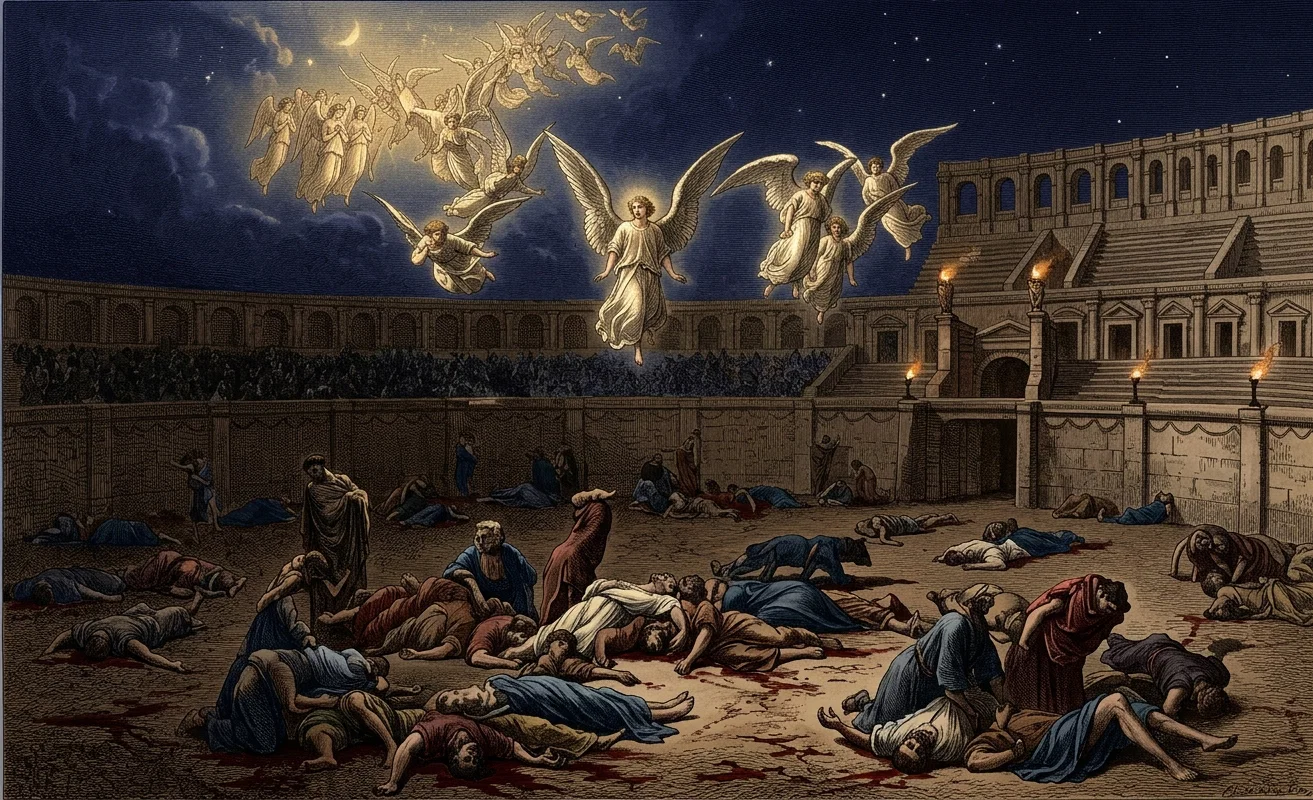
EARLY CHRISTIAN MARTYRS IN THE ROMAN COLOSSEUM
NOTE.— Here, as in the second chapter of Daniel, the announcement of the setting up of the everlasting kingdom of God is given; and the earth concludes a brief outline of the history of this world; and the prophecies of Daniel concerning the powers that would oppose the purpose of God, furnish additional features for this outline. The exact fulfillment of this outline in the history of the world since the time of Nebuchadnezzar constitutes an unimpeachable testimony to the inspiration of the prophecies, and furnishes a ground of confidence that the unfulfilled portion of the prophecies will be brought out in the future with absolute certainty and in every detail.