The Garden of Eden

3%

Review and Herald Publishing Association · Takoma Park, Washington, D. C. · Jul 5, 1915

FromReview and Herald, Vol. 92, No. 33.

Read the full edition

The Garden of Eden

By Daniel March
Among all nations and in all times there have been beautiful legends and blessed memories of a glory that once shone on the earth with the fullness of heavenly light. It has ever been supposed that all things were fair and lovely in the fresh morning of the world, and that every voice sang for joy when the heir of earth entered upon his great inheritance. The all-creating Father took the hand of his earthly child and walked with him, “teaching him to go,” in the brightness of the broad noon and in the coolness of the forest shade. The sun shone upon the genial landscapes and gentle home, and the silent stars looked down upon sleeping innocence and secure repose.

God Walks and Talks With Man

Between heaven and earth the flow of thought and sympathy was free as the flight of angels, and constant as the succession of day and night. The homes of men were not yet haunted by the shadowy forms of fear. The thorns of regret had not yet grown in the path of pleasure. Sin had not mingled the poison of death in the full cup of life. The inner chambers of the soul were all open to heaven’s light. The sun of peace and gladness was never hidden by the cloud of care and pain and sorrow. Man talked with God in open vision, as friend with friend, and he lived in daily companionship with the blessed. The poets of every age have sung their sweetest, saddest strains when lamenting the lost glory of that happy age, and the toiling millions of mankind have mourned over their hard lot, as the caged bird mourns in remembrance of the wild woods, and the slave groans under the burden of inherited bondage.

The Legend of All Nations

These faint beams of a glory that has passed away from the earth are found among the traditions of all nations; they can be traced back to the earliest periods of human history. Though darkened with many errors and superstitions, they point to a common origin, and they spring from the actual and inspired history of man’s first days on the earth. That better state, so brief in duration, so far away in the past, is fully described by the meaning of one word, “Eden” — a garden of delight, a paradise of loveliness and purity. By common consent the name stands for riches without want, health without sickness, pleasure without pain, joy without sorrow, life without death. Wherever man can now find a region having most of what all desire and least of what all dread, they call it Eden.

The First Man

In such a home, surrounded with beauty and loaded with blessing, man woke to conscious being when the Lord God breathed into his nostrils the breath of life and he became a living soul. The first father of our race knew nothing of the helplessness of infancy. He started upon his career in the strength and fullness of perfect manhood. In the first moment of self-scrutiny he found himself everything that he would desire to be, with no feeling or suspicion that anything had been omitted or overdone in the selection and finish of his faculties. As the bird could wish itself nothing else than what it was when bursting forth upon the wing, so the first man could find no defect in the constitution of his being. The whole creation around him was pronounced very good by Him whose standard is infinite perfection, and man was the last and best work of all.
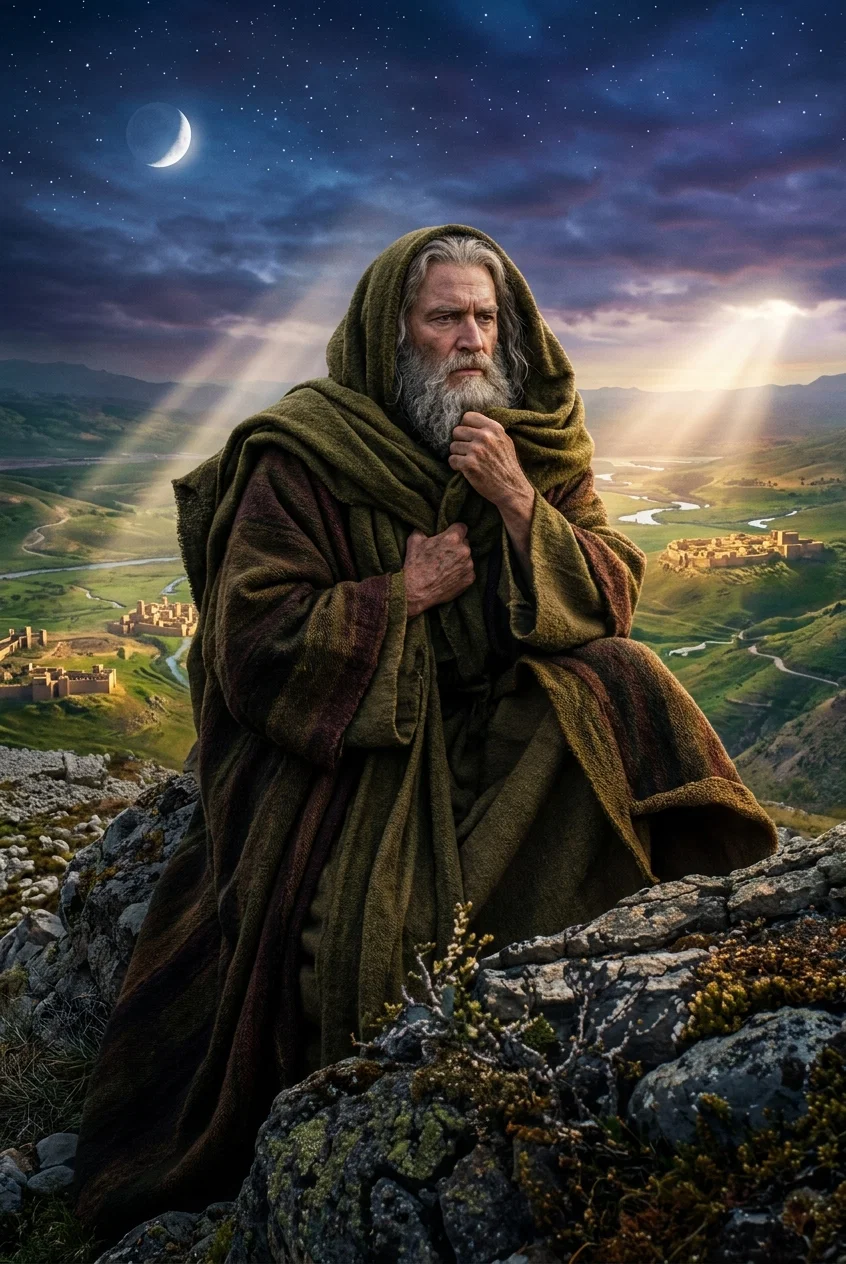
MOSES VIEWING THE PROMISED LAND

Perfection and Beauty

The flowers that bloomed on the banks of the fourfold river of Paradise, the forests that clothed the hills and climbed the distant mountain sides, the singing birds that lifted the sweet incense of song highest into the dome of heaven, the splendors that poured from the open gates of the morning, and the golden hues that robed the setting, were all that God made them to be in beauty and in use the first day of their existence, and man himself was the crowning glory of the whole, the consummation of all completeness, the last and grandest achievement of infinite wisdom and power in the work of creation.
The first rose that bloomed in Eden was mature and perfect on the day of its appearance. The grape was already hanging on the vine, and the fig was formed upon the tree; the goodly feathers adorned the ostrich, and the tawny lion “shook his brindled mane;” the mighty oak and the mountain pine rose to their loftiest height in the same day that the Lord God created them by his power.
They did not grow up at first by slow development from germs and atoms. Every race started with a full-grown and perfect life. All this is implied in the simple statement of the inspired record, that the Lord God planted the garden and made it complete before delivering it into the hands of its new possessor. It was fitting that the Creative Power, in bringing new classes of beings upon the earth, should start them in their generations at the highest perfection.

Evolution a Fable

And so man began his existence on the earth at the very highest grade of human power and excellence. The utmost that the race could do in all subsequent time would be to equal the first perfect man as God made him. He was not left to roam the wilderness in search of food and to seek a shelter in the caves of the earth. The idea that the first man was a savage, and that his first home was with the brutes, is a fable of heathen poets or an invention of misnamed philosophy, having no foundation in reason or revelation. The highest attainment of modern culture is only an imperfect return to the blessed age when the human mind was taught directly by divine inspiration, and every faculty was fresh and free to range through all the works of God.

A Garden of Delight

The first home which the heavenly Father gave his earthly child was in a garden of delight — a paradise of loveliness and beauty. The Lord God selected the site, and planted the garden with his own hand. Along the shaded walks and winding streams he set the fruitful trees and hung the climbing vines. He chose every shade and shape of leaf and flower to make them pleasant to the eye. He gave the form and flavor of fruit such as should satisfy both the desire for beauty and the appetite for food. Within that sacred conservatory the first man could survey the most rare and beautiful productions in the whole vegetable world, collected and ranged in order by his divine teacher for him to study and admire. The towering cedar crowned the distant heights, the branching banyan spread its “pillared shade high over-arched” along the quiet walk; the tufted palm waved its feathery fronds in the evening wind, when the voice of the Lord God was heard while he walked among the trees of the garden in the cool of the day.

Adam Names the Beasts of His Dominion

The wild beasts were moved by divine impulse to present themselves in peaceful homage before their human lord and receive such names as he would give. Bright birds flashed like meteors among the branches of the dim woods. The wildest were tame in the presence of man, and all came with beauty and song to receive his praise and to adorn his garden of delight. Dominion was given unto him over all the living tribes of the earth, and he was inspired with skill to exercise that dominion so far as to make the bird and the beast obey him. The names which he gave to the multitudes of living creatures indicated a knowledge of their habits and instincts more precise and significant than the dry and studied terms of modern science. The wild man of the West named the bright cascade Minnehaha, that the word might bring to mind the merry sound of “the laughing water.” And so the names which were given to the winds, the clouds, the rivers, the forests, the beasts, the birds, by the inspired man in Paradise, were all significant of the objects to which they were given. The most obvious and distinctive characteristic of the bird or flower was conveyed by the sound and sense of its name. If we could still speak the language of Eden, our children would learn the qualities of things from the names they bear.

Taught of God

God himself was the teacher of the first man, and under the instruction of Omniscience the pupil was conducted at once through the whole range of knowledge by special inspiration. The Almighty Father spoke to his earthly child with a human voice, and so man learned to speak. In the beginning of language, man received every word from the mouth of the Lord. The vocal sounds which give the names of things, the forms and inflections of words which express connected thought, were never invented by man nor created by necessity. They were given as truly as were the faculties of the mind and the organs of the body. No effort or want or invention of man could have created the organs of speech. Just as little could he originate language itself. It must be given by the inspiration of the Almighty or he would be speechless forever.

A Pure Language

And the first language spoken by man was the best, because it came fresh and living from the mouth of God. The perfection of the first speech was correspondent to the perfection of the first man. The many languages now spoken on the earth, compared with the first, are only as the shining fragments of a broken vase compared with the beautiful whole. The fragments are not only irregular and incomplete, but they have been scattered in the dust and soiled. Taken piece by piece and polished with ever so careful a hand, we can only guess at the primitive language — we can never reconstruct the perfect whole.
All the philosophers in the world could not create a language, any more than they could create a man. They can only take what has been given by God, and the gift itself as now received is marred with all of man’s imperfections. The child learns to speak only by hearing others speak. If the whole race were struck dumb, or one generation should grow up without hearing a word spoken, language would be lost to the earth, and it could be recovered only by direct inspiration from the Almighty. All our attempts to refine and improve language are only slight approaches toward the power and the purity with which the first man was taught to speak with his Maker in the garden of delight.
The first man had a home suited to his wants and gratifying to his taste. The first human habitation was built by him who built the worlds.

Happy Days of Innocence

And so lived the great first father of mankind in his garden home while the happy days of innocence lasted, and the holy heavens looked down upon a new world of purity and love. To the first created man was given a companion correspondent to him in nature and his counterpart in affection. Hand in hand the blessed pair walked through the green fields and shaded aisles, conversing in language which both had learned from the mouth of God, as angels walk by the river of life in the Paradise above. Birds of the sweetest song joined with them in their morning hymn of praise. Flowers of the sweetest perfume shed incense on their path. Celestial harmonies murmured in the air. Guardian spirits kept them secure by night. The Son of God appeared in form like their own, and poured into their attentive ear, fast as they could receive it, the knowledge of all things in heaven and earth.

The Paradise of the Pure in Heart

Such was man’s first home in the garden of delight; such the freedom and high command which he enjoyed in the paradisiacal state. Alas for him that he should ever lose that blest abode! Alas for us that the lost Paradise should be so hard to regain! And yet it is not so much change of place that we need as change of heart. If Eden still remained, with all its primitive beauty, and the flaming sword of the cherubim were lifted from the guarded gate that we might enter and reclaim the lost possession, it would not be to us a garden of delight unless the innocence of the first man were ours. Long and dark as have been the ages of sin and sorrow since Adam fell, the pure in heart can still see God. If we should wander the earth over, and sound the deep and question the stars, in search of the joys of Eden, we should find them only in the paradise of the pure in heart. Long as have been the woes of exile from the garden of delight which God planted for man’s first home, deep and dark as have been the shadows which have fallen upon every path trodden by human feet, the Holy One still dwells with the humble and contrite; guardian angels still keep the home of those who walk with God.

“Return Unto Me”

The whole purpose of divine revelation is to open a way for the wanderer to come back, to convince the doubting, the fearful, and the penitent, that their injured Father desires their return.
The whole Book of God, from beginning to end, is a continual cry unto the children of men, “Return unto me, and I will return unto you.” And God orders the whole course of his all-teaching and eternal providence to confirm the voice of a Father’s yearning and pleading love which cries through his Word. It is impossible for the wanderer to go beyond the reach of those bonds of love with which the Holy and the Blessed One is ever drawing the disinherited child of earth back to his lost inheritance.

Paradise Regained by the Cross of Christ

The cherubim whose fiery sword guarded the gate of the forfeited Eden, forbidding all return, spread out their covering wings over the mercy seat in the tabernacle of Moses and in the temple of Zion. They were represented as bending forward with reverent and adoring study to learn what might be signified by the divine symbol of a propitiatory sacrifice for sin. Thus God taught his ancient people the great mystery which angels desired to look into — the mystery of Paradise regained by the cross of Christ.
When the weary exile of earth returns from all his wanderings and stands in penitence at the guarded gate, pleading only the cross of Christ for admission, “the watching cherub hears and drops his double-flaming sword.” The way of entrance is open and free. Angel hosts come forth to welcome him to bliss. Crowned and proclaimed as the ransomed of the Lord, he finds a brighter home and a better life than Adam lost in Eden.