Meiktila Industrial School

7%

Review and Herald Publishing Association · Takoma Park Station, Washington, D. C. · Sep 24, 1914

FromReview and Herald, Vol. 91, No. 40.

Read the full edition

Meiktila Industrial School

R. B. THURBER
SEVERAL years ago a telegrapher in Rangoon became interested in our work, but was soon after transferred to Meiktila. Brother Votaw found opportunity to follow him for a stay long enough to present our belief more thoroughly. The government prosecutor of the district attended the readings, and in a short time united with us. Through his influence many prominent persons in the town became interested in our system of education, and urged that we start a school. Some money was raised, and the opening seemed so providential that I was called from America to begin educational work. This was late in 1909; in March, 1910, the institution took form. That was “the day of small things” indeed; but in the four and one-half years since then God has helped us to gain much in facilities and efficiency.
The school is the most successful of its kind in Burma; but to say this is not rating it high compared with schools of like nature in other Eastern countries; for industrial education is at a low ebb in this land of the toil free. As a people, the Burmese do not appreciate skilled workmanship in the ordinary trades. They continue to class work with drudgery, and take no pride in training the hand to accuracy. Many parents highly approve our work—for the other man’s boy. Until the people are educated away from this erroneous idea, technical education will not be popular in Burma. While we knew this from the beginning, our work has been to identify this truth with a growing cause; for from economic necessity the industries are forcing attention from the natives. Commercially they are giving their country to foreigners, while we are taking the best methods of saving Burma to the Burmans. Perhaps all we have been able to do by way of creating sentiment has yet to be seen; but we are gaining souls for God’s kingdom, and that is our chief aim. We shall not take space to give an account of all our struggles during the past four years, but shall show the aspects and prospects of the institution as it stands today.
ROBERT MAPEPUKA
ROBERT MAPEPUKA
Meiktila is three hundred and twenty miles north of Rangoon on the railway. It is a town of about seven thousand people, and an important civil and military station. We have twenty-five acres of land, one and one-half miles from the station. This land is nearly all cleared and tillable. Although near the shore of a lake, we are in the dry zone, and irrigation is needed during the dry season to make crops succeed. Because of a lack of proper fences, a water supply, and an able man to lead out, we have not done much in agriculture. But the soil is excellent for such crops as watermelons and peanuts.
There are five permanent buildings on the land: a school, a workshop, a dormitory, the superintendent’s house, and a teacher’s house. The land and buildings are the property of the mission, and are free from debt. Approximately six thousand dollars has been invested in the institution, about half of this coming from mission funds and half from the interested people of the country.
Because of peculiar conditions, the number in attendance has varied greatly. We shall try in a few words to describe these conditions. The Burmese are an agricultural rather than a manufacturing people, and those who are educated prefer office work to anything else. The various branches of the government provide many openings in this line, and Burmans are given the first choice, because it is their country. But no one can get a clerkship who has not passed a certain grade in the government-aided schools. These schools are usually conducted by the various missionary societies, and charge a small tuition; but the government pays half the teachers’ salaries, and helps also in buildings and equipment. To secure government aid a certain curriculum must be followed, authorized textbooks used, and the teachers must hold government certificates. The nature of our work compelled us to do without this aid. The textbooks and teachers did not suit our work, and we had no teachers of our own who held certificates. Attracted largely by some new thing, many boys attended the school at first, most of whom, however, were undesirable. But many were easily coaxed away to other schools, when, in their ignorance, they were told that we would make coolies of them, while with a government certificate they would become magistrates and judges. The truth is, many of the other schools are fitting their boys for neither trades nor professions, but are making idlers of them.
Our new workshop is well built, having a cement floor, tile roof, and corrugated iron siding. It measures seventy-two by thirty-two feet. Part of the side is composed of huge doors, which can be raised outward, providing an awning under which the boys can work. Thus the structure affords ample room for the three trades, and also a room for a fourth, which we hope will be printing.
The leather-, cane-, and wood-working divisions are making and repairing boots, shoes, harness, belts, wood and cane furniture, baskets, etc. Besides what can be sold from the shop, an agency is maintained in Rangoon; and ordinarily we have no difficulty in disposing of the finished products. These trades are nearly self-supporting. The fact that there is some waste incurred in teaching the boys, and that scarcely any capital has been put into the business, keeps them from being able to stand alone. With proper supervision there is no reason why they should not be made a source of profit.
For a long time we have been calling for a capable layman to take charge of this industrial work and business; and we hope soon to be able to welcome one to the field. It has been necessary for me almost entirely to neglect gospel work and teaching and to give my time to buying and selling. This is not as it should be. There is a great opportunity here for a consecrated young business mechanic.
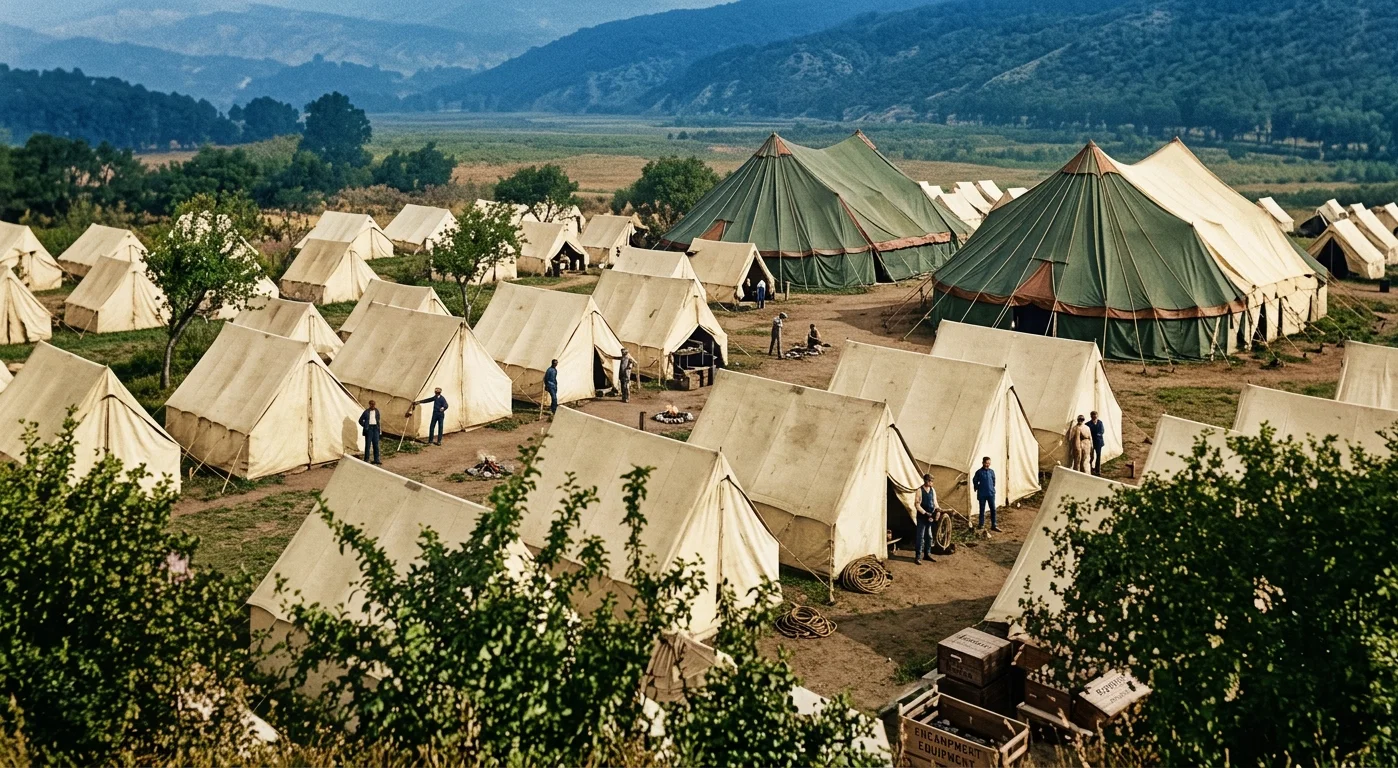
LATIN UNION ENCAMPMENT
Twelve students from the school have been baptized. Three have gone into the canvassing work, and the school has been instrumental in better fitting other native laborers for places in the work. This institution is now known and watched throughout the length and breadth of Burma; and it must and will succeed.
(To be continued)