The Eastern Question

2%

Review and Herald Publishing Association · Takoma Park, Washington, D. C. · Oct 9, 1916

FromReview and Herald, Vol. 93, No. 50.

Read the full edition

The Eastern Question

Its Relation to the Great World War, and Its Meaning in the Light of Prophecy
By Arthur G. Daniells
The most gigantic, devastating war recorded in the annals of the human race, suddenly broke upon the world in the summer of 1914. Into this cataclysm have been swept fourteen nations, representing three fifths of the human family, and three fifths of the land area of the world. The nations that have not been drawn into this struggle are fighting to keep out. It is not without good reason that this great conflict has been named “The World War.”

A Heavy Toll in Human Life

The world is staggering under the terrific blows already dealt by this great war, and the end is not yet. The reports of the casualties for the two years of unprecedented warfare are paralyzing. Four million killed, eight million wounded, four million missing—a total of sixteen million. And yet, after these fearful losses, there are still twenty millions of men under arms; and these millions, when called to the front, were in the prime of life. They were the strength and flower of the men of this generation.
Never before in the history of the world have such vast armies been assembled on battle fields, never has warfare been so deadly, never has the toll in wounded and dead been so heavy.
A TWO YEARS’ WAR RECORD Killed ............ 4,000,000 Wounded .......... 8,000,000 Missing ........... 4,000,000 Total casualties ...... 16,000,000 Cost ............... $50,000,000,000 This war has filled the world with more sorrowing relatives, fatherless children, and broken-hearted widows, than has any other war since the world began.

A Heavy Toll in Money

And never before has the cost of war in money been so great. In round numbers the two years’ war has cost the nations engaged in it fifty billions of dollars. The average cost has been about sixty-eight million dollars a day. At the present time it costs one hundred million a day. The total expense for operating the government of the United States during 1915 was a little more than seven hundred million dollars—the amount required to finance this great war only one short week. These figures are truly appalling.

Waste and Ruin of Previous Wars

The war now going on far exceeds, in magnitude and waste and ruin, any previous war of which we have any records.
In the Napoleonic Wars, covering a period of nineteen years (1796-1815), the losses were six millions of men, and the cost fifteen billion dollars.
The losses in the war between Great Britain and the United States (1812-14) were fifty thousand men and one hundred eighty million dollars.
The Crimean War (1853-56) cost eight hundred thousand men and a little less than two billion dollars.
The toll of the Franco-Prussian War (1870-71), which has always been considered heavy, was only two hundred twenty-five thousand men and three billion dollars.
The Boer War (1899-1902) destroyed one hundred twenty-five thousand soldiers at a cost of one and a quarter billion dollars.
In the Spanish-American War (1898) six thousand lives were lost at an expense of eight hundred thousand dollars.
The losses in the Russo-Japanese War (1904-1905) were heavy—five hundred fifty thousand men, and nearly two billion dollars.
These seven great wars, extending over a period of more than a hundred years, record a loss of less than 8,000,000 men and an expenditure of less than twenty-five billion dollars—a little less than half the terrible destruction wrought in two short years by the war now in progress.
But, as Hamilton Holt truly says, “It is impossible to compute statistically the grief, misery, and want necessarily involved in these amazing totals. Hunger and suffering do not lend themselves to the processes of arithmetic. Blasted homes are not to be expressed in algebraic symbols, and stunted lives are not to be interpreted by mathematics.”
This war has filled the world with more sorrowing relatives, fatherless children, and broken-hearted widows than has any other war since the world began.
It would seem that the terrible destruction already wrought would so appall the rulers of the nations involved that they would find some way to bring this struggle to an end. But it does not. The combatants apparently grow more determined as the war lengthens. One writer declares that this war seems “like some infernal dream devised by the imps of hell sitting in an eternity of inventive council.” Another says: “The rulers of nations are stupid. It would seem that they were blinded by the gods. It is as if madness is upon them, a fatality, incurable; a mania, fatal, malignant, satanic.”

Nothing Like It Since the World Began

There is a growing conviction that this world struggle is a far more serious affair than was at first realized. The editor of Life (Australia) says: “The great war grows in scale and significance as each day passes. It is plainly ‘the war of all the centuries.’ . . . The war will not only give the world a new map; it will give to civilized history a new date, and perhaps a new form.”
Woodrow Wilson, President of the United States, says: “The world has never before in the history of mankind seen war on such a scale, seen war with so many terrible features, seen the sweep of destruction comparable to that which is now devastating Europe. . . . We are witnessing a cataclysm, and God only knows what the issue will be.”
Always thoughtful and temperate in his utterances, William Howard Taft, former President of the United States, says of this war: “Nothing like it has occurred since the world began. It is a cataclysm. The future looks dark indeed.”
Near the close of the first year of the war, an observant writer said: “The most critical moment of the world’s history is upon us. . . . Events are transpiring to stun the stoutest mind. We are at time’s meridian.”
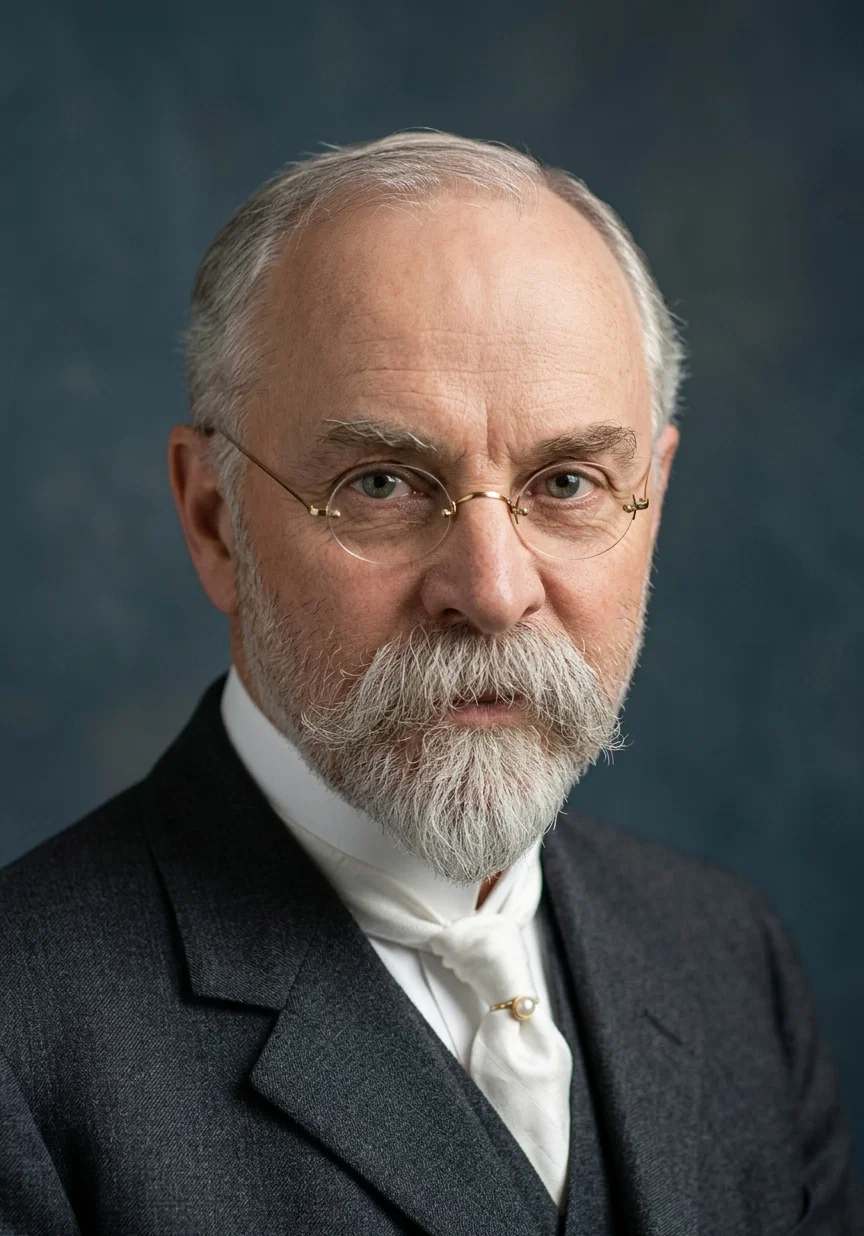
ARTHUR G. DANIELLS, EVANGELIST, WORLD-WIDE TRAVELER, AND LECTURER
Mr. H. G. Wells, an English writer, says: “This is already the vastest war in history. It is a war not of nations, but of mankind. It is a war to exorcise a world madness and end an age.”

The Cause and the Meaning

As the months have rolled by and the horrors of this great tragedy have been driven deeper into the hearts of multiplied millions, the question has been repeated with increasing emphasis: What is the cause of this war? What are these nations fighting so desperately about? What is the cause for which such heavy toll is being paid? What does it mean, and what will be the end of the struggle?
Facing these pressing inquiries, the editor of the Springfield Republican says: “Writers who can tell a stupefied world what this fearful portent means, who can throw light on the great fundamental problems of the race, and give some hint as to its destiny, will have an attentive and even anxious audience.”
This “fearful portent” must have both a cause and a meaning, and both should be made as plain as day. A world war is not being fought without a cause. The rulers, the premiers, the secretaries of foreign affairs, the ambassadors, the great generals and admirals of those warring nations know very well what is at stake in this great conflict.
Furthermore, a world war must have a great meaning as well as a great cause. What this colossal struggle means to the world, how it will leave mankind when it is over, what will follow—these are questions of supreme interest to the whole human race. And the meaning concerns us more vitally and seriously than does the cause.
Unquestionably this great war belongs to a series of epoch-making events which lead toward one great culminating event in the history and destiny of the human race. Only a partial explanation of its meaning can be found in the field of international politics, treaties, commerce, and the like. Not until the realm of the supernatural is entered, and the high purpose and controlling power of the Supreme Being are recognized, can there be found a full and satisfactory explanation of this great catastrophe that has overtaken us.
The insistent demand for an explanation of what is felt to be the “greatest crime in all history,” has led to a most diligent study of the real cause, and to a clean-cut statement of the findings in this investigation. Members of cabinets, statesmen, and diplomats have taken the world into their confidence, revealing and explaining to them international policies, intrigues, and complications that had previously been labeled “confidential” and “secret.” Editors, historians, and veteran war correspondents have dug their way into the hidden ramifications of international affairs, and have brought to the public the facts they have found.
As a result of this thorough research and candid explanation, there is a far better understanding now of the cause of the war than there was when it broke upon the world so suddenly two years ago. And a remarkable unanimity of views regarding the cause has been reached. While it is clearly recognized that there are a number of secondary contributing causes, yet there is a general agreement that one primary outstanding cause looms above all the others.

“A World-Change”

In his statement of the cause of this world conflict, Dr. Hobhouse, in The World in Conflict, says: “It is not in reality one event that has changed the world. It is a world-change that has culminated in a great event.” This is an important discrimination. The devastating war into which the world has been plunged is more than an event. It is the culmination of a “world-change” that has been effected by decades of international expansions, rivalries, and intrigues.
These world conditions that have been created by international developments are seriously conflicting. The settled, determined policies of the nations are conflicting in so many vital points that war is inevitable, unless some of these policies are abandoned. But abandonment would mean serious loss, and the possible elimination of some of the independent kingdoms. This, none are willing to risk.

Fighting for a World Highway

Writing from the war zone to the Christian Herald of May 31, 1916, Maynard Owen Williams gives some very direct statements regarding the primary cause of the war. He says: “The war is being fought, not for a European capital, but for a world highway. . . . Russia is fighting for access to the Mediterranean. . . . England, through her fleet, the honeycombed heights of Gibraltar, and the Suez ditch at Suez, will maintain control of the inland sea. . . . Germany is fighting to win a commercial triumph over the sea route to the East. . . . Turkey is on the shortest line between the population centers of the world. . . . Germany is fighting for this trade route.”
Frederic C. Howe, author of “Why War?” says: “Access to, free passage through, or control of, the Mediterranean is the permanent objective behind the foreign policy of all the greater European powers. . . . It is an objective, however, that lies at the very industrial and commercial life of Great Britain and Russia, that is bound up with all the ambitions of Germany, and that underlies the industrial and financial aspirations of Italy and the Balkan States. For the Mediterranean is the greatest trade route in the world. It is the gateway from the Occident to the Orient.”
“The recent shifting of the seat of war from the French and Russian frontiers is a shifting from assumed centers of conflict to the actual center of conflict, a conflict which, under diplomatic conversations and conventions, has been going on for the greater part of twenty years. And it is a struggle almost as old as the world.”

The Real Bone of Contention

It is the situation outlined in these excerpts that has led to the general statement by nearly all authorities that the Near East is the “storm center” of this great cataclysm. Prof. Roland G. Usher, of Washington University, St. Louis, says:—
“Sir Harry Johnston, a traveler, statesman, and diplomat of repute, has declared that ‘Constantinople is really the core of the war.’” Then Professor Usher adds: “It should now be evident that there is much to be said for the view that the key to the present situation is Constantinople. We are dealing with a world war whose results are not expected to develop in Europe proper. The key to this situation lies in Constantinople, and the Turk holds it.”
Soon after the war began, one of Europe’s oldest and most experienced diplomats ventured to tell the world what this great conflict was about. Beginning with Austria’s declaration of war on Serbia, he says:—
“What is the vital, paramount importance of Serbia, that Austria and Germany should have been willing to risk their very existence as nations to conquer her? What is the extraordinary value of Serbia to Russia, that, at the mere threat of war, and before a shot had been fired, the czar’s armies were summoned together as hurriedly as troops can be summoned together in Russia? These are the questions that should be asked if the problem of the outbreak of the war is to be properly understood.”

“Constantinople the Grand Prize”

“The answer is this: Serbia, a small but powerful Slav country, is the only buffer state in the Balkans that bars the approach of Austria to the Aegean Sea. Saloniki, the chief port to the northern side of the eastern Mediterranean, lies less than three hundred miles from Belgrade, the Serbian capital, which is itself situated on the very borders of Austria-Hungary. Clearly, it is all to the advantage of any great power which has interests in the Aegean, in the Balkans generally, or in Asia Minor, that Saloniki should be in its possession, and that the way to Saloniki should be at all times open without the shadow of a doubt.
“Two great powers have vital interests in Asia Minor and the Aegean. They are Russia on the one hand, and Germany plus Austria on the other. Up to 1908, the strength of Turkey rendered the two groups impotent; they could express vain wishes without taking steps to realize them. . . .”
“The long struggle between the Teutons and the Slavs for the possession of the Balkan Peninsula was to be fought out. Serbia’s paramountcy meant that Russia would dictate the policy of the peninsula; Serbia’s decline would mean the end of Russia’s prestige in the peninsula, as well as the end of Serbia herself. That—the struggle for Asia Minor—is the sole reason why Europe has been plunged into war.”