Solusi Mission

7%

Review and Herald Publishing Association · Takoma Park Station, Washington, D. C. · Apr 20, 1916

FromReview and Herald, Vol. 93, No. 20.

Read the full edition

Solusi Mission

W. C. WALSTON
Much has been written about Solusi, and there is still much that could be written. This mission is a busy place all the year round. We have a large native school of about one hundred students, and there are ten outschools. The farm consists of eight thousand acres, nearly three hundred of which are under cultivation. There are two hundred and fifty head of cattle and six mules. About sixty of the cattle are milch cows, sixty are working oxen, and the rest are young stock. All this, with our store, through which passes each year six or seven thousand dollars’ worth of goods, makes the life of the workers a busy one.
The day’s work begins just before daylight, when one hears the rattle of milk cans and buckets. The milkboys are going to milk. It would amuse our American farmers to witness the milking process here in Africa. The idea prevails that the calf must begin in order to induce the mother to give down her milk. Then the small boy who attends each milker takes off the calf and holds him until a good portion of the milk is taken, after which the calf is allowed to finish his breakfast at leisure. The cows do not always submit kindly to being milked. Sometimes a screen has to be thrown over their horns and tied down before they will allow of milking.
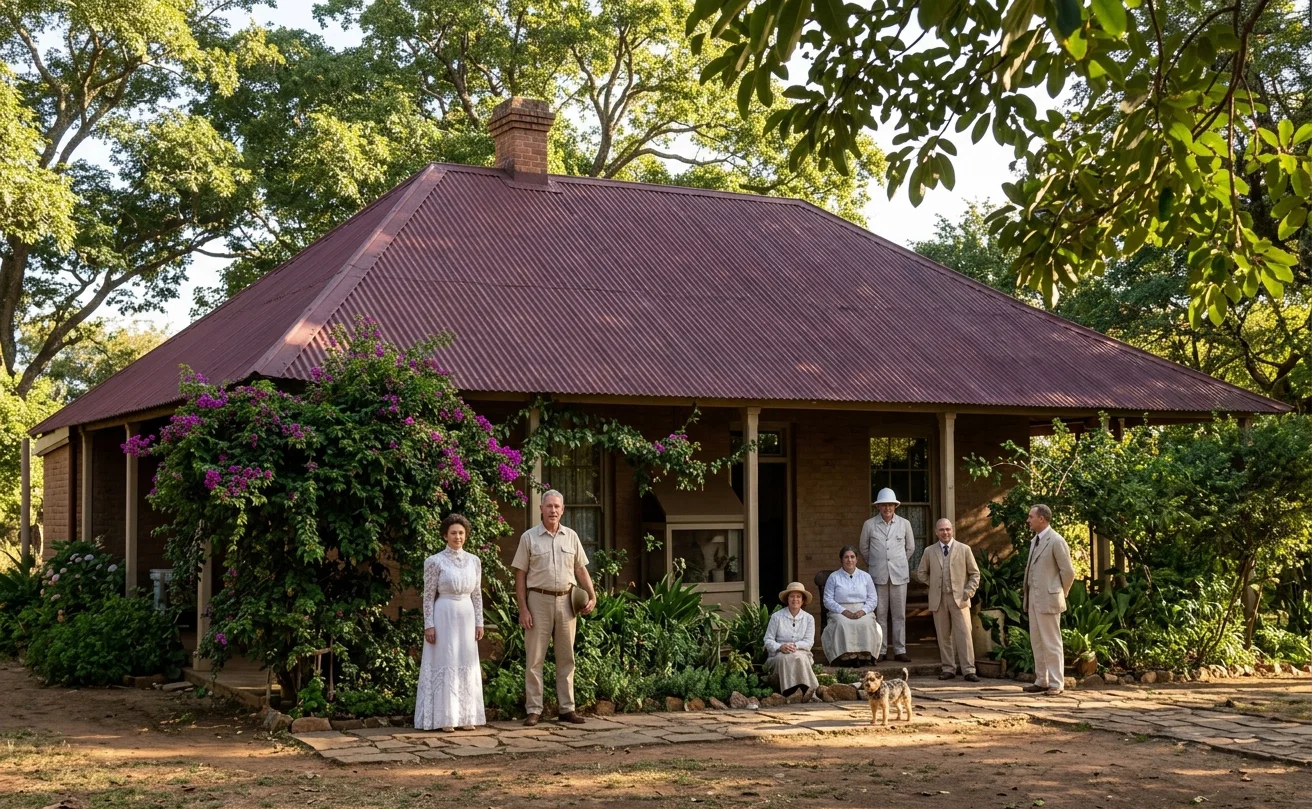
SUPERINTENDENT'S COTTAGE, SOLUSI MISSION
Elder and Mrs. R. P. Robinson — Visitor — Elder and Mrs. W. C. Walston
SUPERINTENDENT'S COTTAGE, SOLUSI MISSION Elder and Mrs. R. P. Robinson — Visitor — Elder and Mrs. W. C. Walston
Soon after the milkboys are astir there is a good deal of shouting and cracking of whips. The ox drivers are inspanning for their morning’s work. These long whips have a stock like a fish pole, and a lash nearly twenty feet long. The drivers crack them so they sound like pistol shots. A team for transporting is sixteen oxen; for farm work, less. We have three teams of oxen and our mule team, which are kept busy all the time. While the drivers are inspanning the foreman blows his police whistle, and the whole mission family is soon astir. There are many duties to be attended to, and soon all are busy, some in the field, others about the buildings.
It is planting time now (December). The teams are plowing, harrowing, and planting. Some of the white workers drive the planter, as it is difficult for the native to go in a straight line. The work of the morning goes on until seven o’clock, when the bell rings for worship and breakfast. All come in, except those with the teams. They continue until eight o’clock, and then outspan until three o’clock in the afternoon.
After breakfast the bell rings again, and the beginners have school work until 10:15, when they are dismissed, to take their turn in the field, while the older students come in. At 1:45 P. M. school is out, and the whole family prepare for dinner, which comes at two o’clock.
“Who cooks the dinner?” some one inquires. This is done by the girls as shown in the illustration on the first page.
At three o’clock the bell rings for all to go to work again, which continues until sundown, when everybody comes in and an hour is spent in play. All have a good time, and are pretty noisy, but we do not mind.
At seven o’clock the bell calls all the students in for night school, which is really but the preparation of lessons for the following day, except for the herdboys, who are out all day with the cattle. They recite what they have learned on the veldt during the day, as they always take their books with them while they herd. At eight-thirty school closes, and at nine the silence bell rings. Quiet is supposed to reign until morning, though sometimes it takes more than the tap of the bell to induce quietness. This schedule is carried out through the whole year, with the exception of four vacations of two weeks each.
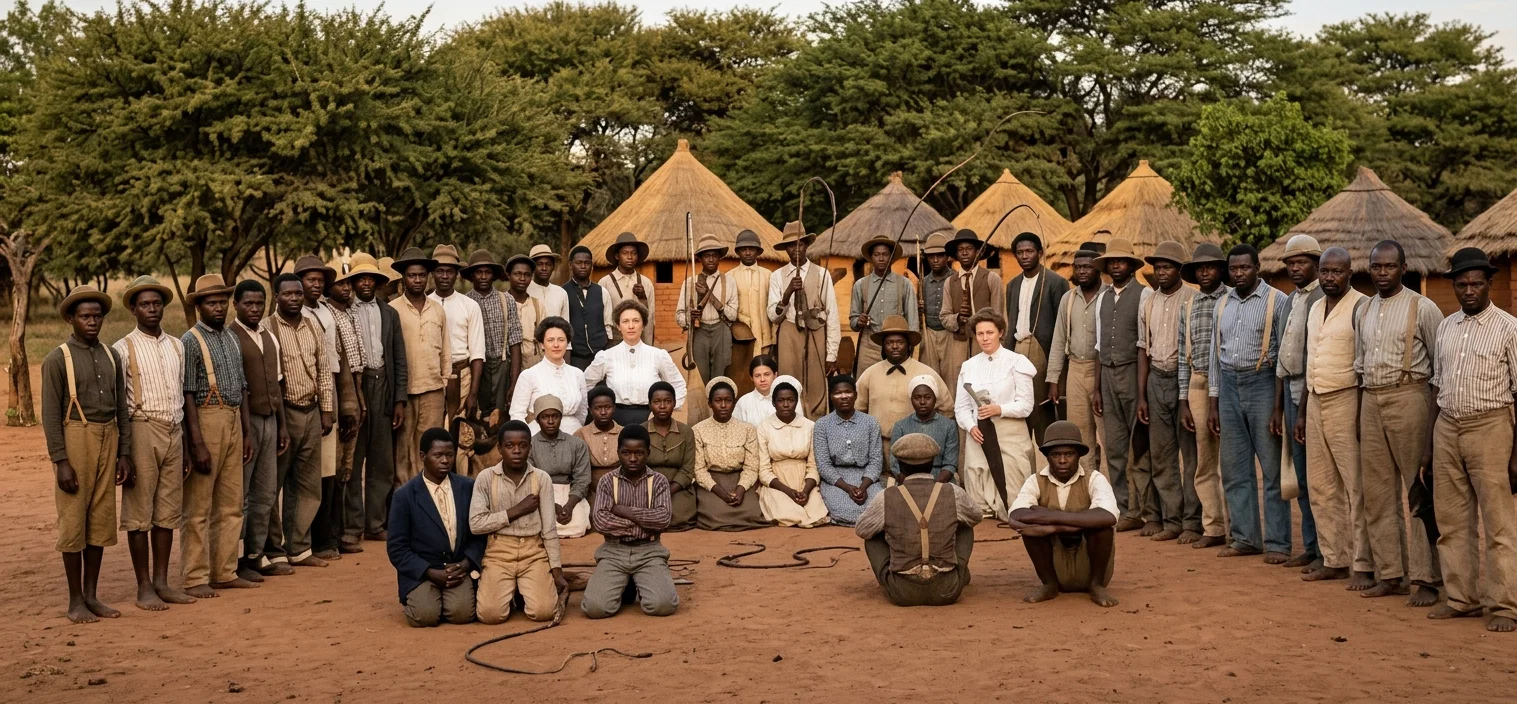
SOLUSI MISSION SCHOOL, WITH TEACHERS
Notice boys in rear with long ox whips.
SOLUSI MISSION SCHOOL, WITH TEACHERS Notice boys in rear with long ox whips.
We have our difficulties on these mission stations. Some of the stations are a long way from a repair shop, and it is necessary that there should be some one at hand who is an all-round workman, for when there is a break in some implement it would mean a long delay to send thirty miles for repairs.
Here is one day’s experience: The superintendent starts out with the planter. The foreman comes to him and says, “Teacher, the calf that was sick is dead.” “Very well, take off his skin and bury the calf.” He reaches the field only to find that the driving chain that revolves the plates in the planter has been tampered with, and the planter does not work. A small boy must be called to hold the mules while a return is made to the mission to find the lost section of chain. When it is found and adjusted, the planter starts, but gets only about half-way across the field when one of the plowboys comes running to tell the teacher that the plow is broken. Again the small boy holds the mules, while the teacher goes to fix the plow. Returning, he makes one or two turns, when another plowboy rushes up to tell him the disc plow has gone wrong. He spends thirty minutes setting it right, and then the work goes merrily on until something else is wrong. The natives have very little idea of how to use modern farm implements properly, and there are many breaks.
We are all of good courage here at Solusi Mission, and are the recipients of many blessings in our work. We ask our friends in the message to pray for us.