The Literature Work in Brazil

7%

Review and Herald Publishing Association · Takoma Park Station, Washington, D. C. · Mar 23, 1916

FromReview and Herald, Vol. 93, No. 15.

Read the full edition

The Literature Work in Brazil

One of the most encouraging features of the work in Brazil is the success the brethren have had in establishing and developing their printing plant. This branch of the work began in 1904, when Brother John Lipke, while on a visit to the States, received a second-hand press from the Berrien Springs school as a donation. He also collected about $1,800 in cash for the enterprise. After his visit to Brazil in 1906, Brother W. A. Spicer reported to the General Conference Committee that “in Brazil they have a small printing plant; they have a small press, and one man turns the crank while another feeds in the sheets. I found that they did not have anything in the way of literature in the language spoken in Brazil to offer to the people on the second coming of Christ.”
But since Brother Spicer made this report, things have greatly changed. The printing plant has been moved from Rio Grande, in the south of Brazil, to Sao Bernardo, a small town about eleven miles southeast of the city of Sao Paulo. This location is much nearer the center of the work in Brazil. Twelve acres of land were secured, on which the plant has been established, and also dwelling houses for the workers. The main building has a press and type room about thirty-five feet square, a bindery and signature room about the same size, a shipping room, an editorial room, a chapel, and a business office. Then there is a building twenty-six by forty feet, used as a stock room; and a third building has a stereotype room, a storeroom, etc. These are all substantial one-story brick buildings, which are a credit to our work. The garden and grounds are well kept, and everything about the place has an appearance of thrift and prosperity.
The note of courage and progress which Brother A. Pages, the manager, sounded in his biennial report at the union conference, had a familiar sound. It is the same cheering note that comes from every land where our publishing work is being carried on. The following is a translation of a few extracts from this good report:—
“If there is anything in these last days which reveals the mighty hand of God, it is the revival and progress of our literature and publishing work. In 1906 the machinery in our plant consisted of one cylinder press, one job press, a paper cutter, and a wire stitcher, with a total value of three contos of reis, or about $1,000. Until three years ago all our sewing and folding had to be done by hand, but since then we have had a book-sewing machine and a folder, which are a great help.
“At present we have the following machinery: One large cylinder press, one pony cylinder press, one job press, one folding machine, one book-sewing machine, one wire stitcher, a rounder and backer, a card cutter, and a stereotype outfit, with a total value of seventeen contos, or $5,600. The presses and folder are now run by electric power instead of by hand. In 1906 the total value of literature printed in one year amounted to $1,000, while in 1915 it had increased to nearly $17,000.
“Aside from the Rundschau and Revista [union conference papers in German and Portuguese], Week of Prayer Readings, Sabbath school lessons, etc., we have printed during the past two years the following in the Portuguese: 500 copies of ‘Testimonies for the Church,’ a pamphlet of 56 pages; 5,000 of ‘Home and Health’; 18,000 of ‘Christ Our Saviour’ in two editions; 3,000 hymn books without music; 5,000 of ‘Gospel Primer’; 10,000 of ‘His Glorious Appearing’; 10,000 of ‘Steps to Christ’; and 16,000 of ‘The Coming King.’ We have also published the following tracts: 10,000 each of ‘Why Not Found Out Before?’ ‘The Catholic Christian,’ ‘Catholic Authorities,’ ‘The Future Explained,’ ‘The New Birth,’ ‘The Second Coming of Christ’; 500 of ‘Spiritualism,’ 4,000 of ‘Missionary Tract,’ and 500 of ‘Faithfulness in Health Reform.’ We also published three special war periodicals, of which we sold 30,000 of the first number and 20,000 of each of the other two.”
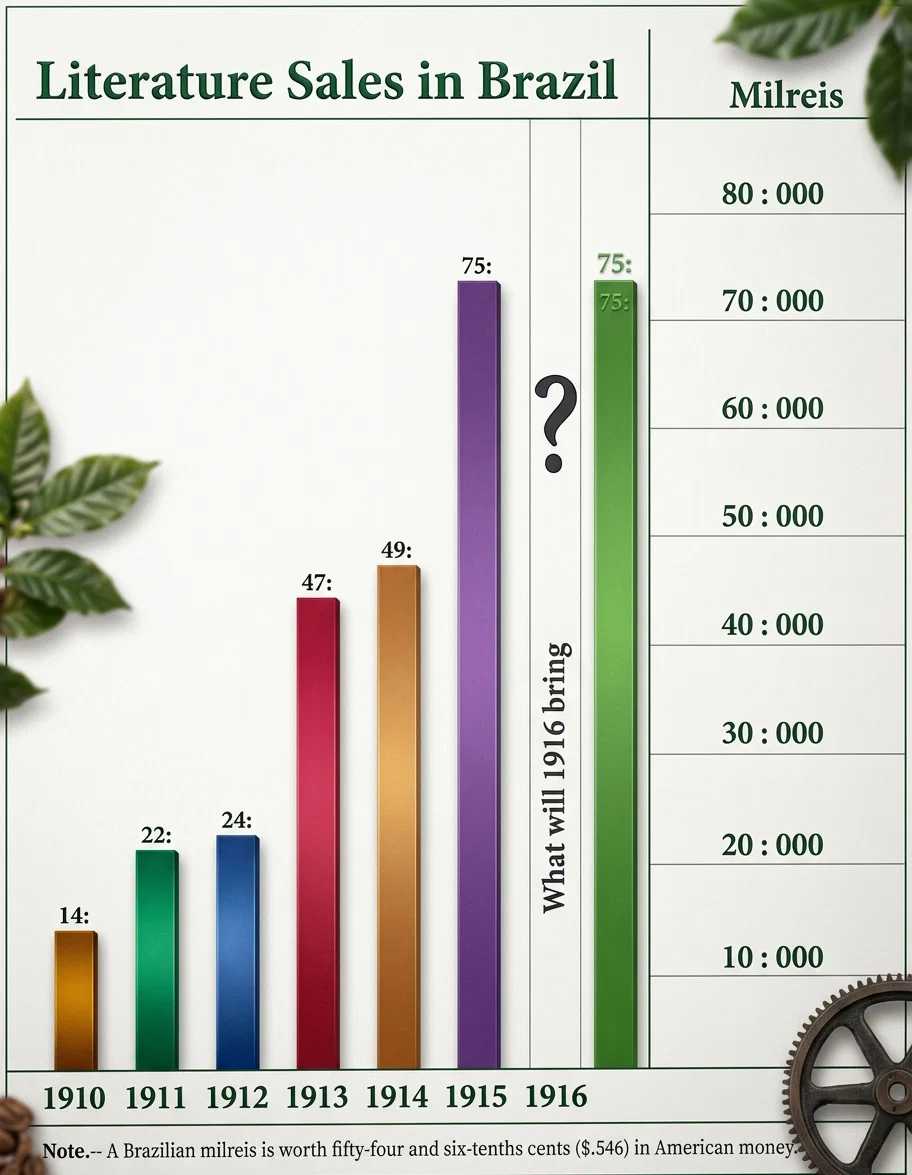
The accompanying chart shows how the Lord has been blessing the work of the colporteurs in the field. A gain of from fourteen thousand milreis in 1910 to seventy-five thousand in 1915, or$7,644 to $41,050, in a country where only fifteen per cent of the people are able to read, is another evidence that the success of the colporteur work is not dependent on circumstances. When the war broke out, Brazil was one of the countries that suffered most; but as in other countries, the colporteurs here have learned that there is no crisis with the Lord. They kept steadily at work, and as a result the sales of literature during 1915 show a gain of nearly sixty per cent over 1913, and fifty-three per cent over 1914. Brother R. M. Carter, who has been acting as field missionary secretary in Minas Geraes during the last eighteen months, gave a cheering report from that field. Through the efforts of Brother Carter and another brother when they first went to that state a little company began to keep the Sabbath. Out of this company Brother Carter secured five canvassers, and trained them for the work. During 1914 the sales in Minas Geraes amounted to five thousand milreis, but during 1915, by the blessing of God, Brother Carter and his workers were able to bring the sales up to twenty-seven thousand milreis. The state of Sao Paulo came next, with twenty-six thousand milreis during 1915.
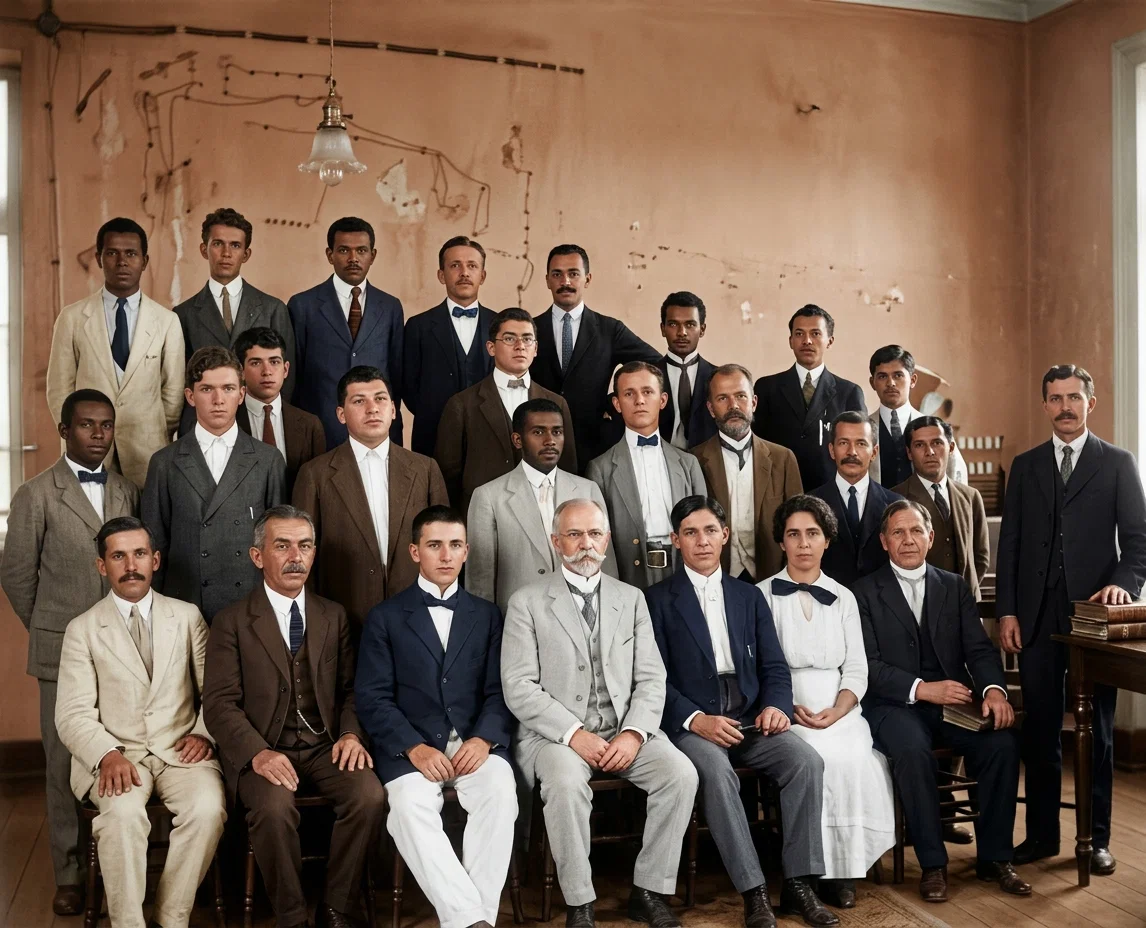
COLPORTEURS IN BRAZIL
Careful consideration was given to the interests of the colporteur work at the recent union conference. As the greatest apparent need was a man to take general oversight of the work in the union, it was unanimously voted that Brother Carter act as the union field missionary secretary. The Rio Grande Conference has had a field missionary secretary for some time, and at the union meeting two native brethren who have done successful work were appointed to do the same work in the Sao Paulo Mission and in Minas Geraes. Brother Carter has a field larger than the United States, but for the present he will have to give his attention to three or four of the central states, where the most of his men will be located. He must have other good, strong leaders as soon as they can be provided.
Literature Sales in Brazil
The scholarship plan was started at this union meeting, and several young people will probably earn scholarships this year.
From the beginning of our work in Brazil, the literature work has been an important factor, and many have been brought to the truth through this means. One interesting experience was told us at the union meeting. A native Brazilian, sixty-three years old, who had been a Protestant minister several years, accepted the truth and entered the canvassing work. In the town where he began work he soon found persons who were interested. He read the Bible with them evenings, when he could get time from his canvassing work. As he continued his work, the interest increased. He remained in the place eight months, supporting himself by his literature sales, and teaching the people the truth. As a result of his work, forty-three were baptized, and last year they paid over a thousand milreis in tithe. Brazil is one of the best fields in the world for our colporteur work, and now is the time to push forward as much as possible.
N. Z. TOWN.