THE Philippine Islands look very small on the map, but they have been a subject of no little concern to the United States. Politically we leave them in the hand of the politician. There are, however, between eight and nine million people dwelling in this archipelago, for every one of whom Jesus shed his precious blood. The tongues and dialects represented here are included in the scope of the everlasting gospel to be preached unto them that dwell on the earth.
The writer and his family the first of this year opened a station in Iloilo, on the island of Panay, among the Visayans. The Visayans comprise 46.8 per cent of the population of the civilized tribes, of which there are eight, and 42.6 per cent of the entire population.
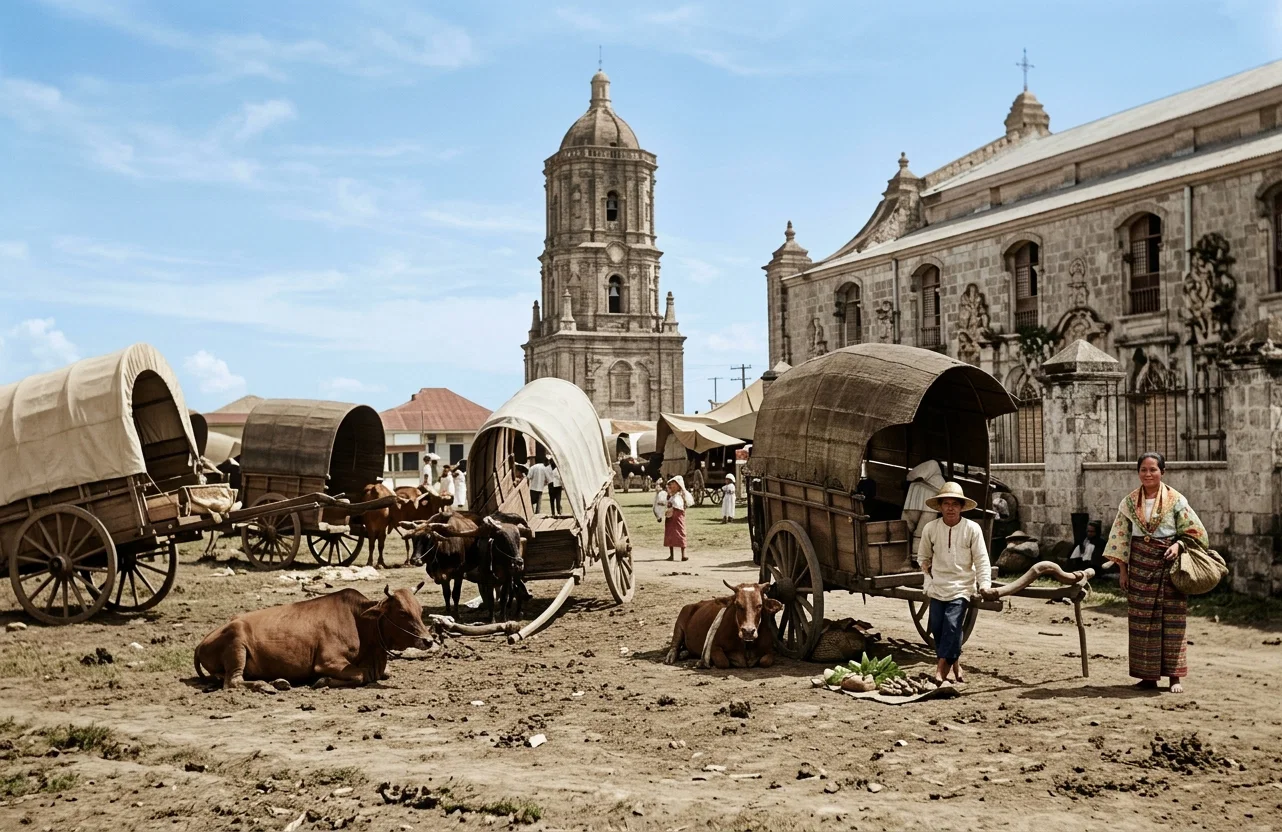
Moro market day, Philippine Islands. Foreground, single oxcarts with oxen at rest, during noon hour. Large Catholic church at right, with the Moro watchtower in background.
There are sixteen wild tribes. The important Visayan islands are Panay, Cebu, Negros, Samar, Leyte, and Bohol. Although the Tagals have had advantages over the other tribes, since the American occupation the Visayans have forged ahead until they are now second to none. They have made great progress agriculturally. In fact, Occidental Negros is considered to be first in this respect.
Brother Floyd Ashbaugh in the past two years has sold several hundred dollars' worth of books in the Spanish and English languages on the islands of Panay and Negros. It is too early to report results from evangelistic efforts. There seems to be a great demand for Bible study. A young man, who for a short time has been coming to the writer's home twice a week for Bible studies, has asked for about two hours every night. He is a teacher in the public school. The outlook is very good for a large harvest of souls from among these unfortunate people.