MRS. G. F. JONES

6%

Review and Herald Publishing Association · Takoma Park Station, Washington, D. C. · Sep 18, 1913

FromReview and Herald, Vol. 90, No. 38.

Read the full edition

MRS. G. F. JONES

Our Mohammedan Sisters—No. 4

MRS. G. F. JONES

Although something has already been attempted for the Mohammedan women by woman missionaries, naturally there are many difficulties to surmount. One of these missionaries say: “While polygamy and divorce exist and there is no standard of purity equally applicable to both sexes, more freedom than woman now possesses cannot with safety be granted her. I fail to see any remedy but in the doctrine and practise of Christianity. The fact known to be true of a school in Syria, points out the solution of the problem. Of the pupils of a Protestant school conducted there for many years and largely attended by Moslem girls, it is stated that a case has never been known where a pupil who had passed through their hands had been divorced, or obliged to accept a second wife into her home. These women have learned lessons of duty, of personal responsibility to God, of self-respect, self-control, kindness, and love, which cause the hearts of their husbands safely to trust in them.”
Another says she believes from experience that there is little doubt that a medical missionary can find access to their homes, and get nearest to them. A missionary in south India, where work has been extensively carried on for Moslem women, says that there divorce is rare, and it is seldom that a woman is married in succession to half a dozen husbands. Another says: “In a recent tour I was a welcome guest in several Turkish homes, and warm approval wasexpressed by the women of their Protestant neighbors. Only one failing was regretted, they ate pork. But still they begged me to come again and read to them from our Great Teacher’s Book.”
Speaking of unclean foods, which is a very strong point with them, I might mention here my husband’s experience with Mohammedans while traveling in Sumatra. At first they did not care to have much to do with him, but no sooner did they discover that he did not eat swine’s flesh than all prejudice was at once removed. Their interest was aroused, and they would follow him and listen to whatever he had to tell them, and when any others met them on the way, they were informed that “this Christian is not unclean like other Christians.” Since that time some of these men have become Christians.
To illustrate their feeling toward Christians in general: A woman medical worker could gain access to a patient only by entering through the stable door, as the main entrance was “too near a so-called saint’s place.” In another instance she was asked to treat a very sick person in the open street, “to avoid standing on their holy ground and defiling the spot.”
Speaking from my own experience in working for Mohammedan women, I can say that when they are converted, they are not a whit behind their white and more fortunate sisters. In Singapore, a Mohammedan servant, whose mistress was having Bible studies, would sit on the stairs to listen and pick up the crumbs of the gospel, as it were. On learning of this, I at once began giving her studies, adapting them to her case. A more receptive, appreciative, and joyful reader I never had, and her mistress told me that every day she would count the days till the meni would come to teach her the gospel story. At times she would laugh aloud for joy, and say, “O, how good it is!” Another woman whom my husband recently baptized in Java, had been divorced from several husbands, like the majority of these women, and was living with one who was not her husband, like the woman of Samaria, and, like her, became converted. The man also became an earnest Christian, and they were both most anxious to be baptized after being married. However, this latter was by no means an easy matter, for it was found on investigation that their former lives were so involved and complicated with other marriages and divorces, that it took much time and patience, with many prayers, to unravel the difficulties, so as to have a legal marriage in the eyes of God and man. At times it looked like an utter impossibility; but finally, with the help of the Lord, it was done, and they were able to be baptized, to their great joy. The woman was brimful of love to her Saviour for what he had done for her, and never failed to give a heartfelt testimony whenever opportunity offered. A more devout, humble, and joyful Christian it has never been my privilege to meet.
But there must be scores, even hundreds, of others among all the millions of these benighted, downtrodden souls who are longing for light and liberty, if only we would go and tell them. What opportunities! What a wide field to be entered by our humble, Spirit-filled sisters who have the love of God shed abroad in their own hearts, to go as teachers, medical missionaries, Bible workers! And who can gain the confidence of these women better than Seventh-day Adventists, who have not the great obstacle of unclean food to surmount, as other Christians have.
“Who then is willing to consecrate his [her] service this day unto the Lord,” and say, “Here am I; send me”?

Egypt

GEORGE KEOUGH
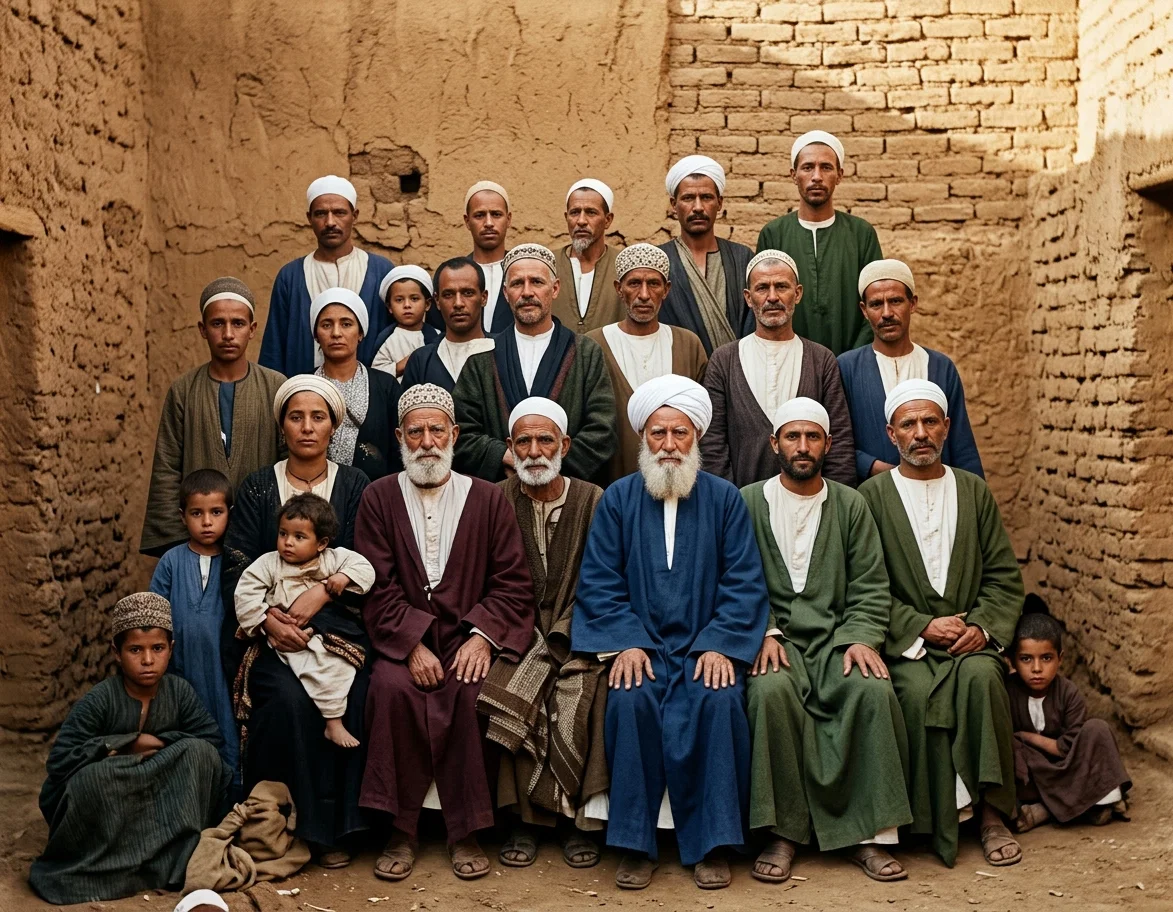
COMPANY OF BELIEVERS BAPTIZED AT BENI ADDI, EGYPT
BENI ADDI is situated on the west side of the Nile valley, at the foot of the hills that separate the green fields from the Libyan desert. The town is built almost entirely of sun-dried bricks, and, plastered with mud mixed with finely chopped straw. Very few of the houses are whitened, either inside or out. There is, I believe, not a pane of glass in the whole town, and the houses generally are only partly roofed over. However, surrounded as it is by palm-trees, and having the sandy hills for a background, it is a pleasant sight to travelers. Caravans sometimes gather here, for there is a path between the hills leading to the Inner Oasis.
The inhabitants number over eighteen thousand, and are chiefly peasants, weavers, and traders; and, being some six miles from the railway, they are not so civilized as in the towns on the railway. Of the eighteen thousand inhabitants, three fourths are Moslems and one fourth Christians. There are three Coptic churches and two Presbyterian places of worship.
The people live very simply. Bread is the staff of life in the fullest sense. They eat bread which is made of a native corn, called dura, at every meal, dipping it in something to give it relish. Two eggs cooked with a little butter, with plenty of bread, make dinner enough for four persons. One does not realize how much the use of knives, forks, and spoons adds to the cost of living until he sees how cheaply these people live.
To this town we were invited by letter in June of last year. One man had been keeping the Sabbath, in a way, for over five years. He preached everywhere and was a source of great trouble to the religious powers that be. He had convinced another, and they two thought they were the only Sabbath-keepers in Egypt, when they accidentally heard of us. The same day they heard of us they wrote inviting us to visit them. We went, and feeling that the Lord had opened a door before us, decided to come here to work. Accordingly, last November we came and took up residence among the people of Beni Addi.
The Lord has been with us, and on May 3 we were able to baptize twenty-four persons who had decided to obey their Lord in all things. There were many difficulties to be overcome, and much opposition to contend with, but thanks be to God who gives us the victory through Christ Jesus. The accompanying illustration shows those who have taken their stand for the Master. Two others have begun to keep the commandments since the baptism. We are sure that the readers of the REVIEW have been praying for the work in Egypt, and will be glad to hear that the Lord has answered so fully. Continue to pray, for the Lord has great things in store for us.