Our First Visit to Persia

8%

Review and Herald Publishing Association · Takoma Park Station, Washington, D.C. · Sep 5, 1912

FromReview and Herald, Vol. 89, No. 36.

Read the full edition

Our First Visit to Persia

(Concluded)
L. R. CONRADI
URUMIAH is a town of about forty thousand inhabitants. It lies only thirty miles from the Turkish border. There has been considerable dispute with reference to boundary lines. The Turks have advanced their border up into the mountains some thirty miles or more. As they were getting nearer and nearer to Urumiah, and in fact had already a number of soldiers stationed there, the Russians came in, thus creating a rather peculiar condition of affairs,—a Persian country, with a Persian government and police and a Russian force, and also a number of Turkish soldiers. For some time war seemed imminent between Turkey and Russia, but the matter has now been referred to The Hague Tribunal.
While the population of the country is mostly Mohammedan, there are many thousands of Nestorian Christians. One can see a marked difference in their dress. The people about Urumiah speak Turkish mostly, but Persian is their written language, while the Christians use modern Syriac. Since the occupation of the northern part of Persia by the Russians, the people are picking up a great many Russian expressions and phrases, and this is the only language in which we could converse with the driver, who lives at Tabriz.
Urumiah is a city of small compass. We drove almost around it before we entered the city gate. We arrived early in the forenoon, happily surprising Brethren Oster and Dirksen, as they did not expect us until the evening. We found our missionaries comfortably settled in a pleasant house, the Lord having especially favored them in enabling them to find good quarters with a Syrian Christian family in the city. After we had been boarding ourselves and sleeping in dirty khans, we felt happy indeed to find such a comfortable home.
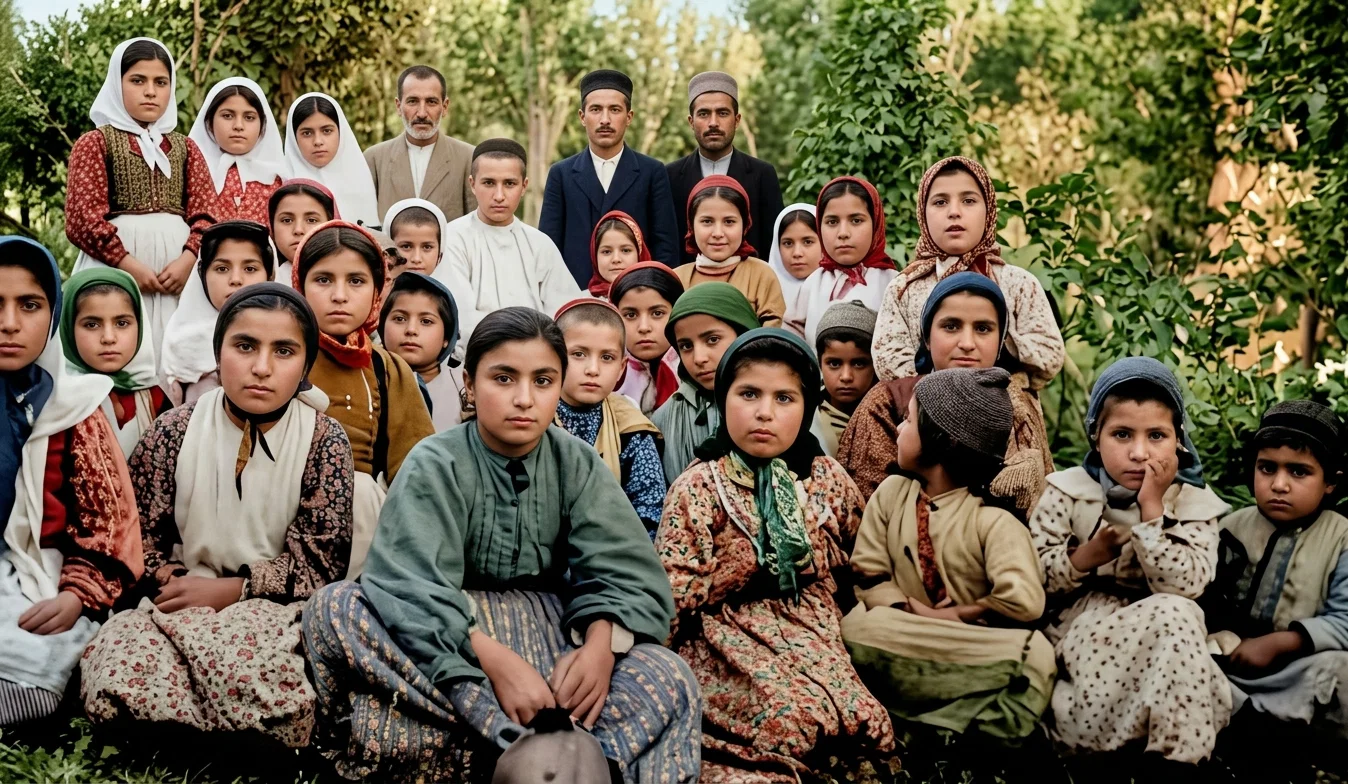
ORPHANS IN THE GERMAN ORPHANAGE AT URUMIAH, PERSIA
We had but three days to spend in the city of Urumiah, and planned our work to make the best of every moment of our time. In this we were favored in many ways. The first day was mostly spent in planning and counseling with our brethren until late at night, and in calling on a few persons. The next morning the Presbyterian school for girls had its annual commencement exercises, at which twenty-two young women were to be graduated; we were kindly invited to be present. In the Presbyterian compound we found a nice brick church, also good school buildings. The exercises were held in a fine new American tent, which had been donated to the Presbyterian mission. This tent was crowded with about three hundred Syrian Christians. Dr. Sheed, who is in charge of the Presbyterian work here, courteously invited us to the front, that we might the better see and hear. A number of the young women recited in the English language, as well as in the Turkish and Parsee. There were also a number of songs rendered, some in English and one in German. After the doctor had addressed the graduates in their own language, they received their diplomas. Among them was one of the daughters of the lady with whom we were stopping. This occasion gave us the opportunity of meeting the leading Christians in the city, and as we were invited to dinner, we had quite an interview with the missionaries, when the question of our entering Persia was thoroughly discussed.
Our brethren have made many good friends, and have obtained a good speaking knowledge of the Turkish dialect spoken here. In harmony with the customs of the country, the afternoon of the second day was spent by us in the reception of visitors, many of whom came to our home, so that we had the opportunity of meeting a number of leading persons, both Mohammedans and Christians. The last day was indeed a very busy one, devoted to counsel, to the reception of callers, and to visiting. We drove out to the Presbyterian Boys’ College, located about two miles from town. The grounds are beautifully laid out. Dr. Sheed received us very cordially, and took us over to the hospital building. There are several American physicians here. The head physician kindly showed us many specimens of his successful operations. While we were there, a Kurd from the mountains was present, and his little boy, who had been afflicted with typhoid fever, was paralyzed in his arms and legs, and the father told the physicians that he would gladly give them one thousand dollars if they would only cure his child. Without question, medical missionary work in a country like this, if it is rightly carried on, acts as a great opening wedge of the gospel. The Presbyterians have medical missionaries in other parts of Persia also. They have been working in this land since 1835. We understand they have about eighty boys in the school here, and they charge about thirty-five dollars a year for board, tuition, and other school necessities. The plan is to carry the school on so simply that the expenses, aside from the teachers’ salaries, will be covered by the income. At first the Mohammedans were very shy, but now they have begun to attend the school. They will be charged a much higher rate than the Syrian Christians have paid, but the service will be correspondingly better. The American consul had just come in from Tabriz, but as he was weary from the journey, we contented ourselves with leaving our cards.
From the Presbyterian compound we went over to visit the German orphanage. This institution, as well as the American Mission, suffered from the inroads of theKurds. The orphanage is in a beautiful spot,—a large park,—one of the best compounds about the town. In the evening we visited another orphan home, opened by a Syrian physician, and now in charge of an American woman, assisted by a German missionary.
This visit with our missionaries aided us in many ways in obtaining a good understanding of the situation, and in giving them intelligent counsel. As there are so many different languages spoken, it was decided that Brother Oster should continue the study of the Parsee, and also give some attention to the Turkish dialect; while Brother Dirksen will continue the Turkish, and give special attention to modern Syriac. As matters are still so unsettled in the interior, and the province of Azerbaijan (where Urumiah is situated) is a good location for our work, we have considered it advisable to continue here for the present.
We now have churches along the Caucasian border, and a growing work. Some of the German colonists of southern Russia have visited Persia, and may settle at Asterabad, of the Central Asiatic Mission, where already a large Russian church exists. Then again on the other side of the line, in the Armenian field, there is a growing work in old Armenia. Therefore we thought it would be better for the brethren if they could get a foothold here, as this would help to consolidate our work. Then, too, this part of the country is best supplied with passable roads that are being patrolled by Russian soldiers, and consequently are comparatively safe for the traveler. We expect, however, that within a year or so these two brethren will separate, and we hope by that time some native help can be secured, so that each of our workers here may have a native helper. Considerable attention was also given to the question of the preparation of literature in these different tongues, and we hope that something can soon be done to supply the demands of the field in this respect. The task of printing this literature will probably fall to our Constantinople house.
When we consider the fact that Persia has nearly ten million people, among whom are some men of culture, we can at once realize the necessity of our securing a good start in such a field as this. We are glad indeed to see that God has helped our workers in the study of the language and in their efforts to become acquainted with the people and their customs, and we have every reason to believe that in another year we shall see the first-fruits of our work in this land. The seed is being sown. Careful plans have been laid for the extension of the work. Let us remember this new field in our prayers and in our gifts, so that our force of laborers may be strengthened, and the message be carried to every part of this great country.