Beirut, Syria

7%

Review and Herald Publishing Association · Takoma Park Station, Washington, D.C. · Apr 18, 1912

FromReview and Herald, Vol. 89, No. 16.

Read the full edition

Beirut, Syria

W. C. ISING
You certainly have read the reports of the bombardment that occurred here last Sabbath, February 24. It was indeed a surprise to all. Early in the morning we heard a few cannon-shots, and did not quite understand the meaning, because there was no salute. Frequently foreign men-of-war call at Beirut so as to show themselves, because of the animosity between the different peoples.
About nine o’clock, some of the brethren came for worship, and brought the news that all shops had been suddenly closed, and that the streets were crowded with soldiers, and the Italian cruisers were out in front of the harbor. From our veranda we saw the one battle-ship taking position, and a few moments later a regular bombardment started. The guns could be seen flashing at every shot, and the cannon-balls came screaming through the air in real earnest.
The suddenness of the affair naturally caused much surprise. The brethren quickly made preparations to return to their families. Before we separated, however, we all knelt in prayer and called upon the Lord to hold his hand over us. We had a good season of prayer, and then dispersed. It was a vivid suggestion to us of the troubles of the last days, when there will be no opportunities for God’s people to meet together, when in such moments of alarm there will be no spirit of real rest, and when there will arise constantly reports of new troubles.
The people were relieved when, about eleven o’clock, the cruisers took their way out to sea. In the afternoon, my wife and I, in company with a gentleman, went out to see what was really going on, and what there was to do. We had been told that the public building, with all the foreign post-offices, had been struck and was on fire, and we thought we could perhaps procure our mail. We also thought of visiting a brother who was living in that portion of the city most affected by the shooting, and who had not come to the meeting. Meanwhile the cruisers returned, and the bombardment reopened. On our way we stopped at the house of another brother, where a number of families were crowding the place. Soon the cruisers left the port and steamed out to sea again.
Everywhere one could see the various foreign flags hoisted; double guards were placed at all the public buildings, to watch the entrances. There were rumors that the Moslems were seriously excited, and that attacks upon the foreigners and Christians were planned. So hundreds of families fled to Mt. Lebanon, while others crowded the grounds and buildings of foreign institutions and private homes. The government began to distribute arms to the people (Moslems), though it is said that the people broke into the storehouses, and everybody took what he pleased, the officials losing all power over them.
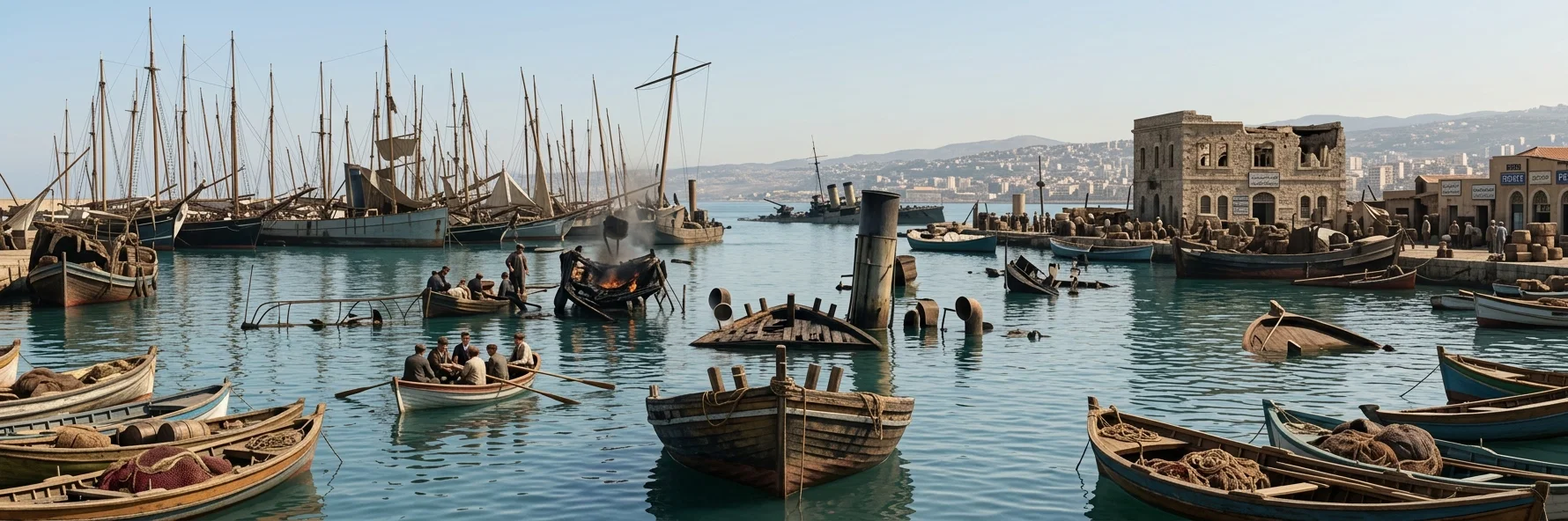
We were cautioned to return home and not to show ourselves. The following night, of course, was one of general unrest. While all day there was no traffic in the city, the street-cars were going all night, carrying soldiers all along the main lines. Reenforcements have come from Damascus to look after the order in the city. Martial law has been proclaimed. In consequence no papers are published, and therefore there is no information as to the exact condition of things. But the general version is that the Italians fired early in the morning to make their coming known. A deputation from the government went out to see what was wanted. The reply was that the Turks should deliver the Turkish cruiser and torpedo-boat which were in the harbor. The deputation said they would communicate with the authorities. However, the cruiser and the barracks opened fire on the Italians, when immediately the latter answered, with the result that these two vessels were destroyed and sunk in the harbor. About one hundred persons were killed, and a large number wounded. Pieces of shells were found in a number of places,where they had caused more or less damage.
One big shell was found in our neighborhood, where it struck the sand; it has been dug out and brought to the college. Serious damage was done to some of the buildings near the harbor. The torpedo-boat was not entirely sunk in the forenoon, therefore the Italians returned in the afternoon to finish sinking it.
We hope that erelong quiet may reign again, though naturally there is great excitement on the part of the Moslems. It is openly stated that the lives of foreigners are still in danger.
UNDER THE LEFT CROSS WILL BE SEEN THE FUNNELS OF THE SUNKEN TORPEDO-BOAT IN BEIRUT HARBOR; IN THE REAR, UNDER THE OTHER CROSS, THE SUNKEN CRUISER
This experience has taught us that our lives are really in the hand of the Lord. How important it is that in the time accepted and in the day of salvation (2 Cor. 6:2) the heart be established in grace (Heb. 13:9), that we may obtain mercy and find grace to help in time of need, and that we may have that heavenly peace that nothing can destroy.
We must look for greater troubles in the future, and it is good to learn these lessons now. It is another suggestion also as to how earnestly we should labor and push the work, because very suddenly the opportunity to labor will be cut short.
We have to stop our public meetings for a little while, because the government will not assume any responsibility for people who expose themselves to danger in the evening. For this reason people will not attend the meetings until the shock is entirely over, which we believe will be soon, unless other difficulties arise.