The Catholic Convention at Columbus

10%

Review and Herald Publishing Association · Takoma Park Station, Washington, D. C. · Oct 12, 1911

FromReview and Herald, Vol. 88, No. 41.

Read the full edition

The Catholic Convention at Columbus

The tenth annual convention of the American Federation of Catholic Societies was held at Columbus, Ohio, from the twentieth to the twenty-third of August. It was one of the most spectacular conventions yet held, and was considered by its members to have been one of the most successful.
The federation now claims a membership of nearly three million, and practically every State and Territory in the Union is represented on its muster-roll. The advantage to the church and her interests in possessing such a strong organization of voters was quickly apparent to the astute politicians of the Vatican; and at each convention of the federation the Pope is present to give his blessing in the person of his special representative in America, Mgr. Diomede Falconio.
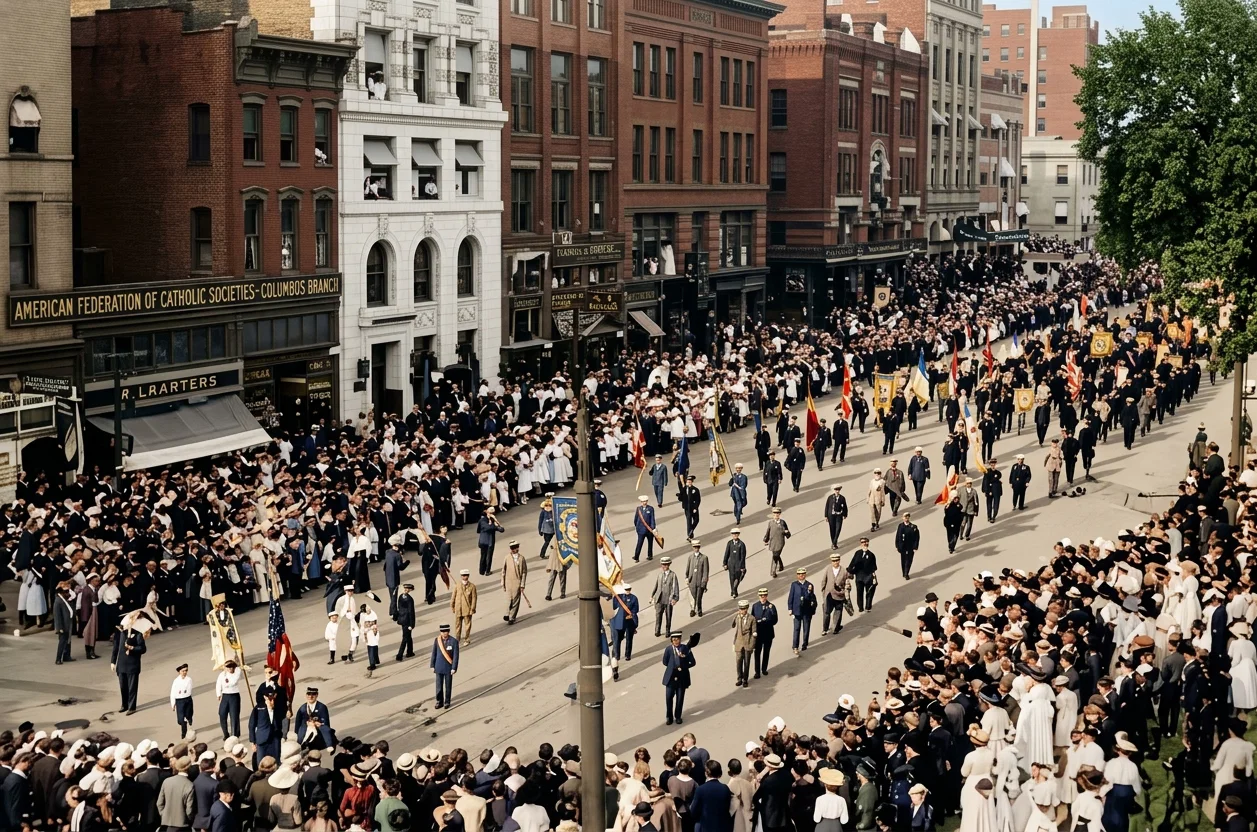
On Sunday, August 20, the convention was opened by a great parade, gaudy with banners and the trappings of war. The governor of the State and the mayor of the city contributed the influence of their presence to the success of the gathering. Two reviewing stands were erected, one for the prelates of the church, and the other for the State and city officials and lesser clerical lights. The latter was built upon the front of the capitol grounds. Not only were the municipal and State officials brought into the program, but representatives of two denominations other than the Catholic added their influence to the attainment of the federation’s purposes. While the parade was in progress, the beautiful chimes of Trinity Episcopal Church intoned sacred melodies, and at one of the public meetings following, the pastor of the First Congregational Church of Columbus had a place on the platform among the Roman priests and bishops.
The city was in gala attire. Fluttering flags and draped bunting were in evidence everywhere. The flag which was most generally used in these decorations was the federation’s official flag, having in its center the escutcheon of the United States, and stamped upon that escutcheon the cross of the Catholic Church, while a palm branch stretched the length of the flag from top to bottom. There were printed on this flag the words, “In union is strength.”
PARADE OF AMERICAN FEDERATION OF CATHOLIC SOCIETIES AT COLUMBUS, OHIO, SUNDAY, AUGUST 20
This banner, in its peculiar make-up, was emblematic of Rome’s purpose to “make America Catholic.” The cross stamped upon the flag or escutcheon indicates that she proposes one day to rule this nation in her own interests through the power of the hierarchy, and the union of her many secret societies will be the force through which she will bring it about. Companies of riflemen in her Sunday parades ought to furnish a strong hint as to one of the means she might not hesitate to use to accomplish that purpose.
Bishop McFaul, of Trenton, N. J., in giving, in a public address, a brief history of the organization and a statement of its purposes, extended to Protestant denominations an invitation to unite in the effort to accomplish results which Catholics and non-Catholics both desire to see accomplished. He said they were now ready to join with their separated brethren for the solving of all great national problems; and Bishop Canevin, of Pittsburg, Pa., declared that one of the great problems to be solved was the securing of a day of rest and worship for all the people of the country, and that day of rest and worship he plainly indicated must be Sunday.
Here, then, is an organization of nearly three million voters committed to that undertaking, which, when accomplished, will make the nation stand sponsor for an institution of the Catholic Church, a rival of the Sabbath of Jehovah. Will Protestantism assist in bringing the scheme to a successful culmination? Organized Protestantism, as represented by the Federal Council of the Churches of Christ in America, has already committed itself to that undertaking. And that organization claims to represent between seventeen and eighteen millions of adherents. With these organizations, the National Reform Association, the International Reform Bureau, the American Federation of Labor, the Lord’s Day Alliance, the W. C. T. U., the civic leagues, and the young people’s societies of the various denominations all working to that end, there is no human power in the country that can successfully oppose the accomplishment of their united object. When God sees fit to permit it, they have the power to bring it to pass. It seems certain to those watching the development of these movements that the time can not be far distant when this nation will, through its organic law, honor and exalt the sabbath of the Roman Church, the sun-festival of the ancient world, the rival of the Sabbath of “the Lord thy God.” The conflict between truth and error is fast reaching its culmination. May we stand true to the right.
C. M. S.