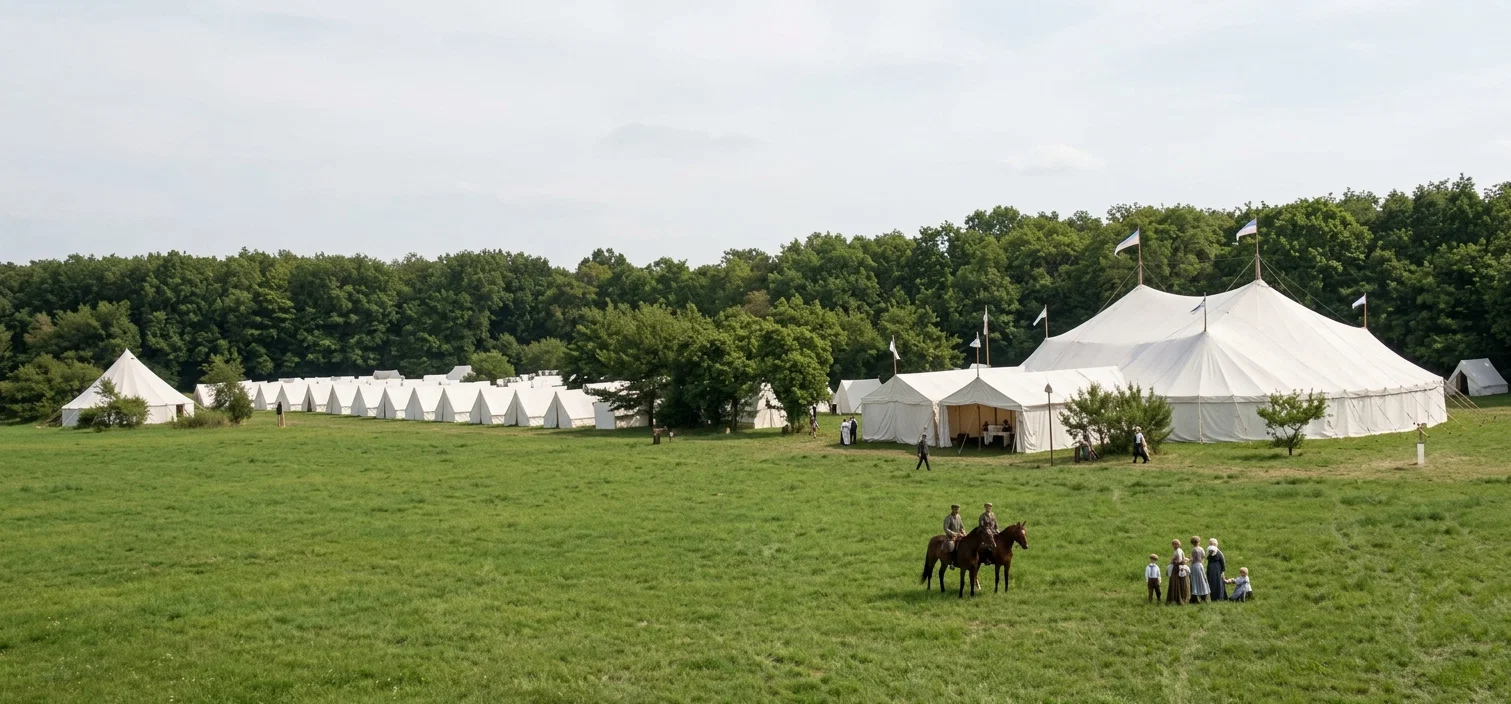
The Biennial Council in Friedensau, Germany

3%

Review and Herald Publishing Association · Takoma Park Station, Washington, D. C. · Aug 10, 1911

FromReview and Herald, Vol. 88, No. 32.

Read the full edition

The Biennial Council in Friedensau, Germany

Third Report

The early morning workers' meetings, devoted to prayer and testimony or to Bible study, and the nine-o'clock Bible study hour have been occasions daily of rich blessings. The school chapel is crowded with workers at these hours.
One of the daily sessions of the council has been devoted to reports from the great field divisions, and in these the progress in the mission fields has been caused to pass before us like a panorama of the closing work of God in the earth.

In Russia

The Russian Union reported first. Elder J. T. Boettcher described the development of the work from the days of 1887—when Brethren Conradi and Perk landed in the Crimea and in the prison—to the present, a wonderful testimony to the fact that when the sure word of prophecy declares that the message is to go to every nation, no power on earth can shut out the message. Elder Boettcher read to us the new law under which any general meeting must now come—a representative of the government to be present at every session, none but members of the church to be admitted, no one to vote in a business meeting except his name be registered at St. Petersburg and he be given permission by the government, and every question introduced to be first set before the government authority. Many other restrictions are included; but the Russian Union reports 731 new members last year, and all the delegation from Russia are of abounding courage.
THE CAMP AT FRIEDENSAU, GERMANY
Elder J. Sprohge, from the Baltic, and Elder K. A. Reifschneider, from the Caucasus, reported progress. In the latter conference, in the land of Ararat, they have baptized 254 members in the last two years, mostly Russians. We have a church of thirty at the foot of Ararat. Elders D. Isaak, of the Crimea, and J. Perk, of Little Russia, followed. Little Russia, as it is called, is the very heart of Russia, its people thoroughly Orthodox and superstitious. Of its three ministerial workers, one is now serving a sentence of two years' imprisonment for turning members from the state church. But in the last two years, two hundred fifty souls have been baptized. The recital of the experiences of these brethren, who had come in from their ofttimes trying and perilous posts of duty, gave all hearts new courage, and firmer confidence in the delivering power of God.

Committee Actions

The following actions of the council may be reported here. It was recommended,—
That Miss Hermine Roth, of Switzerland, be invited to go to America to act as teacher in the newly established French department of the South Lancaster Academy.
That the North American Foreign Department be encouraged to raise an educational fund to aid students to attend the French department of South Lancaster Academy.
That Elders F. Kuempel and A. Rockel, of Germany, be invited to make the Brazilian Union Conference their field of labor.
These brethren, with their families, are in attendance at the council, and at its close they are to sail for South America. Brazil has so long waited that our hearts were made glad to see these strong and devoted ministers and their wives preparing to bring help to that destitute field. Elders Kuempel and Rockel came before the council and were commended to God in special prayer as they accepted the call to their new work.
That the call for teachers in St. Thomas, West Indies, be referred to the Educational Department, to make such arrangements as may be possible in consultation with the president of the West Indian Union.
That the general topic of the next Week-of-Prayer Readings be “A Spiritual Awakening and Missionary Advance.” [The writers of the various readings were selected.]
That great care be used in planning the expenditure of the $300,000 Fund, for the erection of mission buildings in the fields, and that time be taken for the closest cooperation and counsel between the mission fields and the Mission Board, in order that every expenditure may be made to serve the present and future interests of the work in the fullest measure possible; and we urge that local stations be given counsel by the general mission committee in the field as to details of building plans, and that no local committee or company of workers proceed with building operations or expenditure of the money without such counsel.
That workers in mission fields occupying homes provided by mission funds, pay rent for the same at a reasonable rate, as may be arranged between the mission field committee and the Mission Board; and further,—
That any serious inequality in wage rates of workers of the same rating, due to the varying costs of living in different towns or districts, be equalized as far as possible by adjustment of allowance for rent.

Medical Department

Dr. D. H. Kress, secretary of the Medical Missionary Department, made a most cheering report of last year's work of our sanitariums. The year 1919 has been a good one. On the very lowest basis, much lower than the facts might warrant, he reported that our sanitariums had forged ahead financially during the year by over $60,000. In many ways the sanitariums are being made the bases of much more active evangelistic and educational work than ever before. The discussion of the report emphasizes the evangelistic side of the medical missionary work and the important service which physicians and nurses may render in the evangelization of the great cities near which the institutions are located.
Brethren spoke of the active work in the ministry of the word of God which our physicians and nurses are doing in the mission fields while ministering to physical needs. Dr. Thomason, of South Africa, testified to blessed experiences, as he had determined to cultivate this gift of public ministry in work among the churches at the camp-meetings, and otherwise. He referred also to special experiences of spiritual blessing, as he yielded to the counsel of the brethren at the recent South African meeting, and accepted ordination to the gospel ministry. Dr. A. B. Olsen, of England, and Dr. N. P. Nelson, of Denmark, spoke of the close connection between the medical and the evangelistic work, and of the importance of the evangelistic spirit in the institutions. Sister Mackie, a nurse of India, spoke of experiences in that field. The following recommendations relating to special medical questions were adopted by the council:—
That Dr. V. Pampaian, now of Constantinople, be advised to secure suitable qualifications for legal medical practice in Turkey.
That a health home for missionaries be established at some suitable location in East Africa, to serve the growing missionary force in British and German East Africa, so that those who are attacked by fever or other illness may receive care in the field.
That qualified medical help be provided at the earliest possible date to assist Dr. P. A. DeForest in his work at the Gland sanitarium. [The Gland sanitarium, in French Switzerland, is receiving a splendid and increasing patronage; and in the councils of the European members of the committee, it was recommended that Brother L. E. Conradi, who this year will finish his medical course in Germany, visit Switzerland at once in order to investigate the steps necessary to qualify for medical practice in that field.]
That the starting of the proposed sanitarium quarterly, which has been under consideration, be deferred until the next meeting of the General Conference; in the meantime, that all those interested in the matter give it their earnest study and consideration.

India

Elder J. L. Shaw, superintendent of the India Union Mission, sent from India a very interesting report of progress and a fresh review of the crying needs of that great field. The first on the list is the call for evangelistic help to reach the long-neglected and populous English-speaking centers of India. Already Elder C. B. Haynes, of Baltimore, is under appointment to India for the English work, and it was recommended,—
That the officers of the General Conference plan to send a second evangelist to India in the coming autumn, to join in the English work.
That the Publishing Department be requested to hasten the selection of two canvassers to go this autumn to India.
It was agreed that these calls must be responded to without further delay, but that other urgent calls for reenforcements must await consideration at the close of the year, when it may be ascertained how far the increased mission gifts will allow of further help to be sent forward. Earnestly the council prays that the Lord may open fresh streams of liberality, so that these sore needs may be supplied.

The First Sunday

Just a word as to the first Sunday in the camp. During the time of the morning public service the members of the committee visited the school farm, about a mile and a half distant. By noon the public had begun to gather in from surrounding towns and villages, the newspapers having given much notice to the meeting. A little narrow-gage railway, which runs within a mile of Friedensau, brought hundreds. The country roads were lined with cyclists—men, women, and children. The brethren who managed the wheel-check department (charging a ten-pfennig piece, 2½ cents) took care of 380 bicycles, and many other wheels were not placed in check. As the crowd was a moving one, the afternoon was occupied by various speakers, giving brief talks concerning mission fields and experiences in preaching the message in the far lands. The little children gave a missionary program,—arranged by Miss Creeper, of Hamburg,—which was most interesting and touching, their childish voices ringing out over the vast congregation in earnest appeal for souls dying in the darkness. Then the children gathered from the congregation $135 for missions.
Further report must be deferred.
W. A. SPICER, Secretary.
Friedensau.