German East Africa

6%

Review and Herald Publishing Association · Tacoma Park Station, Washington, D. C. · Jun 29, 1911

FromReview and Herald, Vol. 88, No. 26.

Read the full edition

German East Africa

A. C. ENNS
“If we have sown unto you spiritual things, is it a great thing if we shall reap your carnal things? if others be partakers of this power over you, are not we rather? Nevertheless we have not used this power; but suffer all things, lest we should hinder the gospel of Christ.” 1 Cor. 9:11, 12.
The last year has indeed been full of hard work and many obstacles, with interesting experiences which have been of the greatest encouragement.
Those who have read the REVIEW will remember that at Majita, where I have been, it was necessary for me to refuse, although reluctantly, between six and seven hundred boys at once, later on about one hundred twenty-five girls, so that the number attending school (three hundred) could be waited upon in one session in my schoolhouse, 18 x 54 feet. It was not only on this account that I had to refuse these others entrance to our school, as I could have handled that many again in a second daily session; but being all alone at the station, I had all the general work to look after.
A few words of explanation will show how pioneer work crowds in Africa, and some of the experiences that come to one who is starting work among the native peoples. For instance, I had the large chapel (40 x 90 feet) to build, which was intended to provide room for our school and for Sabbath meeting.
For this I secured stone-masons; but I had to show them how to lay the stones, and that, too, for five full months before they caught the idea of building. Yet they think they are architects not to be beaten! The men carrying the stone, and the men in the quarry breaking stone, would do nothing as soon as they were out of sight, and so with all the others. These made up one group of workers.
Then there were the brick-makers, with their crew of helpers, who must be carefully watched and their work constantly superintended. About two miles away the sawyers were at work, and I must supervise their work and help them with it. Often the planks were spoiled because it was impossible for me to be with them all the time. Besides this, the mission boys and I were building a house 24 x 95 feet, of sun-dried brick, which was intended for a boys’ dormitory; but which, after it was finished, was welcomed as a mission house by the new helpers who arrived just at that time, and for whom there was no house. This building has two suites of three rooms each, of 13 x 20, 13 x 13, and 10 x 13 feet respectively; one room 13 x 13 feet; and a guest-room. After it was plastered and whitewashed, we were indeed well pleased with the fine, sturdy building.
I have seen many buildings thus erected, but have not had the privilege of living in a plastered room more than seven months at a time since I left Germany, in 1903; tents and grass huts have been my abode. I have had hundreds of malarial attacks, being seven months in bed with relapsing fever, two weeks each with paralysis and mercury-poisoning, and five times I have looked into the grave with the dreaded blackwater fever. Would I now leave Africa?—Indeed, I would not; there is something else that keeps me here. When I see the field white for the harvest, I am overwhelmed with the mighty work to be done. East Africa has hundreds of thousands of souls who have never dreamed of any hope of salvation; who have never been told about the God who made heaven and earth, nor about Jesus who died to save them from fear and destruction. When I feel safe with Christ, and see these millions on the road to destruction, I arouse myself anew to work more earnestly, and help them in their physical wants, at the same time telling them about their Creator and Redeemer.
If I were a beginner, I should be discouraged by the first experience; I should say: These people do not want help, they are not grateful for the helpgiven them. But such is not the case; these natives for centuries have been, and still are, deceived and frightened. All through their childhood they are told fictitious stories about ghosts and wizards. And these tales must be paid for with goats, and in some cases with the life of him who has dared to aggravate the one above him who has a little more power. For this reason the people are very suspicious. They are always in fear that the one who is pretending to help them is only seeking a reason for destroying them later. When this suspicion is once removed, the victory is won. And those easiest won are the children; for as yet these things are not so stamped on their minds as on those of the grown people.
There is another kind of encouragement which by far outweighs our physical work of building and planting, and that is the success in replacing the satanic power in the hearts of the people with the power of Christ. Then it is that the most wonderful gratitude reveals itself.
Outside of the day-school and the daily work, I have had refreshing meetings at night. Four times a week the mission boys and five men of middle age assembled, three of whom brought their wives, so that the majority of those attending were grown people. This is quite unusual in Africa. All were much interested, but especially one man, who always gave his testimony. He would say to the others: ‘Now see here, have there ever been told words which strengthen and gladden the heart as these do? I never feel tired at night. I can not stop reading these words until my eyes see no more.’ I had given him a New Testament some time before, and by studying evenings he had learned to read.
These Bible readings and prayer-meetings have not been without results. This man asked me many questions which showed that God was working on his heart. One Sabbath, after meeting, I entered my room, and was surprised to see him and his wife seated there. On asking what their wishes were, they looked at each other without answering. So I took my chair and sat down, thinking there would be, as usual, some difficult question; and yet it puzzled me what she could want, as she had never seemed to go faster than the rest. While I was thinking thus, he rose from his seat, placed a rupee on the table, and kneeled down; she did the same, and each said a short prayer. I thanked God for having touched their hearts. ‘If we have sown unto you spiritual things, is it a great thing if we shall reap your carnal things?’ Indeed, it is not so great a thing, and if the heart is converted, that is the natural fruit; for if we have faith, then our works will testify of it. This is one of the experiences which gives a person courage, and also helps him to forget the many things which tend to discourage in this field, where it is so hard to win souls. I would not miss one such experience for a furlough home.
I am glad for these two who have decided to stand on the side of Christ, and who have demonstrated their determination by a voluntary act, no hint ever having been given that they were expected to do this. Such a deed we consider a sure sign of genuineness.
May God grant that Majita will soon have a church; I do not mean a building, but a church of native Christians. I ask all our brethren and sisters in America who have an interest in these souls to pray for the work here. And praying, give. Don’t let these poor black people put to shame those of us who are in a much better condition. Let me suggest to you that to kneel down before God when you give your offering, might tend to multiply your loaves; for we read: ‘Cast thy bread upon the waters: for thou shalt find it after many days.’
Majita.
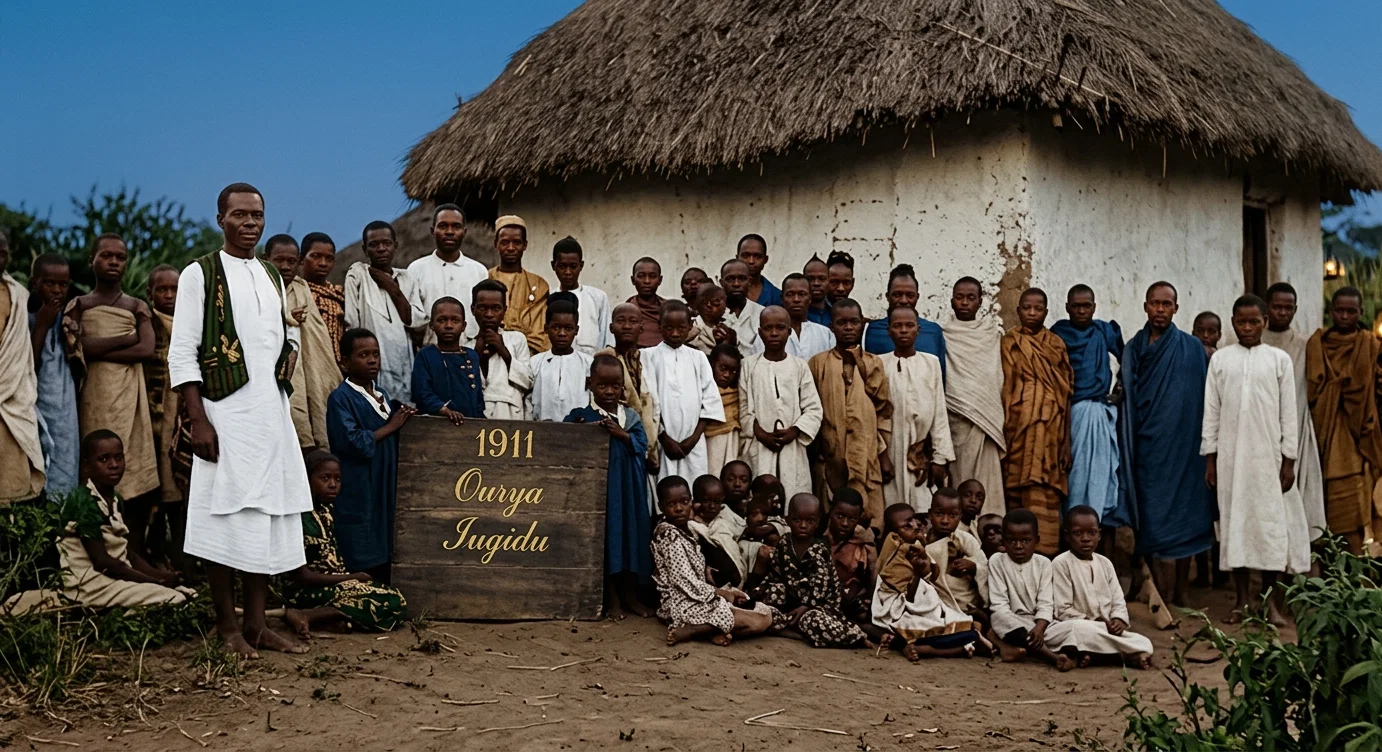
AN OUT-SCHOOL IN GERMAN EAST AFRICA