The New Brazilian Union Conference

6%

Review and Herald Publishing Association · Takoma Park Station, Washington, D. C. · May 25, 1911

FromReview and Herald, Vol. 88, No. 21.

Read the full edition

The New Brazilian Union Conference

L. R. CONRADI
Brazil, with its population of twenty-two millions, is the youngest of the Seventh-day Adventist union conferences. However, it is the largest in extent; for one could easily place the United States of America in Brazil, and still have ample room for such an empire as Germany. Brazil is properly called the United States of Brazil. That it deserves this title is seen not only from its size, but also from the fact that it has twenty states, a federal territory, and a federal district. Up to the present time, only a limited part of that territory, extending along the coast from Uruguay to Pernambuco, has been occupied by us. The vast inland territory has never been touched.
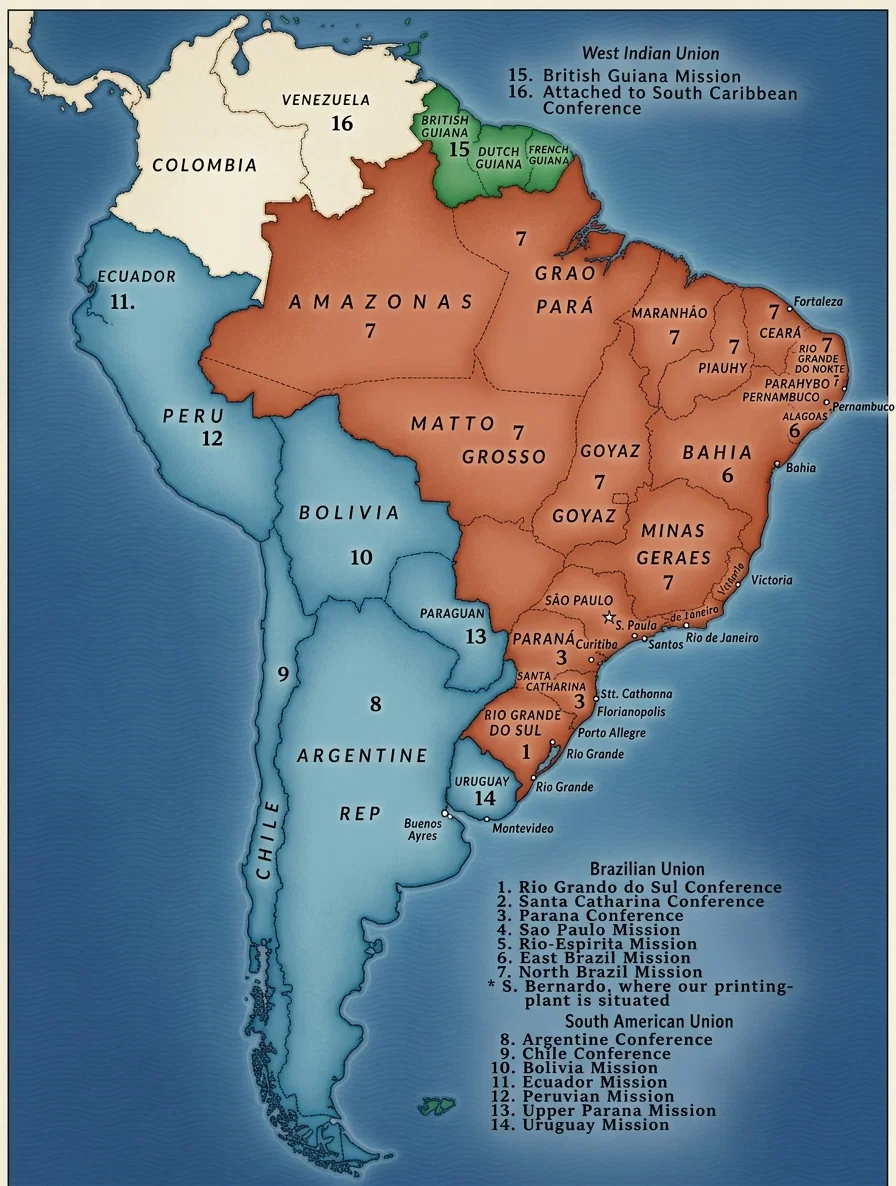
Brazil is now divided into seven unequal parts,—three conferences and four mission fields,—as shown on the accompanying map. The three conferences cover the three southern states,—Rio Grande do Sul, Santa Catharina, and Parana. One mission field takes in Sao Paulo; the other, Rio de Janeiro and Espiritu Santo; besides these, there are the Eastern and Northern Brazil missions. The three states, which form the three conferences, have, all told, a population of only a little more than two million, with a membership of 1,150; while the great mission fields, with a population of twenty millions, have about three hundred fifty members. By far the greatest number of the members are German settlers, who have formed large colonies in the more healthful southern states. As our workers become more proficient in the Portuguese, which is the native language, the Portuguese-speaking Sabbath-keepers increase in numbers.
West Indian Union
15. British Guiana Mission
16. Attached to South Caribbean
Conference

Brazilian Union
1. Rio Grande do Sul Conference
2. Santa Catharina Conference
3. Parana Conference
4. Sao Paulo Mission
5. Rio-Espirito Mission
6. East Brazil Mission
7. North Brazil Mission
* S. Bernardo, where our printing-
plant is situated

South American Union
8. Argentine Conference
9. Chile Conference
10. Bolivia Mission
11. Ecuador Mission
12. Peruvian Mission
13. Upper Parana Mission
14. Uruguay Mission
West Indian Union
  1. British Guiana Mission
  2. Attached to South Caribbean
Conference Brazilian Union
  1. Rio Grande do Sul Conference
  2. Santa Catharina Conference
  3. Parana Conference
  4. Sao Paulo Mission
  5. Rio-Espirito Mission
  6. East Brazil Mission
  7. North Brazil Mission
  8. S. Bernardo, where our printing-
plant is situated South American Union
  1. Argentine Conference
  2. Chile Conference
  3. Bolivia Mission
  4. Ecuador Mission
  5. Peruvian Mission
  6. Upper Parana Mission
  7. Uruguay Mission
All this immense field has at present no school, no medical work, and only a small publishing plant at Sao Bernardo, near Sao Paulo, a growing city of three hundred thousand. Our general meeting was appointed at Porto Alegre, in connection with the Rio Grande do Sul Conference, December 8-17. The workers’ meeting was to precede. Porto Alegre is a city of one hundred thousand, and one would expect good connections from there to any part of the republic; this, however, is not the case. Elder J. W. Westphal and I spent three days in traveling four hundred fifty miles from the Argentine border through the state of Rio Grande do Sul to Porto Alegre. The railroad belongs to a private company, and is narrow-gage. Though the state is comparatively well settled, one could see very few towns along the way, and only now and then some poor houses. When we reached Porto Alegre, Brother Westphal thought he had done very well to get through so quickly. Elder F. W. Spies, with all the rest of the workers from the north, was to be in Porto Alegre about the same time, on the steamer. But on account of the mutiny at Rio de Janeiro, the steamer was delayed several days. They were eight days on the way, and we were very happy when they arrived, on the eighth.
The camp was pitched on the outskirts of the city, and twenty-five tents were put up. The electric tramway led to the entrance of the camp. There were about two hundred persons in attendance; and when we organized the union conference, December 9, all the fields were represented by twenty delegates. The Sabbath was a good day, and quite a number professed Christ for the first time. The Lord blessed his people in uniting them not only as a union conference, but also with him. We had our regular committees appointed, and by Monday were able to select the officers, Elder Spies being unanimously chosen as president. Everything went off in perfect harmony; there was also some outside interest.
Elder W. Ehlers lives in Porto Alegre, and has quite a large dwelling, and in connection with it a good-sized assembly-room. As we began to consider this field, it was apparent to all present that it was most needy. As Elder C. F. Knott’s health was poor, we found that we had only four available men for the seven fields and the union, where there should have been at least eight.
The canvassing work also received some attention, but the population being so scattered, and the distances being so great, it presented many difficulties. On the other hand, we have only a very limited stock of Portuguese literature. Special attention will have to be given to develop such literature, as well as to strengthen the canvassing work; but we are sure that if the same active field work is done here as Brother M. Trummer is doing in Argentina, things will begin to move here also.
As my steamer was not to leave until the twenty-fourth, and the meeting was to close on the seventeenth, I thought I had time to stay till the close, and still reach Rio, which is not more than one thousand miles north. But in this I was disappointed. Fortunately, however, I caught a Brazilian-Lloyd steamer on the fourteenth, reached Rio Grande do Sul the evening of the fifteenth, changed to another steamer, and next morning we had the good fortune safely to cross the sand-bars. On Sabbath we lay at SantaCatharina, a pleasant island town of about forty thousand. Here I visited Sister Knott, who lives alone in that large town. The Sabbath-keepers are scattered throughout the state on the mainland.
On the twenty-first I embarked at Santos, the greatest export town for coffee in the world, and a very busy place. From here I found an excellent railway, operated by an English company. Though we had to make some fairly steep ascents to reach St. Bernardo, yet one could see that neither money nor skill had been spared to make a good road. Arriving at St. Bernardo, a town of five thousand population, I secured a carriage, and drove a mile out into the country, where our printing-office is located. Our brethren had purchased a small farm, in a hilly country, partly timbered; and here, in a good-sized building, they carry on their printing, folding, typesetting, bookkeeping, and shipping. They have invested twenty-five conto di reis (a conto varies from $350 to $500), one third of which is paid-up capital. Brother A. Pages looks after the business, and at the same time acts as union conference treasurer. He has a small dwelling-house on the place, while the other employees live near by. The location has been well chosen, as St. Bernardo is only about twenty miles from Sao Paulo, and has good railway connections, and a good road to the building. The plant is sufficiently large, and could do much more work; but there is a lack of men in the field. A monthly Portuguese paper of excellent quality is published, but altogether too small an edition. Only about one thousand copies a month are printed, and not nearly that number are circulated. Several small German papers are also published.
The following afternoon I spent in the city of Sao Paulo, which presents an excellent field for labor. This prosperous state, where we now have only a little over one hundred members, with its three and one-half millions of people, ought to have several strong workers. I believe that with some earnest work, we could soon have a conference there. From here, a night’s run on the train brought me to Rio de Janeiro. As the brethren expected me by steamer, no one was there to meet me; but I found my way to the steamship company, then to the post-office, and to the police,—to secure the permit to leave, as the city was still under martial law.
When I looked for the car to take me out into the suburbs, where Brother Spies lives, I found none answering the description given me; so I waited half an hour on one corner, then went over to the next. After I had stayed there a few minutes, a gentleman came up and looked at me closely. As he looked somewhat like an Adventist, I asked him in English whether he was looking for any one. To my surprise he answered, in French, “I am looking for a Mr. Conradi.” Brother Wilfart, our French Bible worker, who also speaks Portuguese well, had been searching for me at the steamer, and not finding me, was just ready to go away. Thus God’s providence brought to me the right man at the right time. As I rode out with him on the tram-car, I made up my mind that I would have had quite a difficult time to find the house without him. We afterward returned, and called upon the elder of the Rio church, a German tailor, and enjoyed his hospitality.
As we walked through the streets of that great city, and viewed its beautiful avenues and elaborate houses,—even palaces,—I said to myself: “What a work might be done if we had a few experienced city workers here!” But there is only one Bible worker besides Elder Spies, who has the care of that great union conference. There is a church of about twenty-five members, partly in Rio and partly on the other side of the bay. In Rio they meet at Brother Spies’s house, out in the suburbs. As it was Sabbath evening, we had a Bible study; there were only a few of us, but even then some of the children ran by and called us heretics, and tried to disturb the meeting.
Though Rio has the beautiful Monroe palace of peace, yet it is not all peace. As I viewed the barracks of the marines, recently laid in ruins, because the marines had opened fire on the city during the mutiny, and viewed some buildings in town which had been struck by the bullets, it surely looked like war, and even civil war. Toward noon, the German steamer “König Wilhelm II” steamed up the bay, and the same afternoon we pulled out, homeward bound.
On the twenty-sixth our steamer stopped in the beautiful bay of Bahia. This city of two hundred fifty thousand inhabitants lies in a semicircle about the bay. Many colored people live here, and Brother John Lipke has his headquarters here. It was very hot while we passed the equator. On the sixth of January, we reached Lisbon, where I found some mail, having waited two weeks without news from home. Elder C. E. Rentfro and some of the Portuguese workers met me there, and took me up to their new quarters in the central part of the city, where they showed me their recently rented meeting-hall. One of our French-Swiss workers has come to Elder Rentfro’s assistance, and is making good progress in the Portuguese, which is closely related to his mother tongue.
Later we touched at Vigo, Southampton, and Boulogne, and by the eleventh I was in Hamburg again, after an absence of three months. While the trip had been short, yet I had visited all the institutions of South America, had attended five general meetings at different places, assisted in the organization of the Brazilian Union Conference, attended two local conferences, and had also met all the leading workers of South America, except those of Peru and Ecuador. The South American field is one of promise, and it should have more help and our special prayers.
Hamburg.